

 https://doi.org/10.31261/rias.17977
In their work Anti-Oedipus: Capitalism and Schizophrenia, Gilles Deleuze and Felix Guattari offer an analysis on the formation of political and economic structures in capitalist societies based on the interpellation of subjects via a system of controlling physical and psychological desires. Their analysis showcases how desire control produces effective labor in a capitalist system, creates psychological massification and achieves political hegemony in a community of interpellated subjects. For the machine of society to function properly, desire needs to be filtered and commodified, otherwise it threatens the system with revolutionary ruptures. In Toni Morrison’s Paradise, the concept of community relates Ruby (a small all-black town cut off from the rest of the world) and the sign of its ontological other, the Convent (a house for wayward women), with the history of racial conflict and the politics of gender. Following Deleuze and Guattari’s analysis of how desire politics affect community politics, I attempt to examine how both the interpellating and revolutionary functions of their respective “desiring-machines” lead the communities in Paradise either to decay or evolution. I propose a parallelism between the signs of Ruby and the Convent with the sign of the despotic body (as explained by Deleuze and Guattari) in an attempt to represent the distorting and unifying processes that transform the experiences of both communities. By exploring the restoring flow of desire represented in the dance of the Convent women, I draw attention to the revolutionary changes desire causes in both the physical bodies of the character subjects and the organless bodies of the two communities. As a final point, by applying Deleuze and Guattari’s theory of the body without organs to the symbolic spaces of the Oven and the Convent’s cellar, I highlight the linearity of the process of social-production via desire-production.
Download files
Citation rules
Cited by / Share




Licence

This work is licensed under a Creative Commons Attribution-ShareAlike 4.0 International License.
The Copyright Holder of the submitted text is the Author. The Reader is granted the rights to use the material available in the RIAS websites and pdf documents under the provisions of the Creative CommonsAttribution-ShareAlike 4.0 International License (CC BY-SA 4.0). Any commercial use requires separate written agreement with the Author and a proper credit line indicating the source of the original publication in RIAS.
The University of Silesia Press provides immediate open access to journal’s content under the Creative Commons BY 4.0 license (http://creativecommons.org/licenses/by/4.0/). Authors who publish with this journal retain all copyrights and agree to the terms of the above-mentioned CC BY 4.0 license.
The author warrants that the article is original, written by stated author/s, has not been published before, contains no unlawful statements, does not infringe the rights of others, is subject to copyright that is vested exclusively in the author and free of any third party rights, and that any necessary written permissions to quote from other sources have been obtained by the author/s.
If the article contains illustrative material (drawings, photos, graphs, maps), the author declares that the said works are of his authorship, they do not infringe the rights of the third party (including personal rights, i.a. the authorization to reproduce physical likeness) and the author holds exclusive proprietary copyrights. The author publishes the above works as part of the article under the licence "Creative Commons Attribution - By the same conditions 4.0 International".
ATTENTION! When the legal situation of the illustrative material has not been determined and the necessary consent has not been granted by the proprietary copyrights holders, the submitted material will not be accepted for editorial process. At the same time the author takes full responsibility for providing false data (this also regards covering the costs incurred by the University of Silesia Press and financial claims of the third party).
Under the Creative Commons Attribution license, the users are free to share (copy, distribute and transmit the contribution) and adapt (remix, transform, and build upon the material) the article for any purpose, provided they attribute the contribution in the manner specified by the author or licensor.
If the article was prepared jointly with other authors, the signatory of this form warrants that he/she has been authorized by all co-authors to sign this agreement on their behalf, and agrees to inform his/her co-authors of the terms of this agreement.
Submitting a text to RIAS, the Author automatically declares that in the event of withdrawal of the text from the publishing process or submitting it to another publisher without agreement from the editorial office, he or she agrees to cover all costs incurred by the University of Silesia in Katowice, Poland, in connection with the submission.
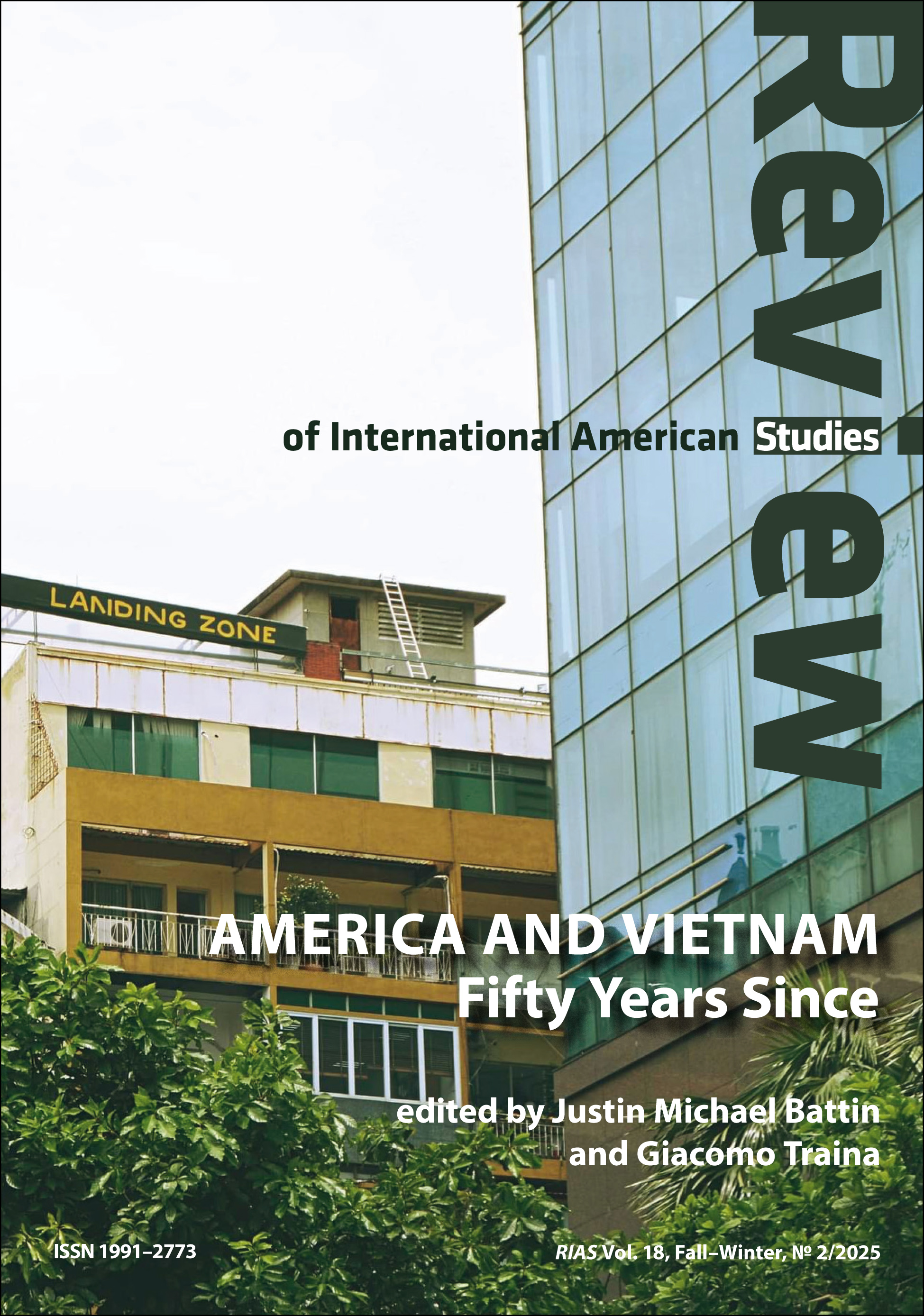
Vol. 18 No. 2 (2025)
Published: 2025-12-31
10.31261/RIAS
This work is licensed under a Creative Commons Attribution-ShareAlike 4.0 International License.

 English