

 https://doi.org/10.31261/rias.18143
In What Moves the Dead, an American author, T. Kingfisher (a pen name of Ursula Vernon), reimagines Edgar Allan Poe’s well-known short story “The Fall of the House of Usher.” The novella introduces a parasitic fungus inhabiting a mountain lake that infects both animals and humans, transforming hosts into hostages, rendering the Usher manor, which stands near the infected tarn, a perilous space for its guests. This article explores the intricate dimensions of hospitality, ranging from the invitation and act of welcoming to the risks associated with overstaying one’s welcome. The concepts of “environment” and “host” are examined in their dual interpretations. “Environment” is understood both as the natural world and as the immediate surroundings of an individual. At the same time “host,” a gender-neutral alternative to “hostess,” is perceived as an individual who receives guests and as a reference to an organism on or within which a parasite resides. The brief overview of such concepts as ecoGothic, ecohorror, and ecophobia allows for the subsequent analysis to situate the examination of the host-guest relations in the ecological framework. The hospitality presented in the story mirrors human interaction with nature, illustrating that both hosts and guests may suffer dire consequences when hospitality is distorted. The article highlights the complexity of host-guest dynamics, emphasizing that the principles of hospitality are fluid and context-dependent, with potentially dangerous ramifications for both human and non-human beings.
Download files
Citation rules
Cited by / Share




Licence

This work is licensed under a Creative Commons Attribution-ShareAlike 4.0 International License.
The Copyright Holder of the submitted text is the Author. The Reader is granted the rights to use the material available in the RIAS websites and pdf documents under the provisions of the Creative CommonsAttribution-ShareAlike 4.0 International License (CC BY-SA 4.0). Any commercial use requires separate written agreement with the Author and a proper credit line indicating the source of the original publication in RIAS.
The University of Silesia Press provides immediate open access to journal’s content under the Creative Commons BY 4.0 license (http://creativecommons.org/licenses/by/4.0/). Authors who publish with this journal retain all copyrights and agree to the terms of the above-mentioned CC BY 4.0 license.
The author warrants that the article is original, written by stated author/s, has not been published before, contains no unlawful statements, does not infringe the rights of others, is subject to copyright that is vested exclusively in the author and free of any third party rights, and that any necessary written permissions to quote from other sources have been obtained by the author/s.
If the article contains illustrative material (drawings, photos, graphs, maps), the author declares that the said works are of his authorship, they do not infringe the rights of the third party (including personal rights, i.a. the authorization to reproduce physical likeness) and the author holds exclusive proprietary copyrights. The author publishes the above works as part of the article under the licence "Creative Commons Attribution - By the same conditions 4.0 International".
ATTENTION! When the legal situation of the illustrative material has not been determined and the necessary consent has not been granted by the proprietary copyrights holders, the submitted material will not be accepted for editorial process. At the same time the author takes full responsibility for providing false data (this also regards covering the costs incurred by the University of Silesia Press and financial claims of the third party).
Under the Creative Commons Attribution license, the users are free to share (copy, distribute and transmit the contribution) and adapt (remix, transform, and build upon the material) the article for any purpose, provided they attribute the contribution in the manner specified by the author or licensor.
If the article was prepared jointly with other authors, the signatory of this form warrants that he/she has been authorized by all co-authors to sign this agreement on their behalf, and agrees to inform his/her co-authors of the terms of this agreement.
Submitting a text to RIAS, the Author automatically declares that in the event of withdrawal of the text from the publishing process or submitting it to another publisher without agreement from the editorial office, he or she agrees to cover all costs incurred by the University of Silesia in Katowice, Poland, in connection with the submission.
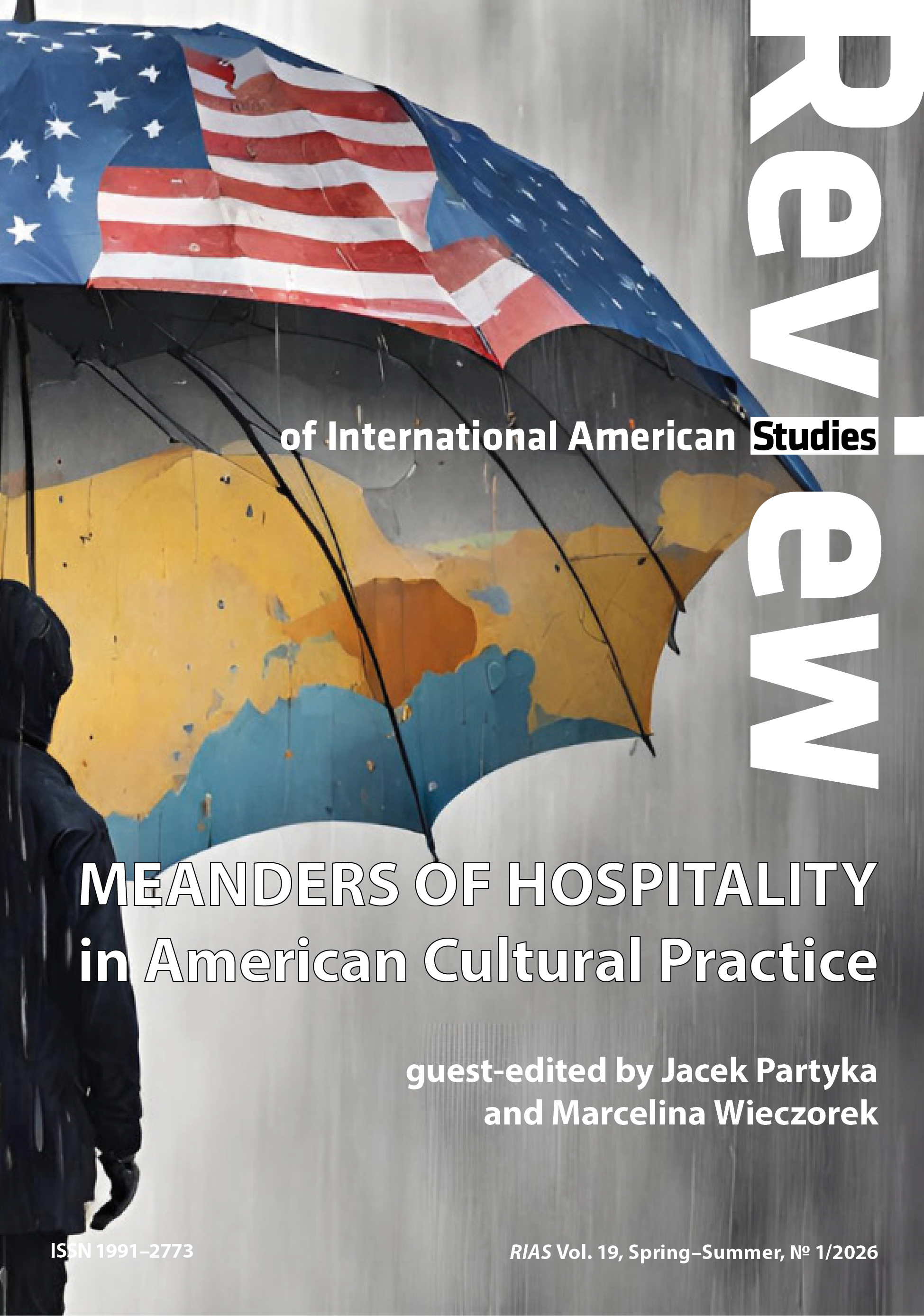
Vol. 19 No. 1 (2026)
Published: 2026-06-30
10.31261/RIAS
This work is licensed under a Creative Commons Attribution-ShareAlike 4.0 International License.

 English