

 https://doi.org/10.31261/rias.18155
According to Jacques Derrida, “unconditional hospitality” requires that you “give up the mastery of your space, your home, your nation” and “accept the risk of the other coming and destroying the place, initiating a revolution, stealing everything or killing everyone” (70–71). The concepts of unconditional hospitality and its inverse, conditional hospitality, apply not only to geopolitical analyses but also to literary studies. Genres and nations share several characteristics. Let us consider the sonnet. Its first “inhabitants” were White European men. The genre had well-established boundaries. Over time, however, non-white, non-male, and non-heteronormative poets have crossed the borders, demanding entry to the restricted space of the sonnet form, often called “prison” by literary scholars and poets. Like newcomers in a foreign land, these “alien” poets had long been denied their “citizenship” as sonneteers. The history of African American sonneteering perfectly illustrates this. To engage in dialogue with the genre’s tradition and to question the culturally oppressive mechanisms of canon formation, Black poets have forced their way into the sonnet. Whereas many have remained within the genre’s boundaries as “guests,” several other African American poets have sought to transform it through formal and thematic alterations. Rephrasing Derrida, one might say that Black poets have “initiated a rebellion” within the sonnet-prison, or sonnet-nation. The question is whether African Americans “destroyed” the sonnet and what has been “the hosts” response to that “intrusion.” In search of an answer, the article explores the host-guest tensions in the context of African American sonneteering, drawing upon Derrida’s theory of “unconditional hospitality.”
Download files
Citation rules
Cited by / Share




Licence

This work is licensed under a Creative Commons Attribution-ShareAlike 4.0 International License.
The Copyright Holder of the submitted text is the Author. The Reader is granted the rights to use the material available in the RIAS websites and pdf documents under the provisions of the Creative CommonsAttribution-ShareAlike 4.0 International License (CC BY-SA 4.0). Any commercial use requires separate written agreement with the Author and a proper credit line indicating the source of the original publication in RIAS.
The University of Silesia Press provides immediate open access to journal’s content under the Creative Commons BY 4.0 license (http://creativecommons.org/licenses/by/4.0/). Authors who publish with this journal retain all copyrights and agree to the terms of the above-mentioned CC BY 4.0 license.
The author warrants that the article is original, written by stated author/s, has not been published before, contains no unlawful statements, does not infringe the rights of others, is subject to copyright that is vested exclusively in the author and free of any third party rights, and that any necessary written permissions to quote from other sources have been obtained by the author/s.
If the article contains illustrative material (drawings, photos, graphs, maps), the author declares that the said works are of his authorship, they do not infringe the rights of the third party (including personal rights, i.a. the authorization to reproduce physical likeness) and the author holds exclusive proprietary copyrights. The author publishes the above works as part of the article under the licence "Creative Commons Attribution - By the same conditions 4.0 International".
ATTENTION! When the legal situation of the illustrative material has not been determined and the necessary consent has not been granted by the proprietary copyrights holders, the submitted material will not be accepted for editorial process. At the same time the author takes full responsibility for providing false data (this also regards covering the costs incurred by the University of Silesia Press and financial claims of the third party).
Under the Creative Commons Attribution license, the users are free to share (copy, distribute and transmit the contribution) and adapt (remix, transform, and build upon the material) the article for any purpose, provided they attribute the contribution in the manner specified by the author or licensor.
If the article was prepared jointly with other authors, the signatory of this form warrants that he/she has been authorized by all co-authors to sign this agreement on their behalf, and agrees to inform his/her co-authors of the terms of this agreement.
Submitting a text to RIAS, the Author automatically declares that in the event of withdrawal of the text from the publishing process or submitting it to another publisher without agreement from the editorial office, he or she agrees to cover all costs incurred by the University of Silesia in Katowice, Poland, in connection with the submission.
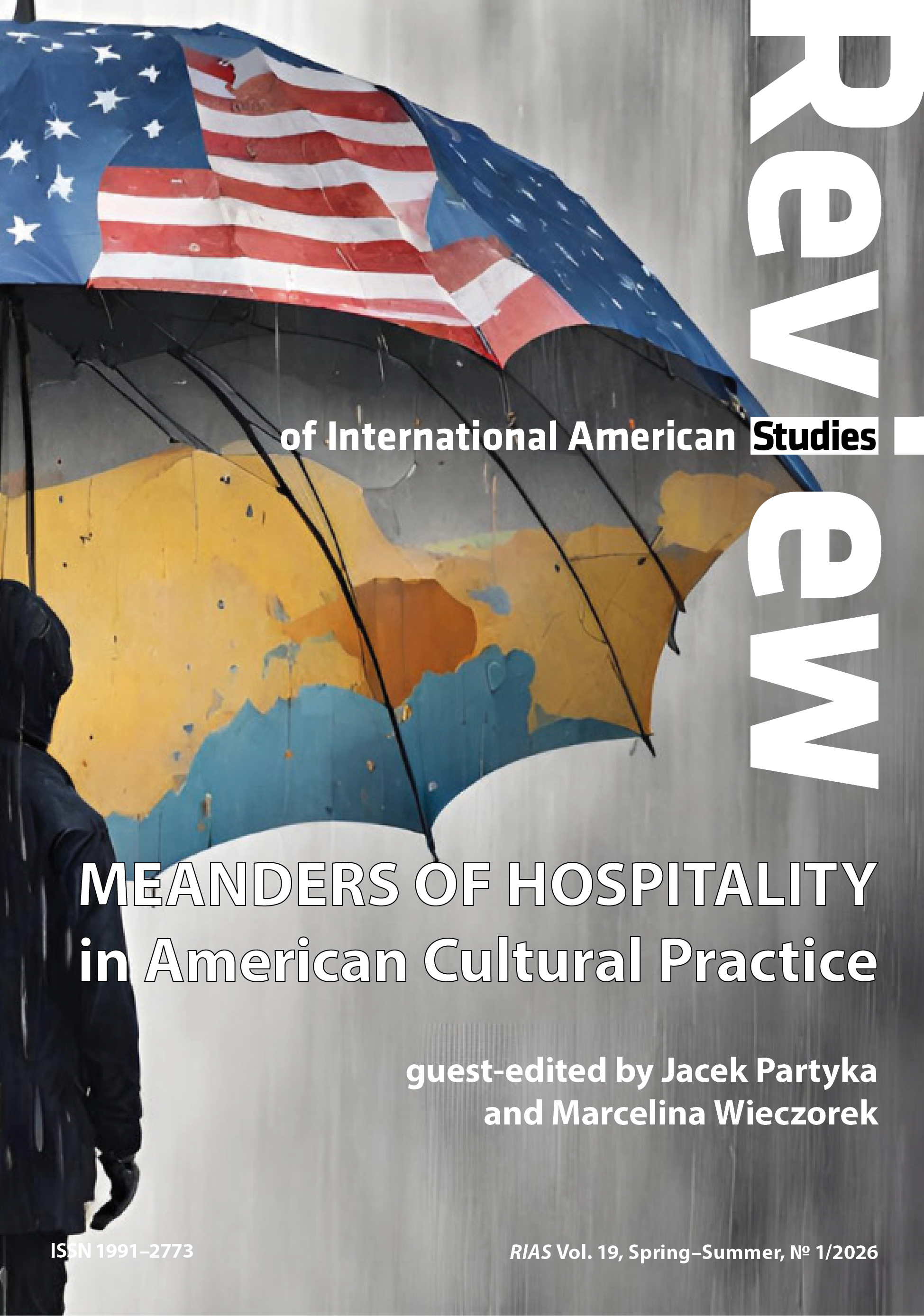
Vol. 19 No. 1 (2026)
Published: 2026-06-30
10.31261/RIAS
This work is licensed under a Creative Commons Attribution-ShareAlike 4.0 International License.

 English