

 https://doi.org/10.31261/rias.18161
This paper proposes the notion of “narrative hospitality” for interpreting a particular kind of discontinuous or fragmentary writing, and discusses this technique with reference to the work of contemporary American author Sigrid Nunez. Arguably, hospitality as a mode of storytelling and as a problem can be found throughout Nunez’s oeuvre. The paper opens with a section on the aesthetics of fragmentation, based on recent theoretical approaches by Vanessa Guignery, Wojciech Drąg, Meritt Moseley, and others. It then goes on to interpret Nunez’s prose as hospitable on the formal level and links her use of fragmentation with the theme of hospitality in “Chang,” “It Will Come Back to You” (2001), Sempre Susan (2011), and The Vulnerables (2023). Although there is nothing inherent in the fragmentary narrative that makes it egalitarian or democratic, it has been embraced as a transgressive form by feminists and queers, among others. Nunez’s use of this narrative technique is egalitarian in that it allows for the juxtaposition of various manifestations of in/hospitality. In fact, Nunez’s prose does the kind of work Lance Olsen described as “effacing, or at least deeply and richly complicating, the accepted difference between privileged and subordinate discourses” (Olsen, qtd. in Drąg, Collage 20). Nunez is particularly sensitive to the precarious position of animals, children, the elderly, the displaced, and all those who depend on the interest and hospitality of others, but her writing repeatedly shows that “guest” and “host” are positions rather than fixed identities. On the formal level, the theme of hospitality is underscored by the narrator’s openness to interrupting herself and being interrupted. In sum, Nunez’s technique of fragmentation lends itself to laying bare the contradictions associated with the practices of hospitality and their affective underpinnings.
Download files
Citation rules
Cited by / Share




Licence

This work is licensed under a Creative Commons Attribution-ShareAlike 4.0 International License.
The Copyright Holder of the submitted text is the Author. The Reader is granted the rights to use the material available in the RIAS websites and pdf documents under the provisions of the Creative CommonsAttribution-ShareAlike 4.0 International License (CC BY-SA 4.0). Any commercial use requires separate written agreement with the Author and a proper credit line indicating the source of the original publication in RIAS.
The University of Silesia Press provides immediate open access to journal’s content under the Creative Commons BY 4.0 license (http://creativecommons.org/licenses/by/4.0/). Authors who publish with this journal retain all copyrights and agree to the terms of the above-mentioned CC BY 4.0 license.
The author warrants that the article is original, written by stated author/s, has not been published before, contains no unlawful statements, does not infringe the rights of others, is subject to copyright that is vested exclusively in the author and free of any third party rights, and that any necessary written permissions to quote from other sources have been obtained by the author/s.
If the article contains illustrative material (drawings, photos, graphs, maps), the author declares that the said works are of his authorship, they do not infringe the rights of the third party (including personal rights, i.a. the authorization to reproduce physical likeness) and the author holds exclusive proprietary copyrights. The author publishes the above works as part of the article under the licence "Creative Commons Attribution - By the same conditions 4.0 International".
ATTENTION! When the legal situation of the illustrative material has not been determined and the necessary consent has not been granted by the proprietary copyrights holders, the submitted material will not be accepted for editorial process. At the same time the author takes full responsibility for providing false data (this also regards covering the costs incurred by the University of Silesia Press and financial claims of the third party).
Under the Creative Commons Attribution license, the users are free to share (copy, distribute and transmit the contribution) and adapt (remix, transform, and build upon the material) the article for any purpose, provided they attribute the contribution in the manner specified by the author or licensor.
If the article was prepared jointly with other authors, the signatory of this form warrants that he/she has been authorized by all co-authors to sign this agreement on their behalf, and agrees to inform his/her co-authors of the terms of this agreement.
Submitting a text to RIAS, the Author automatically declares that in the event of withdrawal of the text from the publishing process or submitting it to another publisher without agreement from the editorial office, he or she agrees to cover all costs incurred by the University of Silesia in Katowice, Poland, in connection with the submission.
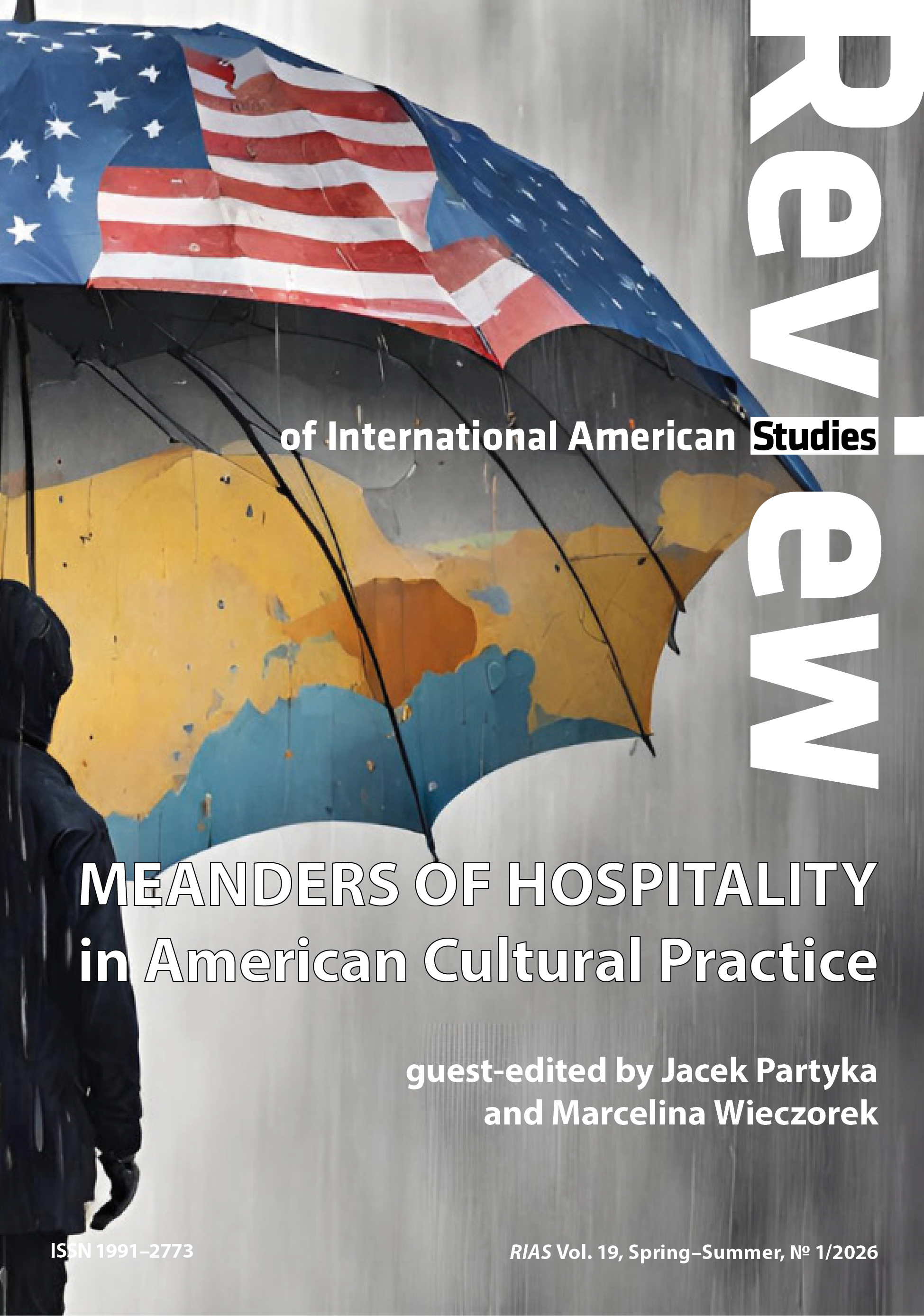
Vol. 19 No. 1 (2026)
Published: 2026-06-30
10.31261/RIAS
This work is licensed under a Creative Commons Attribution-ShareAlike 4.0 International License.

 English