

 https://doi.org/10.31261/rias.18274
This paper examines the complex interplay between Indigenous identity and settler-colonial borders through autoethnographic and storytelling approaches. As both an Indigenous person of the Menominee Nation of Wisconsin and an immigrant from the island of Bermuda, my experiences span both oceanic and continental borders between the United States, Canada, where I presently live and work, and the United Kingdom’s largest remaining overseas territory, providing a unique vantage point on the politics of Indigenous identity across these settler-imposed boundaries. Using these experiences as a starting point and inspired by the works of Mohawk scholar Audra Simpson and sociologist Avery Gordon, in this paper, I integrate personal narrative with critical analysis to examine the complex nature of an Indigenous life lived across the borders of settler colonialism. Further, I also examine the historical and contemporary ramifications of the Jay Treaty and, in doing so, highlight the asymmetrical recognition of Indigenous rights to mobility upon their traditional territories, territories that existed long before the arrival of settlers to North America, between the United States and Canada. This treaty, which ostensibly provides certain border-crossing rights to Indigenous peoples, is upheld by the United States but not Canada. Not only does this asymmetry underscore the persistent challenges faced by Indigenous communities in asserting their ancient pre-colonial mobility rights, but it also speaks significantly to the imbalance of power that exists between nominally sovereign Indigenous nations and the sovereignties of settler nation-states whose border controls Indigenous people are now subject. Through this narrative, the paper seeks to contribute to the broader discourse on Indigenous internationalism and the ethical responsibilities of Indigenous scholars. By centering stories and storytelling as both epistemological and methodological tools, the paper advocates for a decolonial approach honoring the interconnectedness of Indigenous experiences and the enduring ties between Indigenous nations across borders.
Download files
Citation rules
Cited by / Share




Licence

This work is licensed under a Creative Commons Attribution-ShareAlike 4.0 International License.
The Copyright Holder of the submitted text is the Author. The Reader is granted the rights to use the material available in the RIAS websites and pdf documents under the provisions of the Creative CommonsAttribution-ShareAlike 4.0 International License (CC BY-SA 4.0). Any commercial use requires separate written agreement with the Author and a proper credit line indicating the source of the original publication in RIAS.
The University of Silesia Press provides immediate open access to journal’s content under the Creative Commons BY 4.0 license (http://creativecommons.org/licenses/by/4.0/). Authors who publish with this journal retain all copyrights and agree to the terms of the above-mentioned CC BY 4.0 license.
The author warrants that the article is original, written by stated author/s, has not been published before, contains no unlawful statements, does not infringe the rights of others, is subject to copyright that is vested exclusively in the author and free of any third party rights, and that any necessary written permissions to quote from other sources have been obtained by the author/s.
If the article contains illustrative material (drawings, photos, graphs, maps), the author declares that the said works are of his authorship, they do not infringe the rights of the third party (including personal rights, i.a. the authorization to reproduce physical likeness) and the author holds exclusive proprietary copyrights. The author publishes the above works as part of the article under the licence "Creative Commons Attribution - By the same conditions 4.0 International".
ATTENTION! When the legal situation of the illustrative material has not been determined and the necessary consent has not been granted by the proprietary copyrights holders, the submitted material will not be accepted for editorial process. At the same time the author takes full responsibility for providing false data (this also regards covering the costs incurred by the University of Silesia Press and financial claims of the third party).
Under the Creative Commons Attribution license, the users are free to share (copy, distribute and transmit the contribution) and adapt (remix, transform, and build upon the material) the article for any purpose, provided they attribute the contribution in the manner specified by the author or licensor.
If the article was prepared jointly with other authors, the signatory of this form warrants that he/she has been authorized by all co-authors to sign this agreement on their behalf, and agrees to inform his/her co-authors of the terms of this agreement.
Submitting a text to RIAS, the Author automatically declares that in the event of withdrawal of the text from the publishing process or submitting it to another publisher without agreement from the editorial office, he or she agrees to cover all costs incurred by the University of Silesia in Katowice, Poland, in connection with the submission.
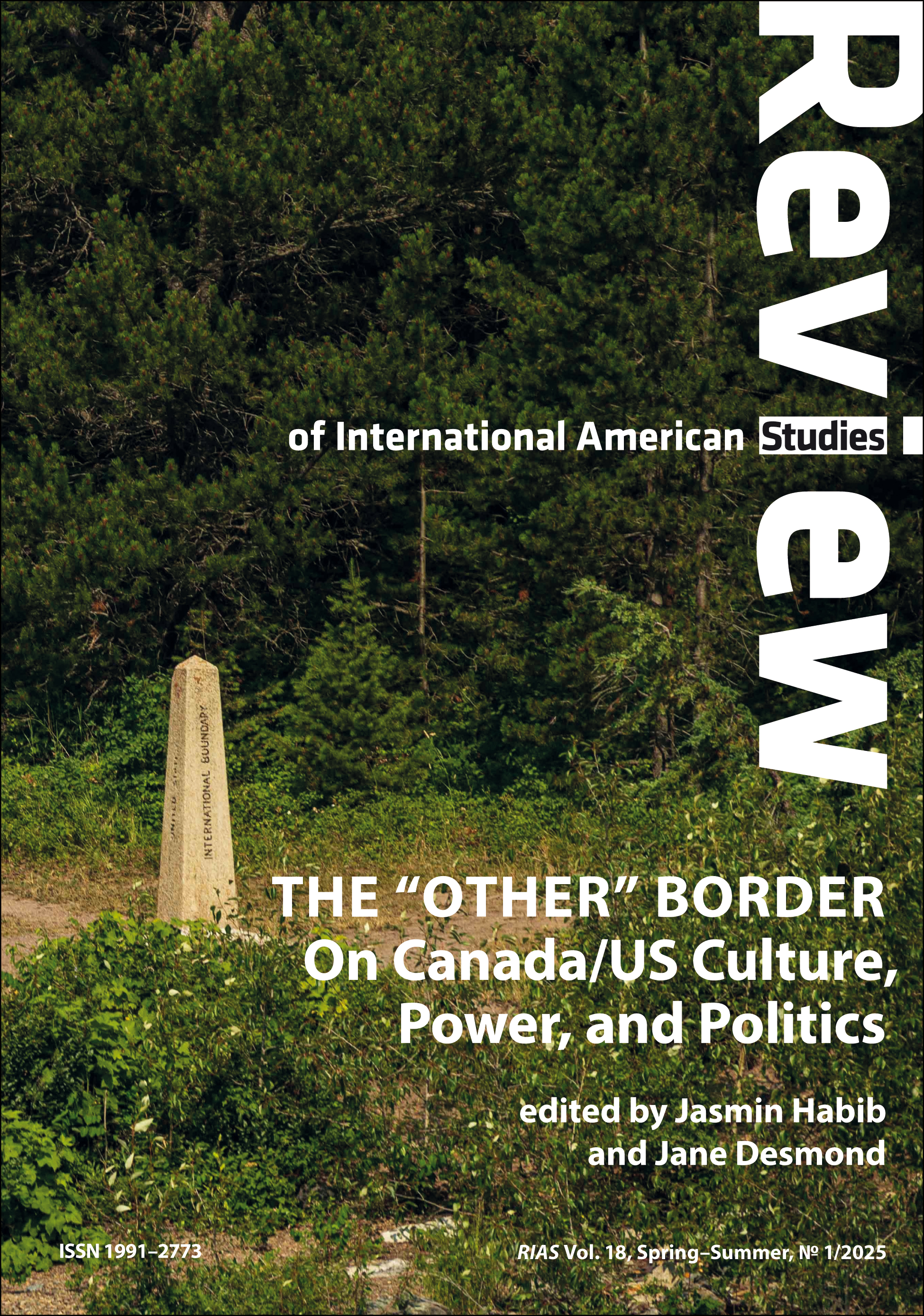
Vol. 18 No. 1 (2025)
Published: 2025-06-30
10.31261/RIAS
This work is licensed under a Creative Commons Attribution-ShareAlike 4.0 International License.

 English