

Human is „moral being” regardless of conditions and the times in which he lives. It results from the fact, that human is a person, it means that he is spiritual-corporeal being, someone who is rational and independent. Despite the fact that the man is exposed to McDonaldization, subjected to numerous crises, it should be noted that he is still religious being and occurred processes did not deprive him of religious sense. Human is still sensitive to religious questions, even though he looks very often for answer outside Christianity, which is old – fashioned in media. It is essential challenge not only for preaching but also for whole Christian formation.
A long time ago, Maurice Blondel said, that: „the times are the same like people are”. As it is known people are either moral good or moral bad. Tertium non datur. This also applies to human morality, which today is sometimes labeled as homo supermercatus. An important challenge is consumerist life style of many people, who live most of the time without awareness of development of appropriate hierarchy of values and necessary spiritual needs. These people usually satisfy their material needs without thinking of human dignity and their Christian vocation.
Homo consumens – is a person, who is suspended between gift and commodity. Detailed sociological and psychological analysis give us a lot of arguments about the behavior of present – day human. This man seems to have many features, which indicate that, „he desires to have more”, instead of „to be a human more and more”. Today, principle is known: I consume, therefore I am.
Strong influence of ethical utilitarianism on daily culture of life was noticed long ago. For example – in the book The New Economic Gospel of Consumption, written by E. Cowdrick in 1927, we can find interesting opinion, that we live in times, when people are forced to regular consume of goods and services. It also impinges on assessment of current homiletic thinking.
Author emphasizes, using criteria from ethic of J. Woroniecki, that the human always was and is just jealous, mistrustful, suspicious and first and foremost selfish and very greedy. It causes, that he is a person of many crises, which can be solved effectively by homiletic teaching.
Analyzing behavior, attitudes and basic sources of numerous crisis (identity crisis, family crisis, political crisis, educational crisis etc.) of consumerist human, author develop thought of Marciano Vidal, that this person is a man of „lost ethical home”.
Under the pulpit and before the alter – we do not have today – saying colloquially – „empty people” and „neuter people”. We have deeply hurt people in their humanity. Moreover we have people with many difficulties in faith. There are difficulties arising from human life experience and civilization’s difficulties. It turns out that only Christianity, with its integrity of salvation, is able to help such people effectively.
Download files
Citation rules
Licence

This work is licensed under a Creative Commons Attribution-ShareAlike 4.0 International License.
The Copyright Owners of the submitted texts grant the Reader the right to use the pdf documents under the provisions of the Creative Commons 4.0 International License: Attribution-Share-Alike (CC BY-SA). The user can copy and redistribute the material in any medium or format and remix, transform, and build upon the material for any purpose.
1. License
The University of Silesia Press provides immediate open access to journal’s content under the Creative Commons BY-SA 4.0 license (http://creativecommons.org/licenses/by-sa/4.0/). Authors who publish with this journal retain all copyrights and agree to the terms of the above-mentioned CC BY-SA 4.0 license.
2. Publication Fees Policy
Authors do not bear any costs associated with the publication of their articles, i.e. article processing charges (APCs), language editing fees, colour charges, submission fees, page charges, membership fees, print subscription costs, other supplementary charges. Authors also do not receive any financial gratification for the published articles.
3. Author’s Warranties
The author warrants that the article is original, written by stated author/s, has not been published before, contains no unlawful statements, does not infringe the rights of others, is subject to copyright that is vested exclusively in the author and free of any third party rights, and that any necessary written permissions to quote from other sources have been obtained by the author/s.
If the article contains illustrative material (drawings, photos, graphs, maps), the author declares that the said works are of his authorship, they do not infringe the rights of the third party (including personal rights, i.a. the authorization to reproduce physical likeness) and the author holds exclusive proprietary copyrights. The author publishes the above works as part of the article under the licence "Creative Commons Attribution-ShareAlike 4.0 International".
ATTENTION! When the legal situation of the illustrative material has not been determined and the necessary consent has not been granted by the proprietary copyrights holders, the submitted material will not be accepted for editorial process. At the same time the author takes full responsibility for providing false data (this also regards covering the costs incurred by the University of Silesia Press and financial claims of the third party).
4. User Rights
Under the CC BY-SA 4.0 license, the users are free to share (copy, distribute and transmit the contribution) and adapt (remix, transform, and build upon the material) the article for any purpose, provided they attribute the contribution in the manner specified by the author or licensor.
5. Co-Authorship
If the article was prepared jointly with other authors, the signatory of this form warrants that he/she has been authorized by all co-authors to sign this agreement on their behalf, and agrees to inform his/her co-authors of the terms of this agreement.
I hereby declare that in the event of withdrawal of the text from the publishing process or submitting it to another publisher without agreement from the editorial office, I agree to cover all costs incurred by the University of Silesia in connection with my application.
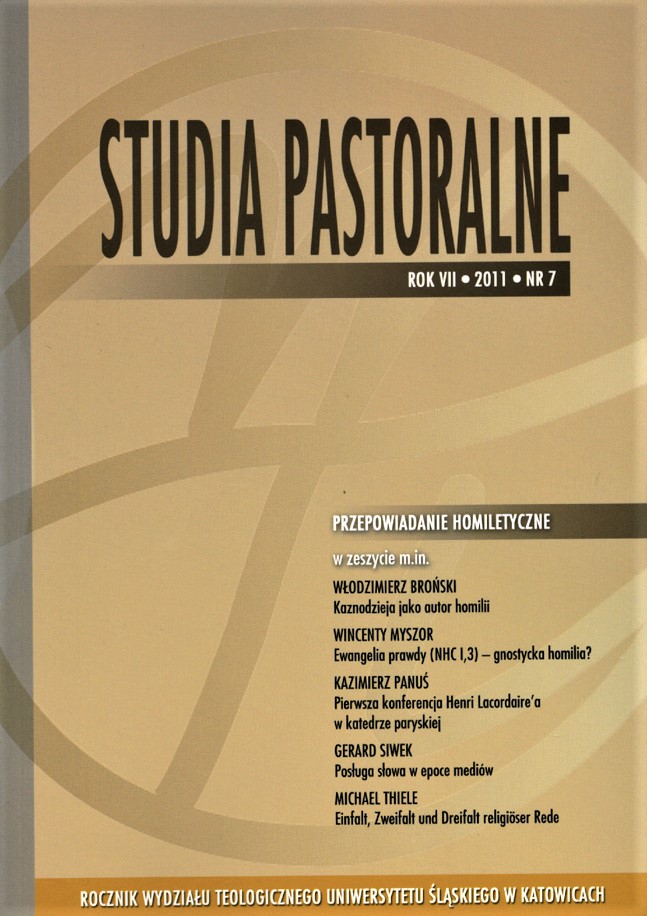
No. 7 (2011)
Published: 2021-08-04
This work is licensed under a Creative Commons Attribution-ShareAlike 4.0 International License.

 English
 Italiano
 Język Polski
 Deutsch