
Two remarks of John Paul II from his Letter to families (1994) constitute landmarks of the contemporary Magisterium de familia christiana. „The family itself – says number 19 of the document – is the great mystery of God. As the »domestic church«, it is the bride of Christ. The universal Church, and every particular Church in her, is most immediately revealed as the bride of Christ in the »domestic church« and in its experience of love: conjugal love, paternal and maternal love, fraternal love, the love of a community of persons and of generations”. This statement correlates with a part of number 17 of the said letter: „As a community of love and life, the family is a firmly grounded social reality. It is also, in a way entirely its own, a sovereign society, albeit conditioned in certain ways. This affirmation of the family’s sovereignty as an institution and the recognition of the various ways in which it is conditioned naturally leads to the subject of family rights”. As P.J. Viladrich rightly observed, a creative academic reflection on a convergence of meaning resulting from the both famous notions „domestic church” and „sovereign family” may contribute to implementation of a postulate to place family in a central position of systematics of the canon law. Christian family has an unquestionable constitutional and legal place in the Church and a society. What is at stake here is „a primary basic structure around which the people of God is build up, configured and fundamentally organised” (J. Hervada). Representatives of the so called „Spanish school” unanimously point at the canon – key to a new placement of a family in a canonical legal order. If the science of canon law still has got a task to introduce a congruent system of family law, a peculiar catalyst and a starting point of its fulfilment may be a formula of canon 226 § 1 of the Code of Canon Law which states that: „According to their own vocation, those who live in the marital state are bound by a special duty to work through marriage and the family to build up the people of God”.
Download files
Citation rules
Licence

This work is licensed under a Creative Commons Attribution-ShareAlike 4.0 International License.
The Copyright Owners of the submitted texts grant the Reader the right to use the pdf documents under the provisions of the Creative Commons 4.0 International License: Attribution-Share-Alike (CC BY-SA). The user can copy and redistribute the material in any medium or format and remix, transform, and build upon the material for any purpose.
1. License
The University of Silesia Press provides immediate open access to journal’s content under the Creative Commons BY-SA 4.0 license (http://creativecommons.org/licenses/by-sa/4.0/). Authors who publish with this journal retain all copyrights and agree to the terms of the above-mentioned CC BY-SA 4.0 license.
2. Publication Fees Policy
Authors do not bear any costs associated with the publication of their articles, i.e. article processing charges (APCs), language editing fees, colour charges, submission fees, page charges, membership fees, print subscription costs, other supplementary charges. Authors also do not receive any financial gratification for the published articles.
3. Author’s Warranties
The author warrants that the article is original, written by stated author/s, has not been published before, contains no unlawful statements, does not infringe the rights of others, is subject to copyright that is vested exclusively in the author and free of any third party rights, and that any necessary written permissions to quote from other sources have been obtained by the author/s.
If the article contains illustrative material (drawings, photos, graphs, maps), the author declares that the said works are of his authorship, they do not infringe the rights of the third party (including personal rights, i.a. the authorization to reproduce physical likeness) and the author holds exclusive proprietary copyrights. The author publishes the above works as part of the article under the licence "Creative Commons Attribution-ShareAlike 4.0 International".
ATTENTION! When the legal situation of the illustrative material has not been determined and the necessary consent has not been granted by the proprietary copyrights holders, the submitted material will not be accepted for editorial process. At the same time the author takes full responsibility for providing false data (this also regards covering the costs incurred by the University of Silesia Press and financial claims of the third party).
4. User Rights
Under the CC BY-SA 4.0 license, the users are free to share (copy, distribute and transmit the contribution) and adapt (remix, transform, and build upon the material) the article for any purpose, provided they attribute the contribution in the manner specified by the author or licensor.
5. Co-Authorship
If the article was prepared jointly with other authors, the signatory of this form warrants that he/she has been authorized by all co-authors to sign this agreement on their behalf, and agrees to inform his/her co-authors of the terms of this agreement.
I hereby declare that in the event of withdrawal of the text from the publishing process or submitting it to another publisher without agreement from the editorial office, I agree to cover all costs incurred by the University of Silesia in connection with my application.
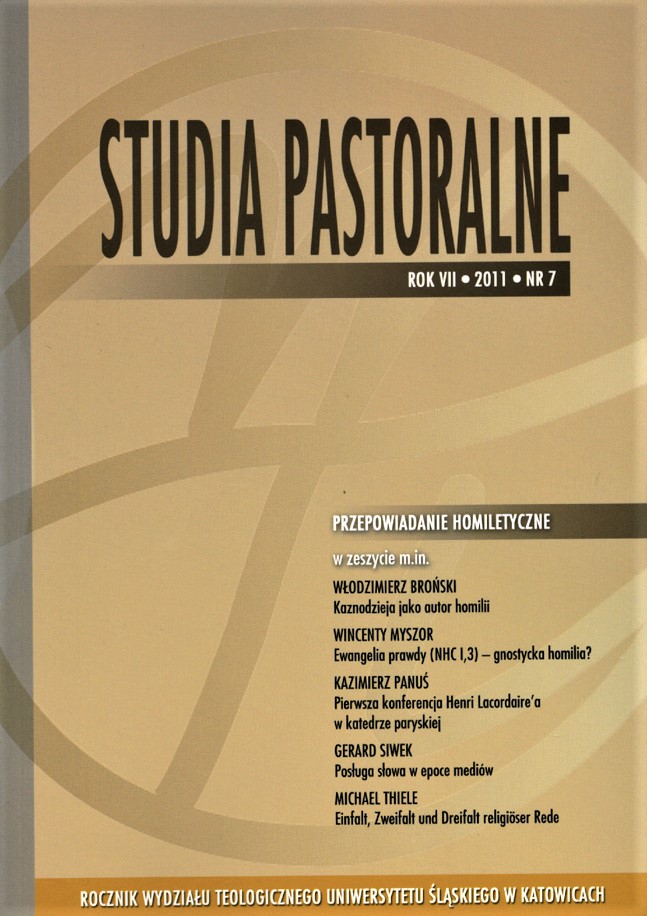
No. 7 (2011)
Published: 2021-08-04
This work is licensed under a Creative Commons Attribution-ShareAlike 4.0 International License.

 English
 Italiano
 Język Polski
 Deutsch