
The word officium summarises a significant characteristic of Roman culture. It describes the Roman ideal of life as public service, i.e. a concern for salus rei publicae. Latin Christianity took over the word and its substance. The ministry of a bishop was described as exercising the officium already in the early ages. That is how Cyprian of Carthage understood the office of bishop, even though he did not use the word explicitly. Ambrose of Milan made the Roman officium a cornerstone of the formation of priests, which he described in his well-known work De officiis ministrorum. He himself exercised the office of the Bishop of Milan according to the best model of a Roman official. The tradition was further developed by Leo the Great, who pointed out that pax christiana was the fulfillment of what the Romans had expected of pax romana. Gregory the Great took over the legacy of his predecessors. However, to a greater extent than Ambrose or Leo, he perceived the tension between exercising the office accompanied by worldly cares and the spiritual dimension of bishop’s ministry. It may have been caused by the fact that, after a total disintegration of Roman administration, Gregory was forced to take on the responsibility of the perfect of Rome. His Regula pastoralis, however, provides a continuation of Ambrose’s ideas concerning the formation of clergy.
Download files
Citation rules
Licence

This work is licensed under a Creative Commons Attribution-ShareAlike 4.0 International License.
The Copyright Owners of the submitted texts grant the Reader the right to use the pdf documents under the provisions of the Creative Commons 4.0 International License: Attribution-Share-Alike (CC BY-SA). The user can copy and redistribute the material in any medium or format and remix, transform, and build upon the material for any purpose.
1. License
The University of Silesia Press provides immediate open access to journal’s content under the Creative Commons BY-SA 4.0 license (http://creativecommons.org/licenses/by-sa/4.0/). Authors who publish with this journal retain all copyrights and agree to the terms of the above-mentioned CC BY-SA 4.0 license.
2. Publication Fees Policy
Authors do not bear any costs associated with the publication of their articles, i.e. article processing charges (APCs), language editing fees, colour charges, submission fees, page charges, membership fees, print subscription costs, other supplementary charges. Authors also do not receive any financial gratification for the published articles.
3. Author’s Warranties
The author warrants that the article is original, written by stated author/s, has not been published before, contains no unlawful statements, does not infringe the rights of others, is subject to copyright that is vested exclusively in the author and free of any third party rights, and that any necessary written permissions to quote from other sources have been obtained by the author/s.
If the article contains illustrative material (drawings, photos, graphs, maps), the author declares that the said works are of his authorship, they do not infringe the rights of the third party (including personal rights, i.a. the authorization to reproduce physical likeness) and the author holds exclusive proprietary copyrights. The author publishes the above works as part of the article under the licence "Creative Commons Attribution-ShareAlike 4.0 International".
ATTENTION! When the legal situation of the illustrative material has not been determined and the necessary consent has not been granted by the proprietary copyrights holders, the submitted material will not be accepted for editorial process. At the same time the author takes full responsibility for providing false data (this also regards covering the costs incurred by the University of Silesia Press and financial claims of the third party).
4. User Rights
Under the CC BY-SA 4.0 license, the users are free to share (copy, distribute and transmit the contribution) and adapt (remix, transform, and build upon the material) the article for any purpose, provided they attribute the contribution in the manner specified by the author or licensor.
5. Co-Authorship
If the article was prepared jointly with other authors, the signatory of this form warrants that he/she has been authorized by all co-authors to sign this agreement on their behalf, and agrees to inform his/her co-authors of the terms of this agreement.
I hereby declare that in the event of withdrawal of the text from the publishing process or submitting it to another publisher without agreement from the editorial office, I agree to cover all costs incurred by the University of Silesia in connection with my application.
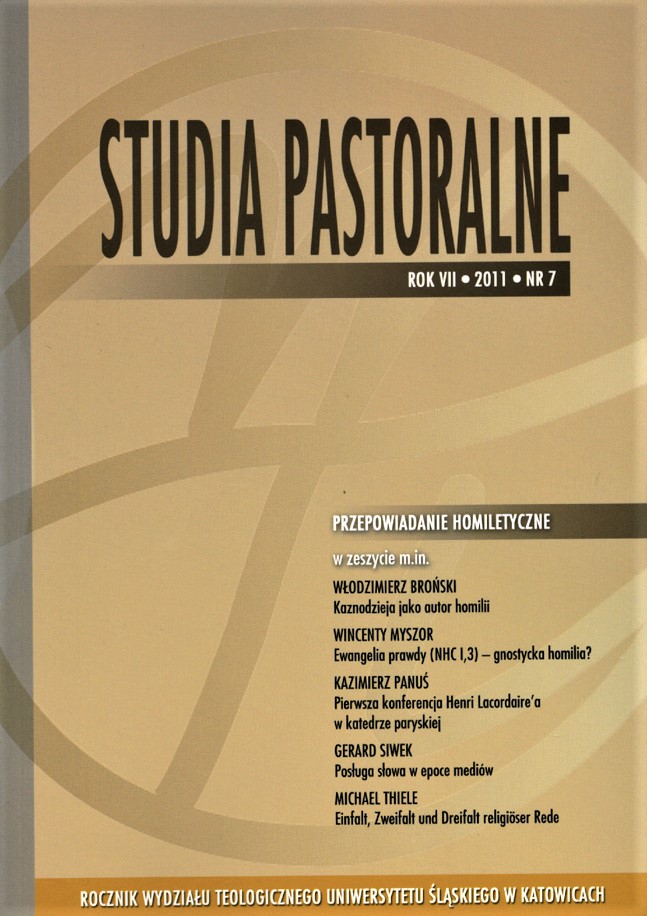
No. 7 (2011)
Published: 2021-08-04
This work is licensed under a Creative Commons Attribution-ShareAlike 4.0 International License.

 English
 Italiano
 Język Polski
 Deutsch