

The cult of saints creates a certain phenomenon that has been present for centuries in the life-mission of the Church. It is therefore worthy to devote adequate space for reflection of this theme, dedicated to its theological foundations. This theme in fact is continually timely and attracts our attention – both in life and research. The article presented above comes from statements relating to the conception and organization of Christian worship, from a previous attention to worship in the Old Testament, and which cult found its fulfillment in the New Covenant people, and so, in the life of Christ’s disciples upon the fulfillment of His work of salvation, brought to fulfillment at the coming of the Holy Spirit. Not surprisingly, and clearly emphasized by biblical texts, early Christians of ecclesial communities felt called to live holy lives on a daily basis, and sometimes even called each other „saints”. In fact, the Christians of that period not only felt a vocation to holiness, but witnessed their ability in practice. In addition, they were aware of the fact that such a calling does not guarantee any social prestige, but an obligation to follow Christ in His great devotion to the will of our heavenly Father – even to the Cross, which was taken up and carried freely, with the knowledge of the need of filling in their own flesh what is still lacking in regard to Christ’s afflictions, for the sake of His Body, which is the Church (Col 1:24).
The demanding Christian life, namely the prospect of holiness lived out in the image of Jesus crucified and risen, caused the birth of a desire in the hearts of believers to memorialize – not only in the archives, but above all in the liturgy – the example left by Christians who throughout their lives could maturely answer the call to holiness addressed to them by God. In the examples of holiness that the Lord has instilled in their hearts, introduced in time into the liturgy, Christians began to discover – and are still discovering – the continuation of a plan holiness undertaken by God, constantly carried out in time according to the rhythms foreseen by Him. In venerating the saints, the Church proclaims the paschal mystery and gives glory to God for the work revealed in their lives, as well as recognizing in them witnesses, who have reached, through God’s multiple graces, eternal salvation – „They sing to God in heaven great glory and intercede for us” (SC 104).
Download files
Citation rules
Licence

This work is licensed under a Creative Commons Attribution-ShareAlike 4.0 International License.
The Copyright Owners of the submitted texts grant the Reader the right to use the pdf documents under the provisions of the Creative Commons 4.0 International License: Attribution-Share-Alike (CC BY-SA). The user can copy and redistribute the material in any medium or format and remix, transform, and build upon the material for any purpose.
1. License
The University of Silesia Press provides immediate open access to journal’s content under the Creative Commons BY-SA 4.0 license (http://creativecommons.org/licenses/by-sa/4.0/). Authors who publish with this journal retain all copyrights and agree to the terms of the above-mentioned CC BY-SA 4.0 license.
2. Publication Fees Policy
Authors do not bear any costs associated with the publication of their articles, i.e. article processing charges (APCs), language editing fees, colour charges, submission fees, page charges, membership fees, print subscription costs, other supplementary charges. Authors also do not receive any financial gratification for the published articles.
3. Author’s Warranties
The author warrants that the article is original, written by stated author/s, has not been published before, contains no unlawful statements, does not infringe the rights of others, is subject to copyright that is vested exclusively in the author and free of any third party rights, and that any necessary written permissions to quote from other sources have been obtained by the author/s.
If the article contains illustrative material (drawings, photos, graphs, maps), the author declares that the said works are of his authorship, they do not infringe the rights of the third party (including personal rights, i.a. the authorization to reproduce physical likeness) and the author holds exclusive proprietary copyrights. The author publishes the above works as part of the article under the licence "Creative Commons Attribution-ShareAlike 4.0 International".
ATTENTION! When the legal situation of the illustrative material has not been determined and the necessary consent has not been granted by the proprietary copyrights holders, the submitted material will not be accepted for editorial process. At the same time the author takes full responsibility for providing false data (this also regards covering the costs incurred by the University of Silesia Press and financial claims of the third party).
4. User Rights
Under the CC BY-SA 4.0 license, the users are free to share (copy, distribute and transmit the contribution) and adapt (remix, transform, and build upon the material) the article for any purpose, provided they attribute the contribution in the manner specified by the author or licensor.
5. Co-Authorship
If the article was prepared jointly with other authors, the signatory of this form warrants that he/she has been authorized by all co-authors to sign this agreement on their behalf, and agrees to inform his/her co-authors of the terms of this agreement.
I hereby declare that in the event of withdrawal of the text from the publishing process or submitting it to another publisher without agreement from the editorial office, I agree to cover all costs incurred by the University of Silesia in connection with my application.
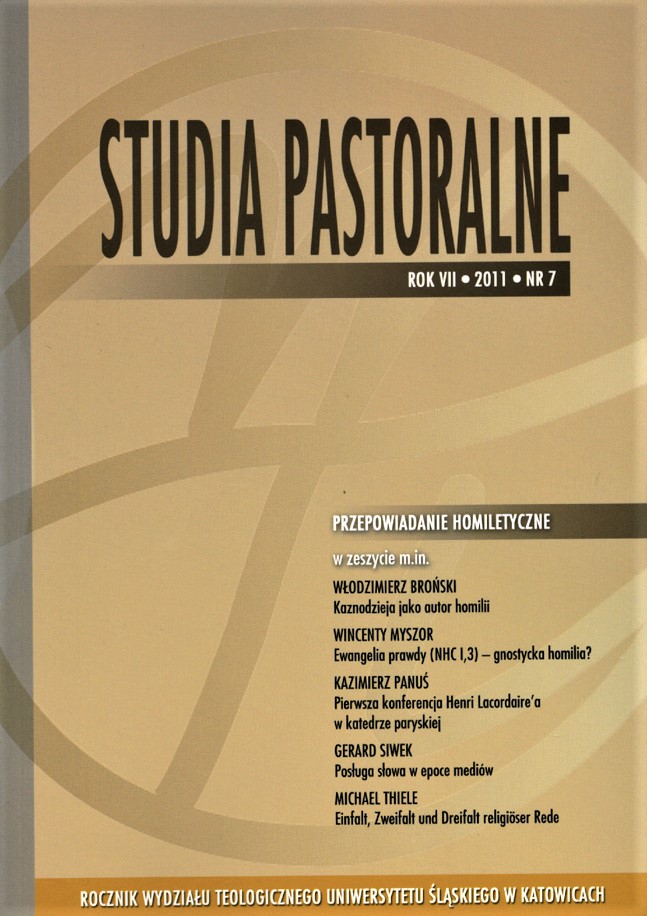
No. 7 (2011)
Published: 2021-08-04
This work is licensed under a Creative Commons Attribution-ShareAlike 4.0 International License.

 English
 Italiano
 Język Polski
 Deutsch