

 https://doi.org/10.31261/TAPSLA.17340
This study explores the use of English emotion vocabulary by learners of English with L11 Moroccan Arabic (MA). Just as with color terms, languages carve up the emotional spectrum differently. Cross-linguistic comparison of emotion lexicons may, therefore, reveal varying degrees of lexical equivalence. In addition to this lexical anisomorphism, the study investigates the effects of word frequency and L2 proficiency on the use of English emotion vocabulary. To examine these factors, intermediate and advanced learners of English, as well as a group of native English speakers, watched two concise films and described the actors’ emotions during specific scenes. The data was analyzed listing the most frequently used emotion terms for each group. Chi-square tests were then performed to compare the significance of the lexical choices made by native speakers to those provided by each learner group. The results indicate that advanced learners managed to describe the suggested scenes using nearly the same emotion words as native speakers. However, some culture-specific emotion terms posed problems for them. L2 proficiency demonstrated a strong effect, as intermediate learners often deviated from native usage. The implications drawn from these results suggest that culturally specific emotion terms, which lead to lexical inequivalence, should be considered alongside factors, namely word type and word frequency, that can challenge learners in acquiring L2 vocabulary. The study also highlights the importance of context-rich instruction of L2 emotion vocabulary and opens avenues for further research that would contribute to the understanding of the intersection between second language acquisition, culture, and emotions.
Download files
Citation rules
Cited by / Share



Licence

This work is licensed under a Creative Commons Attribution-ShareAlike 4.0 International License.
The Copyright Holders of the submitted texts are the Authors. The Reader is granted the rights to use the material available in the TAPSLA websites and pdf documents under the provisions of the Creative Commons 4.0 International License: Attribution - Share Alike (CC BY-SA 4.0). The user is free to copy and redistribute the material in any medium or format, and to remix, transform, and build upon the material for any purpose, even commercially.
1. License
The University of Silesia Press provides immediate open access to journal’s content under the Creative Commons BY-SA 4.0 license (http://creativecommons.org/licenses/by-sa/4.0/). Authors who publish with this journal retain all copyrights and agree to the terms of the above-mentioned CC BY-SA 4.0 license.
2. Author’s Warranties
The author warrants that the article is original, written by stated author/s, has not been published before, contains no unlawful statements, does not infringe the rights of others, is subject to copyright that is vested exclusively in the author and free of any third party rights, and that any necessary written permissions to quote from other sources have been obtained by the author/s.
If the article contains illustrative material (drawings, photos, graphs, maps), the author declares that the said works are of his authorship, they do not infringe the rights of the third party (including personal rights, i.a. the authorization to reproduce physical likeness) and the author holds exclusive proprietary copyrights. The author publishes the above works as part of the article under the licence "Creative Commons Attribution-ShareAlike 4.0 International".
ATTENTION! When the legal situation of the illustrative material has not been determined and the necessary consent has not been granted by the proprietary copyrights holders, the submitted material will not be accepted for editorial process. At the same time the author takes full responsibility for providing false data (this also regards covering the costs incurred by the University of Silesia Press and financial claims of the third party).
3. User Rights
Under the CC BY-SA 4.0 license, the users are free to share (copy, distribute and transmit the contribution) and adapt (remix, transform, and build upon the material) the article for any purpose, provided they attribute the contribution in the manner specified by the author or licensor.
4. Co-Authorship
If the article was prepared jointly with other authors, the signatory of this form warrants that he/she has been authorized by all co-authors to sign this agreement on their behalf, and agrees to inform his/her co-authors of the terms of this agreement.
I hereby declare that in the event of withdrawal of the text from the publishing process or submitting it to another publisher without agreement from the editorial office, I agree to cover all costs incurred by the University of Silesia in connection with my application.
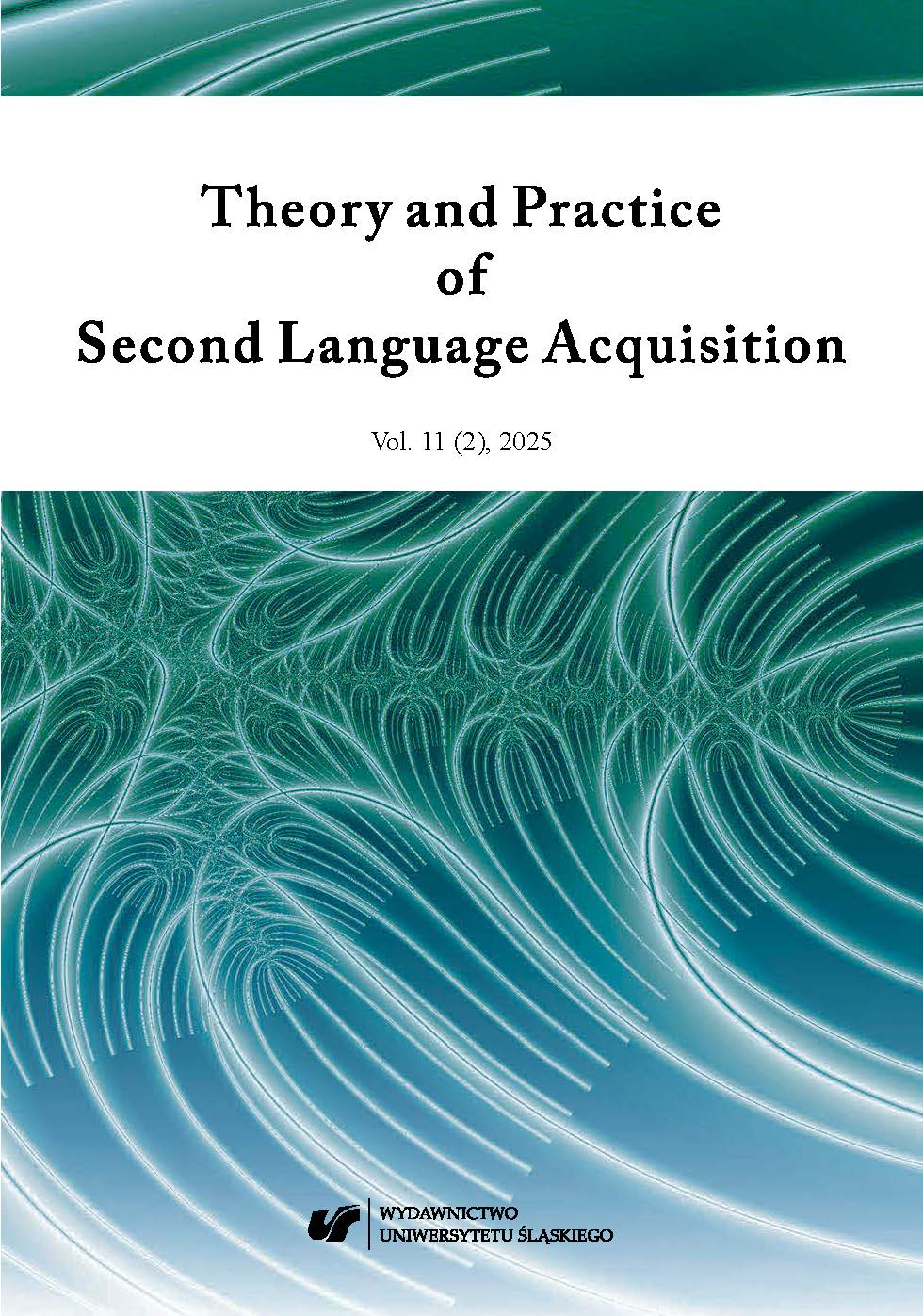
Vol. 11 No. 2 (2025)
Published: 2025-12-12
10.31261/tapsla
This work is licensed under a Creative Commons Attribution-ShareAlike 4.0 International License.

 English