
 ,
Ta Phuong Thinh
,
Ngo Huynh Hong Nga
,
Le Thanh Thao
,
Tuan Le Cong
,
Ta Phuong Thinh
,
Ngo Huynh Hong Nga
,
Le Thanh Thao
,
Tuan Le Cong
 https://doi.org/10.31261/TAPSLA.17658
This study sought to investigate how teachers perceive their self-efficacy in fostering three critical dimensions of student engagement: emotional, behavioral, and cognitive. The research used the Social Cognitive Theory (SCT) as a foundation to unravel the intricate interplay between teacher cognitions and student engagement in academic settings. A mixed-methods approach was employed to ensure both breadth and depth of understanding. Quantitative data were gleaned using descriptive statistics, while qualitative insights were extracted from in-depth teacher interviews. Findings revealed that teachers feel most efficacious in catalyzing emotional engagement, with both quantitative scores and qualitative accounts affirming this observation. A palpable connection between emotional and behavioral engagement was identified, implying that active participation often stems from emotional resonance. Conversely, cognitive engagement emerged as a nuanced challenge, with teachers often grappling to influence it effectively. SCT interpretations underscored the dynamic interplay between individual cognitive processes, observational learning, and the broader educational milieu. The pronounced role of emotional engagement suggests the necessity for tailored teacher development programs. Furthermore, the intricacies of cognitive engagement advocate for more individual-centric curriculum designs. These insights have profound implications for teacher training, curriculum design, policy formulation, and future research, emphasizing the need for creating immersive and holistically engaging learning environments.
Download files
Citation rules
Cited by / Share



Licence

This work is licensed under a Creative Commons Attribution-ShareAlike 4.0 International License.
The Copyright Holders of the submitted texts are the Authors. The Reader is granted the rights to use the material available in the TAPSLA websites and pdf documents under the provisions of the Creative Commons 4.0 International License: Attribution - Share Alike (CC BY-SA 4.0). The user is free to copy and redistribute the material in any medium or format, and to remix, transform, and build upon the material for any purpose, even commercially.
1. License
The University of Silesia Press provides immediate open access to journal’s content under the Creative Commons BY-SA 4.0 license (http://creativecommons.org/licenses/by-sa/4.0/). Authors who publish with this journal retain all copyrights and agree to the terms of the above-mentioned CC BY-SA 4.0 license.
2. Author’s Warranties
The author warrants that the article is original, written by stated author/s, has not been published before, contains no unlawful statements, does not infringe the rights of others, is subject to copyright that is vested exclusively in the author and free of any third party rights, and that any necessary written permissions to quote from other sources have been obtained by the author/s.
If the article contains illustrative material (drawings, photos, graphs, maps), the author declares that the said works are of his authorship, they do not infringe the rights of the third party (including personal rights, i.a. the authorization to reproduce physical likeness) and the author holds exclusive proprietary copyrights. The author publishes the above works as part of the article under the licence "Creative Commons Attribution-ShareAlike 4.0 International".
ATTENTION! When the legal situation of the illustrative material has not been determined and the necessary consent has not been granted by the proprietary copyrights holders, the submitted material will not be accepted for editorial process. At the same time the author takes full responsibility for providing false data (this also regards covering the costs incurred by the University of Silesia Press and financial claims of the third party).
3. User Rights
Under the CC BY-SA 4.0 license, the users are free to share (copy, distribute and transmit the contribution) and adapt (remix, transform, and build upon the material) the article for any purpose, provided they attribute the contribution in the manner specified by the author or licensor.
4. Co-Authorship
If the article was prepared jointly with other authors, the signatory of this form warrants that he/she has been authorized by all co-authors to sign this agreement on their behalf, and agrees to inform his/her co-authors of the terms of this agreement.
I hereby declare that in the event of withdrawal of the text from the publishing process or submitting it to another publisher without agreement from the editorial office, I agree to cover all costs incurred by the University of Silesia in connection with my application.
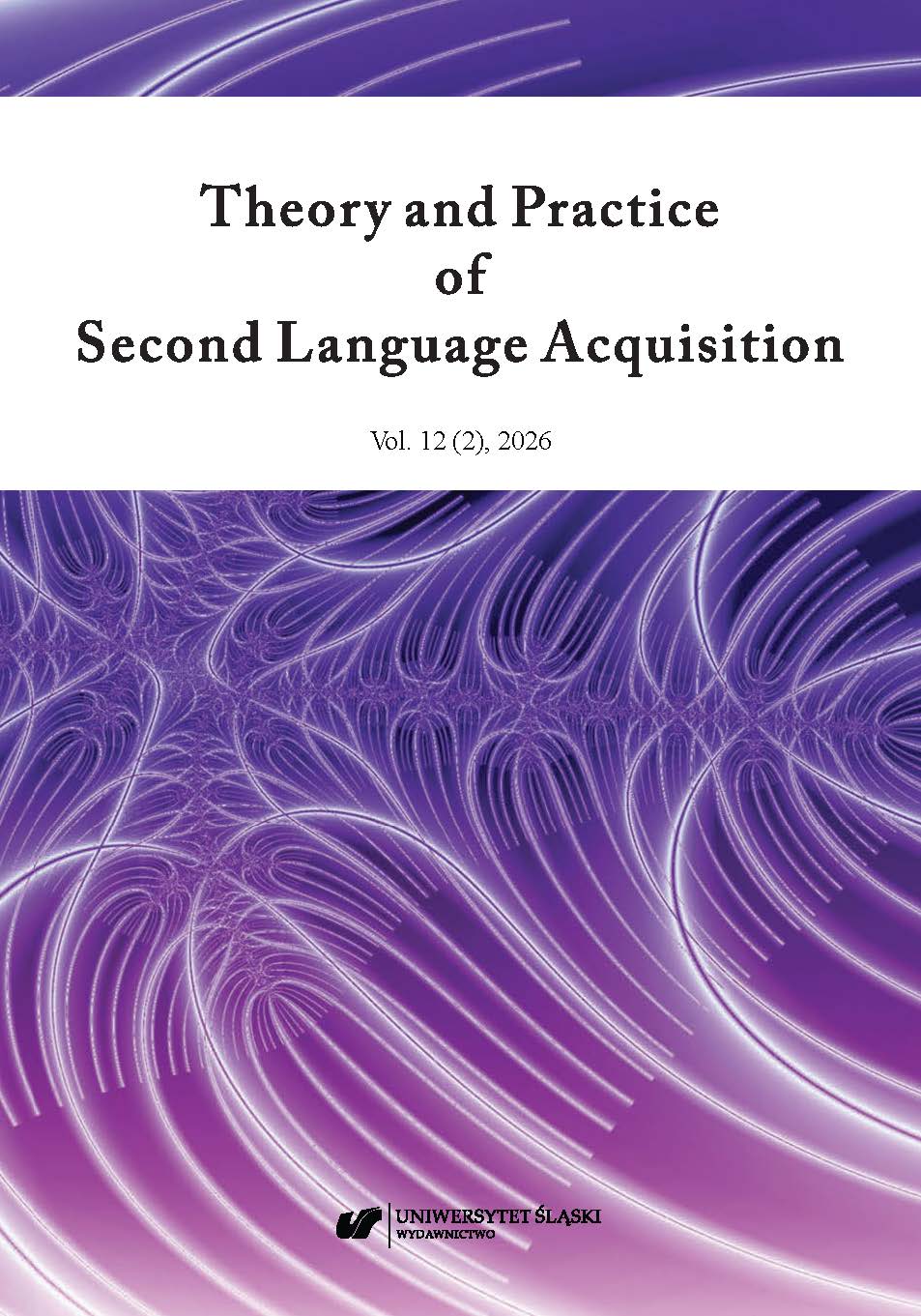
Vol. 12 No. 1 (2026)
Published: 2026-06-30
10.31261/tapsla
This work is licensed under a Creative Commons Attribution-ShareAlike 4.0 International License.

 English