

It is true that in free Poland Sunday became gelatinised. More and more Poles spend this holy day in new „temples of consumption” which are supermarkets. Hundreds of thousands of people are forced to work. It is sad that the apostolic letter of the pope, Dies Domini, in which John Paul II appealed for respecting Sunday did not trigger any legal repercussions in Poland. In view of desacralised time and a lack of a deeper understanding of the meaning of Sunday as the day of celebration, one can see a necessity of a permanent upbringing to celebrating Sunday.
The Eucharist is, in a sense, the aim of a religious life because from the Christian perspective the purpose of life is getting involved in God’s redemptive plans. Their pivotal point is Jesus Christ and His Passover mystery which is constantly being personalised in the Church. It is done especially in a Eucharistic gathering thanks to which people get unified with Christ in the word and the sacrament and with one another. In this way it is the Eucharist where the community with God and among people becomes real and gets deepened. This type of a communion is the purpose of the whole history of salvation. Of course in the eschatological perspective it is also the source towards the purpose since this is the sign pointing at the ultimate community which will get realised at the end ofthe history of salvation. Being the source, however, it already includes its own purpose to which it is supposed to lead.
In view of the above it seems that both in teaching and upbringing the link between Sunday and what can be called „the theology of the eighth day” is insufficiently emphasised. For Sunday, as John Paul II emphasises in Dies Domini is not only the first day, it is also „the eighth day”, set within the sevenfold succession of days in a unique and transcendent position which evokes not only the beginning of time, but also its end in „the age to come”. [...] Sunday symbolizes that truly singular day which will follow the present time, the day without end which will know neither evening nor morning, the imperishable age which will never grow old; Sunday is the ceaseless foretelling of life without end which renews the hope of Christians and encourages them on their way (No. 26).
On the other hand eschatological dimension of the Eucharist, emphasised by the theology of the eighth day, expresses the very nature of a Christian existence on the earth. It is a privileged moment in which the Church experiences itself as „the pilgrim”. The Mass stimulates Christians to live in an eschatological way, as pilgrims, with their eyes and hearts turned upwards. Therefore the Sunday Eucharist should be a real celebration. Theology of the eighth day may be reflected concretely in the pastoral practice of a parish community. For the world does not need a parish in which you can find all sorts of convenient facilities, actions and entertainment which are produced and distributed by the world, but the place of a pilgrimage and joy. The place where one can experience the presence of the Holy Spirit and where someone coming for the first time is forced to notice something else and shout like those who were entering the first Christian communities Truly God is among you! (1 Co 14:25).
Dateien herunterladen
Zitierregeln
Lizenz

Właściciele praw autorskich do nadesłanych tekstów udzielają Czytelnikowi prawa do korzystania z dokumentów pdf zgodnie z postanowieniami licencji Creative Commons 4.0 International License: Attribution-Share-Alike (CC BY-SA 4.0). Użytkownik może kopiować i redystrybuować materiał w dowolnym medium lub formacie oraz remiksować, przekształcać i wykorzystywać materiał w dowolnym celu.
1. Licencja
Wydawnictwo Uniwersytetu Śląskiego zapewnia natychmiastowy otwarty dostęp do treści swoich czasopism na licencji Creative Commons BY-SA 4.0 (http://creativecommons.org/licenses/by-sa/4.0/). Autorzy publikujący w tym czasopiśmie zachowują wszelkie prawa autorskie i zgadzają się na warunki wyżej wymienionej licencji CC BY-SA 4.0.
2. Polityka opłat za publikację
Autorzy nie ponoszą żadnych kosztów związanych z publikacją swoich artykułów, tj. opłaty za przetwarzanie artykułu (APC), opłaty za redakcję językową, opłaty za kolor, opłaty za przesłanie, opłaty za strony, opłaty członkowskie, koszty prenumeraty druku, inne opłaty dodatkowe. Autorzy nie otrzymują również żadnej gratyfikacji finansowej za publikowane artykuły.
3. Oświadczenie Autora
Autor deklaruje, że artykuł jest oryginalny, napisany przez niego (i współautorów), nie był wcześniej publikowany, nie zawiera stwierdzeń niezgodnych z prawem, nie narusza praw innych osób, jest przedmiotem praw autorskich, które przysługują wyłącznie autorowi i jest wolny od wszelkich praw osób trzecich, a także, że autor uzyskał wszelkie niezbędne pisemne zgody na cytowanie z innych źródeł.
Jeśli artykuł zawiera materiał ilustracyjny (rysunki, zdjęcia, wykresy, mapy itp.), Autor oświadcza, że wskazane dzieła są jego dziełami autorskimi, nie naruszają niczyich praw (w tym osobistych, m.in. prawa do dysponowania wizerunkiem) i posiada do nich pełnię praw majątkowych. Powyższe dzieła udostępnia jako część artykułu na licencji „Creative Commons Uznanie autorstwa-Na tych samych warunkach 4.0 Międzynarodowe”.
UWAGA! Bez określenia sytuacji prawnej materiału ilustracyjnego oraz załączenia stosownych zgód właścicieli majątkowych praw autorskich publikacja nie zostanie przyjęta do opracowania redakcyjnego. Autor/autorka oświadcza równocześnie, że bierze na siebie wszelką odpowiedzialność w przypadku podania nieprawidłowych danych (także w zakresie pokrycia kosztów poniesionych przez Wydawnictwo UŚ oraz roszczeń finansowych stron trzecich).
4. Prawa użytkownika
Zgodnie z licencją CC BY-SA 4.0 użytkownicy mogą udostępniać (kopiować, rozpowszechniać i przekazywać) oraz adaptować (remiksować, przekształcać i tworzyć na podstawie materiału) artykuł w dowolnym celu, pod warunkiem, że oznaczą go w sposób określony przez autora lub licencjodawcę.
5. Współautorstwo
Jeśli artykuł został przygotowany wspólnie z innymi autorami, osoba zgłaszająca niniejszy formularz zapewnia, że została upoważniona przez wszystkich współautorów do podpisania niniejszej umowy w ich imieniu i zobowiązuje się poinformować swoich współautorów o warunkach tej umowy.
Oświadczam, że w przypadku nieuzgodnionego z redakcją i/lub wydawcą czasopisma wycofania przeze mnie tekstu z procesu wydawniczego lub skierowania go równolegle do innego wydawcy zgadzam się pokryć wszelkie koszty poniesione przez Uniwersytet Śląski w związku z procedowaniem mojego zgłoszenia (w tym m.in. koszty recenzji wydawniczych).
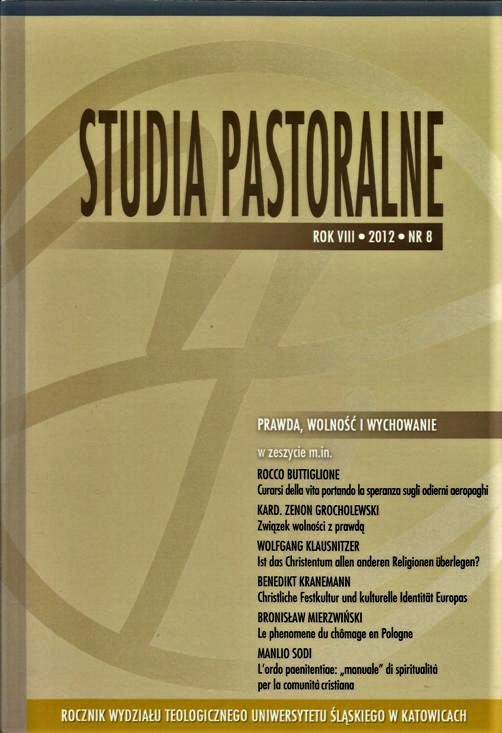
Nr. 8 (2012)
Veröffentlicht: 2021-08-04

 English
 Italiano
 Język Polski
 Deutsch