

It is true that in free Poland Sunday became gelatinised. More and more Poles spend this holy day in new „temples of consumption” which are supermarkets. Hundreds of thousands of people are forced to work. It is sad that the apostolic letter of the pope, Dies Domini, in which John Paul II appealed for respecting Sunday did not trigger any legal repercussions in Poland. In view of desacralised time and a lack of a deeper understanding of the meaning of Sunday as the day of celebration, one can see a necessity of a permanent upbringing to celebrating Sunday.
The Eucharist is, in a sense, the aim of a religious life because from the Christian perspective the purpose of life is getting involved in God’s redemptive plans. Their pivotal point is Jesus Christ and His Passover mystery which is constantly being personalised in the Church. It is done especially in a Eucharistic gathering thanks to which people get unified with Christ in the word and the sacrament and with one another. In this way it is the Eucharist where the community with God and among people becomes real and gets deepened. This type of a communion is the purpose of the whole history of salvation. Of course in the eschatological perspective it is also the source towards the purpose since this is the sign pointing at the ultimate community which will get realised at the end ofthe history of salvation. Being the source, however, it already includes its own purpose to which it is supposed to lead.
In view of the above it seems that both in teaching and upbringing the link between Sunday and what can be called „the theology of the eighth day” is insufficiently emphasised. For Sunday, as John Paul II emphasises in Dies Domini is not only the first day, it is also „the eighth day”, set within the sevenfold succession of days in a unique and transcendent position which evokes not only the beginning of time, but also its end in „the age to come”. [...] Sunday symbolizes that truly singular day which will follow the present time, the day without end which will know neither evening nor morning, the imperishable age which will never grow old; Sunday is the ceaseless foretelling of life without end which renews the hope of Christians and encourages them on their way (No. 26).
On the other hand eschatological dimension of the Eucharist, emphasised by the theology of the eighth day, expresses the very nature of a Christian existence on the earth. It is a privileged moment in which the Church experiences itself as „the pilgrim”. The Mass stimulates Christians to live in an eschatological way, as pilgrims, with their eyes and hearts turned upwards. Therefore the Sunday Eucharist should be a real celebration. Theology of the eighth day may be reflected concretely in the pastoral practice of a parish community. For the world does not need a parish in which you can find all sorts of convenient facilities, actions and entertainment which are produced and distributed by the world, but the place of a pilgrimage and joy. The place where one can experience the presence of the Holy Spirit and where someone coming for the first time is forced to notice something else and shout like those who were entering the first Christian communities Truly God is among you! (1 Co 14:25).
Download files
Citation rules
Licence

This work is licensed under a Creative Commons Attribution-ShareAlike 4.0 International License.
The Copyright Owners of the submitted texts grant the Reader the right to use the pdf documents under the provisions of the Creative Commons 4.0 International License: Attribution-Share-Alike (CC BY-SA). The user can copy and redistribute the material in any medium or format and remix, transform, and build upon the material for any purpose.
1. License
The University of Silesia Press provides immediate open access to journal’s content under the Creative Commons BY-SA 4.0 license (http://creativecommons.org/licenses/by-sa/4.0/). Authors who publish with this journal retain all copyrights and agree to the terms of the above-mentioned CC BY-SA 4.0 license.
2. Publication Fees Policy
Authors do not bear any costs associated with the publication of their articles, i.e. article processing charges (APCs), language editing fees, colour charges, submission fees, page charges, membership fees, print subscription costs, other supplementary charges. Authors also do not receive any financial gratification for the published articles.
3. Author’s Warranties
The author warrants that the article is original, written by stated author/s, has not been published before, contains no unlawful statements, does not infringe the rights of others, is subject to copyright that is vested exclusively in the author and free of any third party rights, and that any necessary written permissions to quote from other sources have been obtained by the author/s.
If the article contains illustrative material (drawings, photos, graphs, maps), the author declares that the said works are of his authorship, they do not infringe the rights of the third party (including personal rights, i.a. the authorization to reproduce physical likeness) and the author holds exclusive proprietary copyrights. The author publishes the above works as part of the article under the licence "Creative Commons Attribution-ShareAlike 4.0 International".
ATTENTION! When the legal situation of the illustrative material has not been determined and the necessary consent has not been granted by the proprietary copyrights holders, the submitted material will not be accepted for editorial process. At the same time the author takes full responsibility for providing false data (this also regards covering the costs incurred by the University of Silesia Press and financial claims of the third party).
4. User Rights
Under the CC BY-SA 4.0 license, the users are free to share (copy, distribute and transmit the contribution) and adapt (remix, transform, and build upon the material) the article for any purpose, provided they attribute the contribution in the manner specified by the author or licensor.
5. Co-Authorship
If the article was prepared jointly with other authors, the signatory of this form warrants that he/she has been authorized by all co-authors to sign this agreement on their behalf, and agrees to inform his/her co-authors of the terms of this agreement.
I hereby declare that in the event of withdrawal of the text from the publishing process or submitting it to another publisher without agreement from the editorial office, I agree to cover all costs incurred by the University of Silesia in connection with my application.
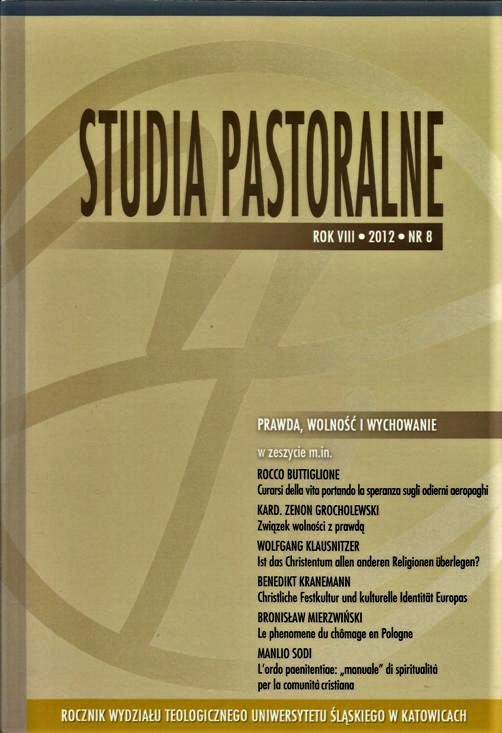
No. 8 (2012)
Published: 2021-08-04
This work is licensed under a Creative Commons Attribution-ShareAlike 4.0 International License.

 English
 Italiano
 Język Polski
 Deutsch