Arctic shrubs record the history of the region – from volcanic cooling to traces of ancient Viking settlements. Prof. Magdalena Opała-Owczarek’s team from the University of Silesia uses microscopic rings of long-lived junipers and polar willows to reconstruct the climatic conditions of several centuries ago. Using not only contemporary samples but also forgotten botanical collections from museums in Copenhagen, London, and Washington, researchers are reconstructing the history of Arctic weather dating back to the 16th century. Their growth rings reveal the effects of eruptions of volcanoes such as Laki and Tambora, which were capable of lowering temperatures by several degrees. Arctic dendrochronology, previously marginalised, is now becoming the key to understanding past and future climate change.
Invertebrate fossils belong to many groups – from the most primitive, including sponges and corals, through arthropods, to echinoderms, the most sophisticated in their anatomical structure. By studying them, we can learn a lot about the history of the Earth. They allow us to determine the age of rocks, and are also an excellent indicator of the palaeoenvironment. Based on various geological clues, we can determine whether their environment was a shallow or deep one. Prof. Mariusz Salamon, a palaeontologist from the University of Silesia, studies fossils of crinoids, corals, and ammonites. The scientist reconstructs ancient marine environments and the history of life on Earth. His expeditions take him from the Atacama Desert to the bottom of the Caribbean Sea. The specimens he collects form a unique database that allows us to understand the evolution of marine ecosystems and the effects of mass extinctions.
The island of Borneo is one of the richest places on Earth in terms of natural resources. Today, however, it faces a catastrophic loss of biodiversity resulting from human activity – mass deforestation and the development of oil palm plantations. The expedition of entomologist Marcin Walczak, PhD Eng., is a starting point for reflection on the global ecological crisis and human responsibility for the future of the planet. Deforestation leads to the degradation of ecosystems, the extinction of species and the loss of natural ecological corridors. The scientist points to possible ways of saving nature – from reducing palm oil consumption to protecting forests outside reserve areas. Restoring lost diversity is an extremely difficult and lengthy process, and every form of nature conservation begins with human awareness and choices.
The mid-5th century AD saw the peak of the migration period – the great migration of barbarian tribes towards southern and western Europe. Groups of Germanic peoples inhabiting what is now Denmark, northern Germany, and eastern Netherlands – the Jutes, Angles and Saxons – crossed the North Sea and invade the British Isles, pushing the Celtic Britons to Cornwall and Wales. Contrary to their barbarian origins, the invaders brought with them sophisticated material culture, beliefs (similar to Nordic ones) and orature – spoken literature, which would later become the basis of Old English (pre-Norman) literature. The elegiac poems, riddles and wisdom literature created at that time reveal the spirituality and sensitivity of medieval people, far from the stereotype of the Dark Ages.
For a 17th-century European, Iceland must have been an almost mythical island – a land of smoking volcanoes and icy winds surrounded by a hostile ocean full of fantastic beasts and sea wonders. It was the destination of Daniel Vetter who reached the island in 1613. He recorded his observations from his several-week stay in one of the most intriguing travel works of Old Polish literature – Islandia álbo Krotkie opisanie Wyspy Islandyji (Iceland, or a Short Description of the Island of Iceland). This inconspicuous work, first published in 1638, remained forgotten for a long time, and it was only thanks to the research of Prof. Dariusz Rott that the text was rediscovered and edited.
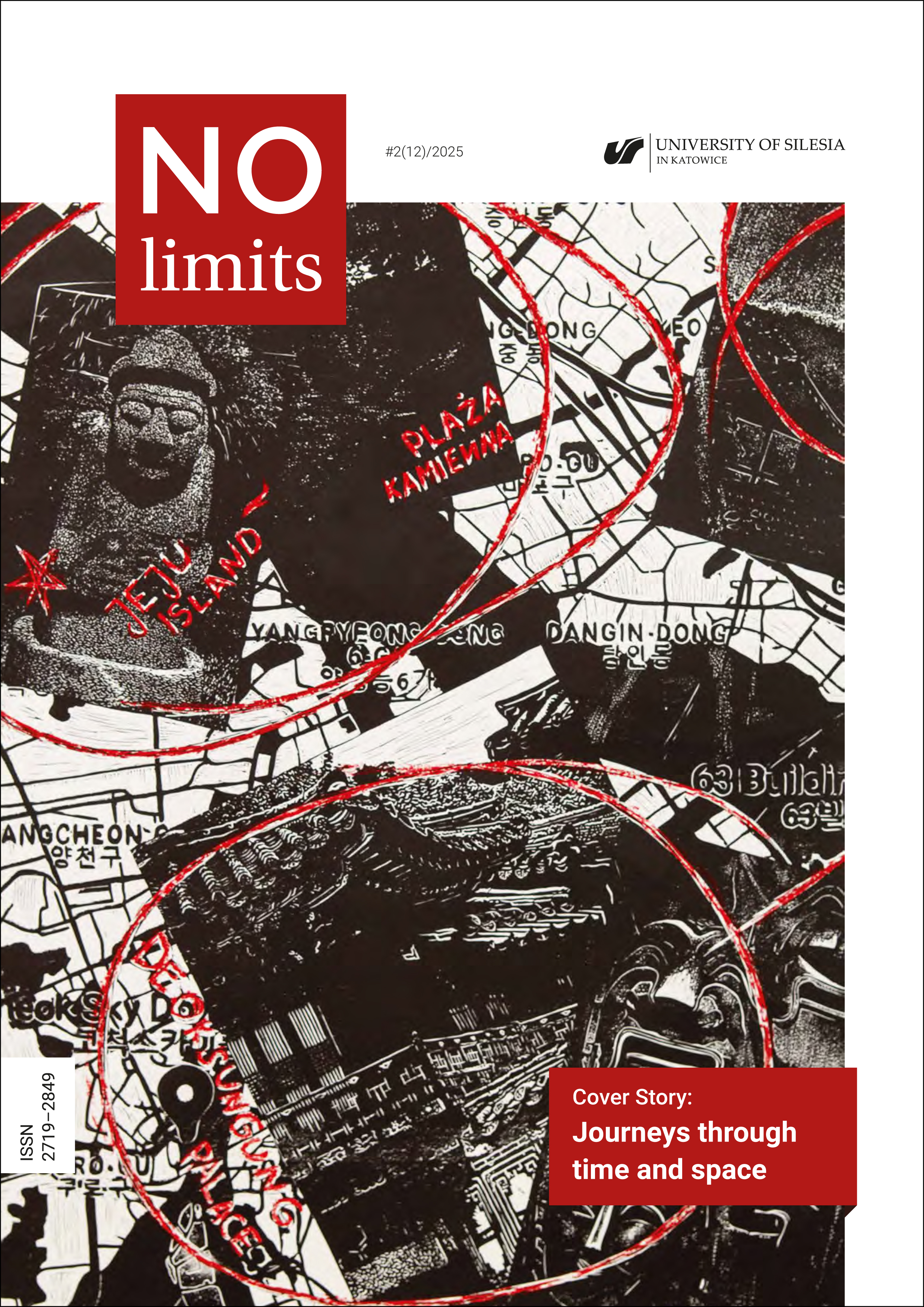
Despite the social restrictions of their era, women had been travelling and exploring the Middle East and Asia since the 18th century, combining their passion for knowledge with a desire for independence. Among them were Gertrude Bell, a researcher and diplomat who played an important role in the creation of the state of Iraq; Lady Mary Wortley Montagu, a researcher of the Orient who broke stereotypes about Eastern women; and Annemarie Schwarzenbach, a 20th-century writer and traveller who made travelling a form of personal salvation. The article shows how travel became an act of courage, emancipation, and creative expression for women, and how their accounts became a valuable testimony to the meeting of cultures and a source of inspiration for future generations.
Anna Brosch, PhD, and Anna Watoła, PhD, from the Institute of Pedagogy at the Faculty of Social Sciences of the University of Silesia, have been visiting selected African countries for years as part of various scientific initiatives. They are currently implementing a project entitled ‘Growing up online – how to protect our children in the digital world?’. The experts want to look into the problem of the so-called ‘sharenting’ – parents sharing images of their children on social media – which carries many potential risks. As part of the research, data will be collected from Poland, the Czech Republic, the United Kingdom and Kenya
In the work of Henryk Baranowski (1943–2013) – director, emigrant, educator, philosopher and actor – travel became not only a geographical experience but also a spiritual necessity and an artistic tool. He directed over 60 theatre and opera productions in Europe, Russia, and the US. From the stages of Warsaw to Berlin’s Kreuzberg and New York’s experiments, Baranowski constantly wandered, crossing the boundaries of cultures, aesthetics, and himself. He was not afraid to experiment. His life and theatre represent a multidimensional journey through eras, places, and ideas, as well as a record of transgression, transformation, and the search for meaning. In a world that today is itself in constant motion, his art proves to be surprisingly relevant.
Time has always fascinated people. But what is it really? When did it come into existence and did it even have a beginning? Does it always flow in one direction? Is it possible to travel in time? Humans, including the most prominent physicists, from Albert Einstein to Stephen Hawking and Michio Kaku, have been searching for answers to these questions since time immemorial. The article presents the current state of knowledge about the creation of the universe and its evolution, as well as various theories related to time travel.




 English
 Język Polski