
 https://doi.org/10.31261/SPiP.2009.05.02
The article concerns the transfer of the remains of two princes from the Rurik dynasty, Oleg (d. 977) and Yaropek (d. 980), which was carried out in 1044 by the prince of Kiev, Yaroslav the Wise. Chroniclers' accounts tell us that on this occasion, the bones of both rulers were "baptized," which suggests that both Rurikids died as pagans and were buried initially according to pagan rites. Since we are dealing with an exceptional event in Rus', questions arise about the goals Yaroslav had in mind and the scope of the activities that involved the "baptism" of both princes. There are many indications that Jarosław wanted to enhance the dynasty's prestige and increase the number of its Christian members, the ancestors of the then-reigning prince. A reasonably close analogy to Jarosław's action can be seen in the decision of King Harald Bluetooth of Denmark, who, after building a church in Jelling around 960, ordered the remains of his parents, Gorm the Old and Thyra, who had been buried according to pagan customs, to be moved to the church. It can be assumed that the remains of both were also "baptized" before being placed in the new grave. A similar ritual in Northern Europe is indicated by the discovery of pagan graves in medieval churches. The related phenomenon of reburial of pagan dead must have been quite popular in medieval Scandinavia, as shown by archaeological findings on the one hand, and written records, sagas, and the oldest legal codes on the other. There are also indications that in both Scandinavia and Russia, Christian and pagan burial customs were mixed for a long time after the conversion. This applies to the custom of carrying the deceased through a hole in the wall, for example. This ritual came to Rus from Scandinavia, and, interestingly, it is only associated with the ruling dynasty. It should also be taken into account that the Scandinavians, in various circumstances and multiple places, accepted the so-called prima signatio and thus became catechumens. Although not baptized, they could participate in church ceremonies and co-create a group of believers. The catechumenate was probably very practical in Scandinavia, abandoning old beliefs in favor of the new faith. It allowed one to enjoy the benefits of belonging to the group of Christ's followers, but it did not mean a definitive break with the pagan sphere. This awareness was also characteristic of rulers, for whom the ability to balance between old and new beliefs was essential. We have examples of such behavior in Russia as well. There are many indications that Oleg and Yaropole received prima signatio and were not baptized before their death. However, their status allowed Jarosław to do so when their remains were being transferred. Perhaps Jaropełk needed the status of catechumen when he became an ally of Otto II and, as some believe, married his relative. Just like his brother, Oleg may have received a prima signatio as a child, thanks to his grandmother, Olga. However, this allowed the brothers to inherit power from their pagan father, Świętopełk, in a still pagan country. Jarosław the Wise performed the "baptism" of his uncles' remains by a custom known and practiced in Scandinavia, which allowed the ruler to expand the Christian scope of his dynasty.
Download files
Citation rules
Cited by / Share




Licence

This work is licensed under a Creative Commons Attribution-ShareAlike 4.0 International License.
The Copyright Owners of the submitted texts grant the Reader the right to use the pdf documents under the provisions of the Creative Commons 4.0 International License: Attribution-Share-Alike (CC BY-SA). The user can copy and redistribute the material in any medium or format and remix, transform, and build upon the material for any purpose.
1. License
The University of Silesia Press provides immediate open access to journal’s content under the Creative Commons BY-SA 4.0 license (http://creativecommons.org/licenses/by-sa/4.0/). Authors who publish with this journal retain all copyrights and agree to the terms of the above-mentioned CC BY-SA 4.0 license.
2. Author’s Warranties
The author warrants that the article is original, written by stated author/s, has not been published before, contains no unlawful statements, does not infringe the rights of others, is subject to copyright that is vested exclusively in the author and free of any third party rights, and that any necessary written permissions to quote from other sources have been obtained by the author/s.
If the article contains illustrative material (drawings, photos, graphs, maps), the author declares that the said works are of his authorship, they do not infringe the rights of the third party (including personal rights, i.a. the authorization to reproduce physical likeness) and the author holds exclusive proprietary copyrights. The author publishes the above works as part of the article under the licence "Creative Commons Attribution-ShareAlike 4.0 International".
ATTENTION! When the legal situation of the illustrative material has not been determined and the necessary consent has not been granted by the proprietary copyrights holders, the submitted material will not be accepted for editorial process. At the same time the author takes full responsibility for providing false data (this also regards covering the costs incurred by the University of Silesia Press and financial claims of the third party).
3. User Rights
Under the CC BY-SA 4.0 license, the users are free to share (copy, distribute and transmit the contribution) and adapt (remix, transform, and build upon the material) the article for any purpose, provided they attribute the contribution in the manner specified by the author or licensor.
4. Co-Authorship
If the article was prepared jointly with other authors, the signatory of this form warrants that he/she has been authorized by all co-authors to sign this agreement on their behalf, and agrees to inform his/her co-authors of the terms of this agreement.
I hereby declare that in the event of withdrawal of the text from the publishing process or submitting it to another publisher without agreement from the editorial office, I agree to cover all costs incurred by the University of Silesia in connection with my application.
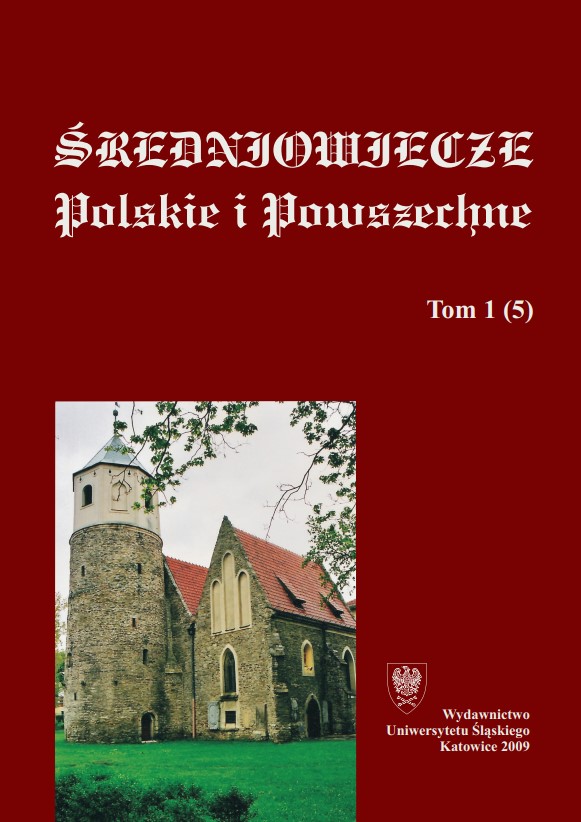
Vol. 1 (2009)
Published: 2009-12-31
This work is licensed under a Creative Commons Attribution-ShareAlike 4.0 International License.

 English
 Język Polski