
 https://doi.org/10.31261/SPiP.2015.11.06
The development of research in the history of social communication showed a new perception of medieval correspondence as a written medium of interpersonal communication. Due to this fact, there has been a growing interest in personal letters, which previously remained overshadowed by official sources. The only paper in Poland dedicated fully to personal correspondence is still the article from 1988 by Jacek Wiesiołowski. However, numerous studies of literacy in the Middle Ages and the appearance of new source editions make it possible to formulate more theses on the social and topical scope of correspondence in Poland at that time. The conclusions were based mainly on the analysis of personal letters from four groups of sources: Private correspondence of Nicolai Serafin, a Krakow manager of salt mine, between 1437—1459, Polish documents from the archive of the Former Kingdom of Hungary (Vol. 1—5), Modus epistolandi by Jan Ursyn from Krakow and the so‑ called Krakow rhetoric. The social scope of the correspondence broadened along with the reception of pragmatic literacy (the end of the 14th century — representatives of the magnate class and municipal patricians, the 15th century — also middle levels of bourgeoisie and nobility). The most intense quantitative increase in correspondence occurred in the second half of the 15th century. The subject matter reflects a variety of topics important for people at that time (two realms: personal and business affairs). One can also observe a certain development trend: correspondence, which was originally official and related to the clergy and power elite, gradually expanded towards a more personal direction. First it was used as an instrument for business, professional and official contact and then it was noted that it can also be used for personal communication: for family, friendly and love affairs.
Download files
Citation rules
Cited by / Share



Licence

This work is licensed under a Creative Commons Attribution-ShareAlike 4.0 International License.
The Copyright Owners of the submitted texts grant the Reader the right to use the pdf documents under the provisions of the Creative Commons 4.0 International License: Attribution-Share-Alike (CC BY-SA). The user can copy and redistribute the material in any medium or format and remix, transform, and build upon the material for any purpose.
1. License
The University of Silesia Press provides immediate open access to journal’s content under the Creative Commons BY-SA 4.0 license (http://creativecommons.org/licenses/by-sa/4.0/). Authors who publish with this journal retain all copyrights and agree to the terms of the above-mentioned CC BY-SA 4.0 license.
2. Author’s Warranties
The author warrants that the article is original, written by stated author/s, has not been published before, contains no unlawful statements, does not infringe the rights of others, is subject to copyright that is vested exclusively in the author and free of any third party rights, and that any necessary written permissions to quote from other sources have been obtained by the author/s.
If the article contains illustrative material (drawings, photos, graphs, maps), the author declares that the said works are of his authorship, they do not infringe the rights of the third party (including personal rights, i.a. the authorization to reproduce physical likeness) and the author holds exclusive proprietary copyrights. The author publishes the above works as part of the article under the licence "Creative Commons Attribution-ShareAlike 4.0 International".
ATTENTION! When the legal situation of the illustrative material has not been determined and the necessary consent has not been granted by the proprietary copyrights holders, the submitted material will not be accepted for editorial process. At the same time the author takes full responsibility for providing false data (this also regards covering the costs incurred by the University of Silesia Press and financial claims of the third party).
3. User Rights
Under the CC BY-SA 4.0 license, the users are free to share (copy, distribute and transmit the contribution) and adapt (remix, transform, and build upon the material) the article for any purpose, provided they attribute the contribution in the manner specified by the author or licensor.
4. Co-Authorship
If the article was prepared jointly with other authors, the signatory of this form warrants that he/she has been authorized by all co-authors to sign this agreement on their behalf, and agrees to inform his/her co-authors of the terms of this agreement.
I hereby declare that in the event of withdrawal of the text from the publishing process or submitting it to another publisher without agreement from the editorial office, I agree to cover all costs incurred by the University of Silesia in connection with my application.
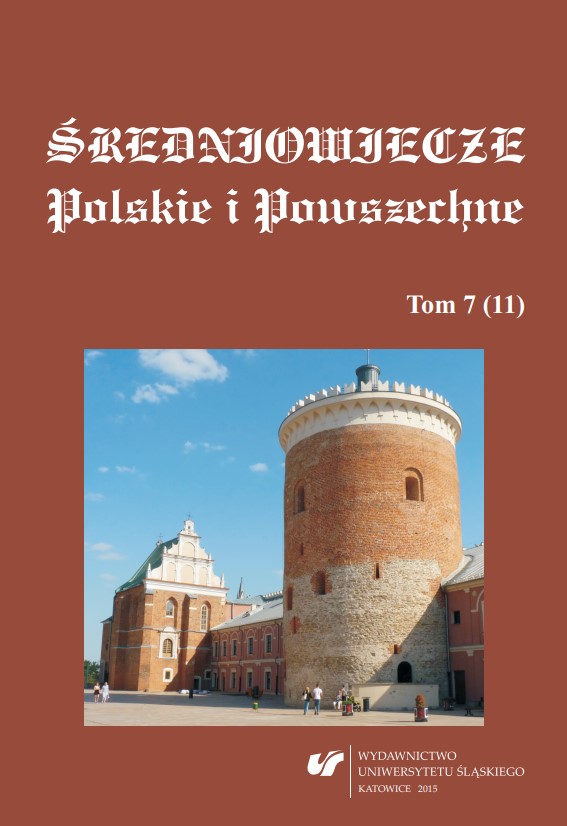
Vol. 7 (2015)
Published: 2015-12-31
This work is licensed under a Creative Commons Attribution-ShareAlike 4.0 International License.

 English
 Język Polski