

 https://doi.org/10.31261/SPiP.2016.12.01
Miracula sanctorum Waldeberti et Eustasii was most likely written by Adso of Montier-en‑Der in the middle of the 10th century, in order to create and propagate the worship of St. Waldebert as the patron of the Luxeuil Abbey. The following article — on the basis of a textual analysis of Miracula… — aims at investigating the genesis of the worship of the relics of St. Waldebert as well as its role and significance for Luxeuil. The monastery, similarly to other abbeys in the Carolingian domain, fell into disrepair as a result of the Norman conquests and the weakening of the royal authority in the face of the rise of local nobility. Moreover, it was at that time that knighthood became recognized as an estate of the realm, while their landed estates continued to be expanded at the expense of the clergy. This, in turn, forced the monks to single‑handedly attempt to reclaim the prestige of the monastery; thus, they created the worship of St. Waldebert, the third abbot of the abbey, who lived in the 7th century. The text written by Adso was to introduce the genesis of the worship, describing his pious life and services to the abbey, as well as encourage people to undertake pilgrimages to his sanctuary. Adso, in his descriptions of the punishments that await those who would persecute the servants of St. Waldebert as well as the miraculous recoveries that await those who worship him, attempted to create a moral example for the worshippers to follow. The worship, which remained of paramount importance to the monks, was also directed at the emerging knighthood. Adso created the image of St. Waldebert as a patron of knights, emphasizing the fact that before his monastic conversion, he had represented the ideal of the Christian knight, miles Christi, and that after his death, he extended his protection to knights and listened to their prayers. Thus, St. Waldebert was to become the patron saint of knights as well as a moral example, in order to force them to accept the superiority of the clergy and treat the estates belonging to the Catholic Church with due reverence. The worship of the relics of St. Waldebert constitutes an example of the early attempts at monastic reform and improving the position and status of the clergy.
Download files
Citation rules
Cited by / Share




Licence

This work is licensed under a Creative Commons Attribution-ShareAlike 4.0 International License.
The Copyright Owners of the submitted texts grant the Reader the right to use the pdf documents under the provisions of the Creative Commons 4.0 International License: Attribution-Share-Alike (CC BY-SA). The user can copy and redistribute the material in any medium or format and remix, transform, and build upon the material for any purpose.
1. License
The University of Silesia Press provides immediate open access to journal’s content under the Creative Commons BY-SA 4.0 license (http://creativecommons.org/licenses/by-sa/4.0/). Authors who publish with this journal retain all copyrights and agree to the terms of the above-mentioned CC BY-SA 4.0 license.
2. Author’s Warranties
The author warrants that the article is original, written by stated author/s, has not been published before, contains no unlawful statements, does not infringe the rights of others, is subject to copyright that is vested exclusively in the author and free of any third party rights, and that any necessary written permissions to quote from other sources have been obtained by the author/s.
If the article contains illustrative material (drawings, photos, graphs, maps), the author declares that the said works are of his authorship, they do not infringe the rights of the third party (including personal rights, i.a. the authorization to reproduce physical likeness) and the author holds exclusive proprietary copyrights. The author publishes the above works as part of the article under the licence "Creative Commons Attribution-ShareAlike 4.0 International".
ATTENTION! When the legal situation of the illustrative material has not been determined and the necessary consent has not been granted by the proprietary copyrights holders, the submitted material will not be accepted for editorial process. At the same time the author takes full responsibility for providing false data (this also regards covering the costs incurred by the University of Silesia Press and financial claims of the third party).
3. User Rights
Under the CC BY-SA 4.0 license, the users are free to share (copy, distribute and transmit the contribution) and adapt (remix, transform, and build upon the material) the article for any purpose, provided they attribute the contribution in the manner specified by the author or licensor.
4. Co-Authorship
If the article was prepared jointly with other authors, the signatory of this form warrants that he/she has been authorized by all co-authors to sign this agreement on their behalf, and agrees to inform his/her co-authors of the terms of this agreement.
I hereby declare that in the event of withdrawal of the text from the publishing process or submitting it to another publisher without agreement from the editorial office, I agree to cover all costs incurred by the University of Silesia in connection with my application.
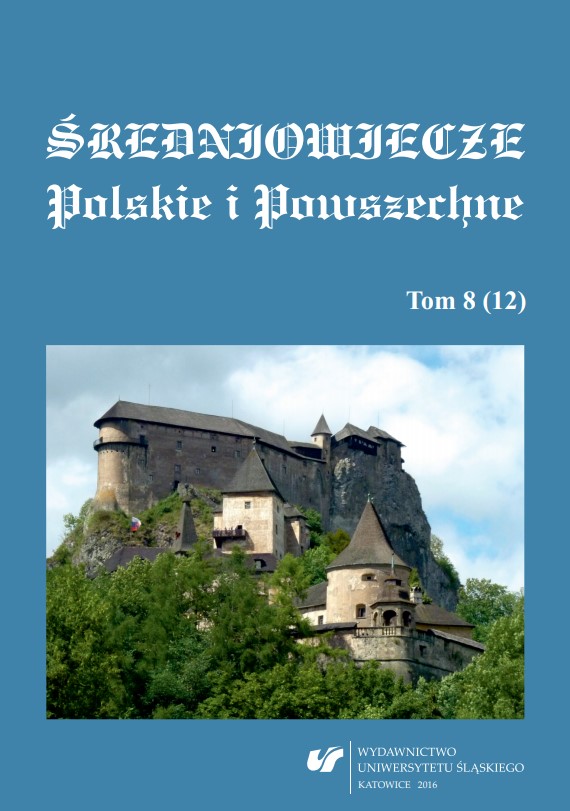
Vol. 8 (2016)
Published: 2016-12-31
This work is licensed under a Creative Commons Attribution-ShareAlike 4.0 International License.

 English
 Język Polski