
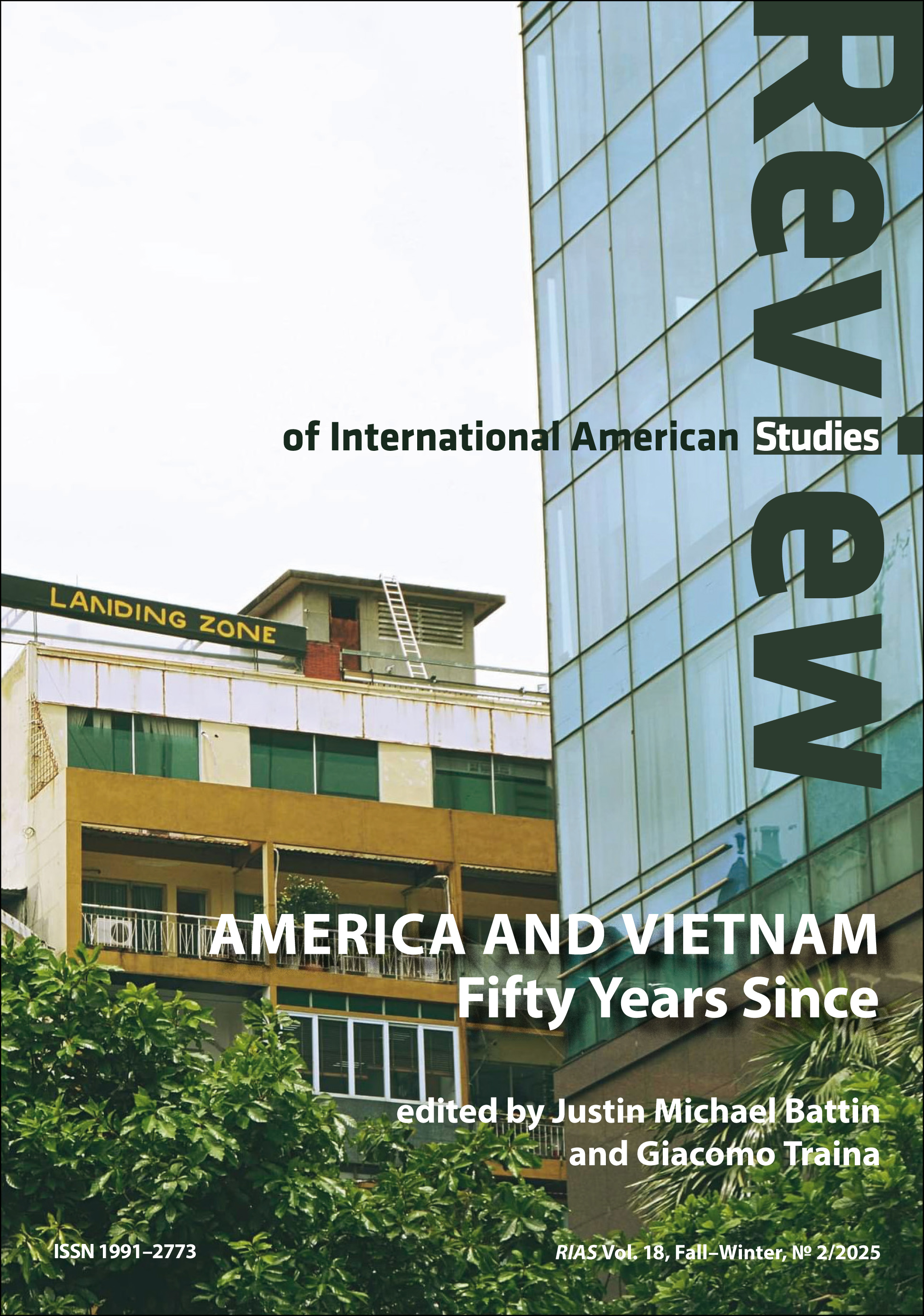
[...] April 30, 1975 not only marked an end of US military involvement in Vietnam but also the end of a decade-long strife for political hegemony between rival Vietnamese state and non-state actors (Goscha 2016). According to Appy (2016), it set in motion a com-plex and contested postwar condition whose reverberations continue across hemispheres. For Vietnam, the fall of Saigon, officially framed as the Liberation of the South, signifies the culmination of a protracted and devastating struggle for reunification, behind which lay power struggles long kept from public knowledge (L.H. Nguyen 2012), whose scars are still visible both in-country and abroad. As argued by Schwenkel (2009) and others, this national victory narrative has always been haunted by counter-memories: of exile, fractured families, and political rupture.Fifty years in, these contested memories surface in multiple forms. Hồ Chí Minh City residents and visitors will not forget soon the impressive military parade held in the early morning of April 30, 2025 to commemorate the communist victory. The city center woke up to lines of marching soldiers, colorful floats, fireworks, and roar-ing warplanes greeted by busloads of screaming boys and girls. This stands in stark contrast with the mournful “Black April” tributes held in overseas diasporic enclaves such as Westminster, CA’s Little Saigon where the three-striped, yellow flag of the Republic of Vietnam (South Vietnam) is still raised and flies at half-staff, remembering a state that vanished from the map decades ago. In Vietnam “Liberation Day” is a public holiday; for the two million who fled after the Republic’s collapse, the date marks instead the beginning of statelessness and dis-location—while at the same time inaugurating a newfound assertion of cultural identity (Aguilar-San Juan 2009; Bui 2017; P.T. Nguyen 2017; Kelly 2019). Across large segments of the Vietnamese diaspora, the memory of the Fall of Saigon lives on in commemorative rituals, political debates, oral histories, and cultural productions—variously presented as a story of abandonment and betrayal (Espiritu 2014), of gratitude (whether genuine or performed) toward host countries, or of survival and rebirth. If the war ended on that day, with the whir of the rotor blades of American Hueys giving way to the rumble of Soviet-made T54s rolling down Saigon’s boulevards, it continued on the battlefields of memory, as the work of authors like novelist/scholar Viet Thanh Nguyen (2015; 2016) have eloquently shown. (Read more in Justin Battin and Giacomo Traina's "Introduction")
Vol. 19 No. 1 (2026)
Published: 2026-06-30
 10.31261/RIAS


 English