
 https://doi.org/10.31261/SPiP.2009.05.11
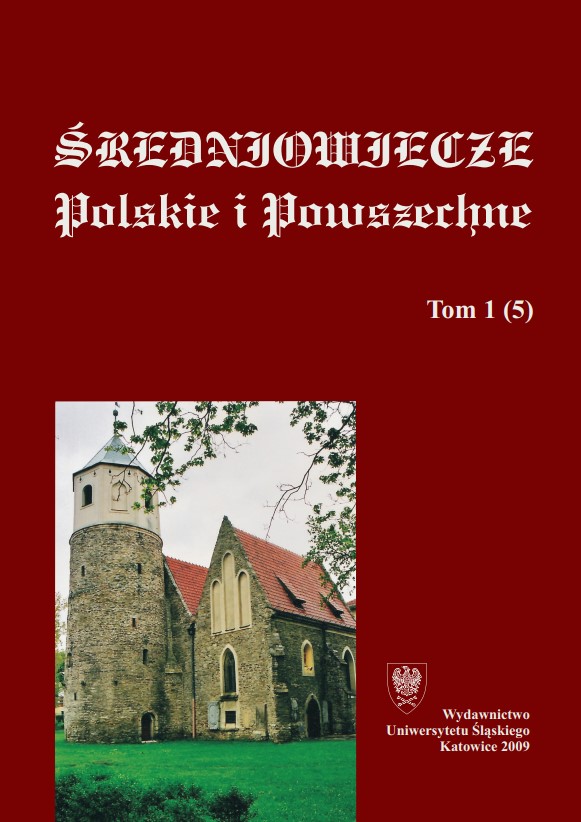
The buildings referred to as “a castle” or “an abbot” are situated in the north-west part of the monastery hill in Tyniec. Their shape resembles the figure of seven which sticks to the north tower of church with its corner. Both arms of the building in its basement involve arched gates through which the road to the monastery goes under the angle of almost 90 degrees. The current structure of the building dates back to the half of the 15th century. The first source information on the monastery incastellation comes form the half of the 13th century and can be connected to battles for the throne in Krakow at that time and ruling of outstanding abbots Lutfryd and Kosmas, as well as connections to the Gryfit family. However, against the accepted opinions, one should claim that the castle in Tyniec has never been possessed by a monarch and consisted of the same staff, apart from special situations and, especially in the earlier period of time (13th century). It was a part of the monastery and abbot residence from the very beginning. Apart from the residence function, it also played the role of the centre of the board of monastery domain which, aside from a steward, was guarded by a separate clerk known as a starost (at least to the end of the 15th century). Also, he represented the abbot during the session of the court of the higher German law. It is likely that the very court had its headquarters (starting from the second half of the 14th century) in the territory of the castle whereas its sessions took place in a big room mentioned in the sources. Here, also the most outstanding guests coming to the abbot (queen Jadwiga, 1394; Długosz with princes, 1467/1468) were received. A reconstruction of the castle into a Renaissance style was directed by an abbot Hieronim Krzyżanowski certainly at the turn of the 1560s and 1570s. Then the development in a south-western direction (along the western part of the monastery courtyard over the precipice leaning towards the Vistula) was conducted and the room of a starost and the room of court sessions were moved to the new wing. A military nature of the castle, likewise the under-monastery transport on the Vistula and the road, had, above all, a local influence. The defense of confederates from Bar as late as at the end of the 18th century increased an awareness of its strategic and military importance.
Download files
Citation rules
Cited by / Share




Licence

This work is licensed under a Creative Commons Attribution-ShareAlike 4.0 International License.
The Copyright Owners of the submitted texts grant the Reader the right to use the pdf documents under the provisions of the Creative Commons 4.0 International License: Attribution-Share-Alike (CC BY-SA). The user can copy and redistribute the material in any medium or format and remix, transform, and build upon the material for any purpose.
1. License
The University of Silesia Press provides immediate open access to journal’s content under the Creative Commons BY-SA 4.0 license (http://creativecommons.org/licenses/by-sa/4.0/). Authors who publish with this journal retain all copyrights and agree to the terms of the above-mentioned CC BY-SA 4.0 license.
2. Author’s Warranties
The author warrants that the article is original, written by stated author/s, has not been published before, contains no unlawful statements, does not infringe the rights of others, is subject to copyright that is vested exclusively in the author and free of any third party rights, and that any necessary written permissions to quote from other sources have been obtained by the author/s.
If the article contains illustrative material (drawings, photos, graphs, maps), the author declares that the said works are of his authorship, they do not infringe the rights of the third party (including personal rights, i.a. the authorization to reproduce physical likeness) and the author holds exclusive proprietary copyrights. The author publishes the above works as part of the article under the licence "Creative Commons Attribution-ShareAlike 4.0 International".
ATTENTION! When the legal situation of the illustrative material has not been determined and the necessary consent has not been granted by the proprietary copyrights holders, the submitted material will not be accepted for editorial process. At the same time the author takes full responsibility for providing false data (this also regards covering the costs incurred by the University of Silesia Press and financial claims of the third party).
3. User Rights
Under the CC BY-SA 4.0 license, the users are free to share (copy, distribute and transmit the contribution) and adapt (remix, transform, and build upon the material) the article for any purpose, provided they attribute the contribution in the manner specified by the author or licensor.
4. Co-Authorship
If the article was prepared jointly with other authors, the signatory of this form warrants that he/she has been authorized by all co-authors to sign this agreement on their behalf, and agrees to inform his/her co-authors of the terms of this agreement.
I hereby declare that in the event of withdrawal of the text from the publishing process or submitting it to another publisher without agreement from the editorial office, I agree to cover all costs incurred by the University of Silesia in connection with my application.
Vol. 1 (2009)
Published: 2009-12-31
This work is licensed under a Creative Commons Attribution-ShareAlike 4.0 International License.

 English
 Język Polski