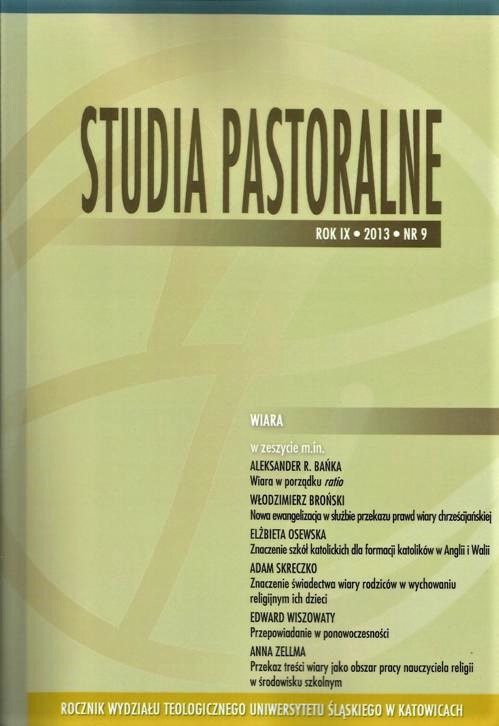
When in 1977, in a book entitled At the root of modern atheism, French philosopher Marcel Neusch formulated the thesis about the coming of postatheistc age, he probably did not think, that at the beginning of the twenty-first century, atheistic thought reborn in the form of a so-called „new atheism”. Its main representatives: Richard Dawkins, Christopher Hitchens, Daniel C. Dennett and Sam Harris, taking the position of scientific scientism, attack with a renewed vigor not only all forms of religion, but also skepticism, relativism and epistemological agnosticism. Their main efforts focus on trying to argue that all faith is an act completely irrational, and the non-existence of God can be confirmed by scientific methods. This article is a polemic with the main theses of the new atheists. It shows the actual place of faith in the order of ratio and discusses the problem of possibility of proving the existence or the non-existence of God.
The faith of parents is an important factor to be taken into account while weighing the problem of educating children. The parent’s part in religious upbringing of their children is constant meeting the challenges which are the consequence of the sacrament of baptism and the tasks it imposes. The problem is vital, because in the process of religious upbringing the parents should be witnesses, not only instructors. The child’s faith is built on the faith of his parents, who, in their lives, should be authentic witnesses of their faith. They should create appropriate situations that may stimulate their children’s willingness to meet God. Simultaneously, they should observe their children’s spiritual development, without using any forms of pressure. The parent’s faith is an example for a young growing person how to get to know God. Christian parents should not only talk about Christ, but also let their children know Him through their own testimony of life and love.
The transmission of the essence of faith takes an important place in teaching religion. It is directly connected with the task of developing the knowledge of faith on every level of children’s and teenagers’ education. People involved in teaching and catechetical education, also religion teachers, are responsible for accomplishing this task. Today, after twenty two years of teaching religion at school, the transmission of the essence of faith is being critically discussed in school environment. The objections concern difficulties and limitations relating to the transmission of the essence of faith in school environment. Catechists and religion teachers unanimously claim that the transmission of the essence of faith is not possible without the grace of God in sacraments. They seldom pay attention to the teacher’s role in the process of transmitting the essence of faith. The author of this article makes an attempt to show the tasks that a religion teacher should fulfill as far as transmitting the essence of faith in school environment is concerned. Not only strategies of development and experiencing faith but also limitations and difficulties relating to it were mentioned. At first, the term „transmission of faith” was explained. Next, a short characterization of teaching religion at school was made. The basic tasks of religion teachers in transmitting the essence of faith were depicted in this context. Apart from catechetical activities directed at pupils, the attention was also paid to teaching staff, school staff and parents. This is because a religion teacher is qualified to have influence on all members of catechetical interaction in school environment. Finally, the most important, crucial to religion teaching and parish catechesis, open issues were described. They require further theoretical research and empirical verification. Searching the new model of catechetical priesthood is also essential.
Każde pokolenie potrzebuje wychowania w wierze, ale w obecnej epoce wymaga tego wychowania jakby od nowa. Wiara rozwija się dynamicznie i systematycznie wówczas, kiedy jest przekazywana jako doświadczenie. W wychowaniu wiary, winno być więc dowartościowane doświadczenie jako stałe zaangażowanie egzystencjalne, całoosobowe przyjęcie prawdy, skierowanie woli ku poznanym wartościom, jakie wynikają z zażyłości człowieka i Boga w Chrystusie. Dlatego katecheza przekazując prawdy wiary, uwzględniając wszystkie czynniki ludzkie oraz dynamizm rozwoju i dojrzewania wiary łączy doświadczenie ludzkie z orędziem zbawczym.
Data publikacji:
28-12-2013
|
Abstrakt
| s. 75-100
The articles published in the Catechetical and Educational Monthly Magazine present the pastoral activity in Polish schools in the interwar period of the 20th century. Proclaiming of faith to students took place during religious education classes within school pastoral care, in parishes and in church organizations. In the twenties, differences in the way of teaching as well as in its level were clear what resulted from historical conditions. Discussions on the curricula of religious education placed in the magazine prove priests’ commitment to the pastoral care of youth. The insight on the Bible was one of the elements, but it is the Catechism that formed the basis of faith contents passed. During religious education classes, the attention was paid not only to religious knowledge, but also to the formation of faith attitudes among children and young people.
Data publikacji:
23-02-2026
|
Abstrakt
| s. 101-118
This article talks about an educational and pastoral tasks in Catholic schools on the example of the Salesian education. These tasks are assigned to specific individuals who run schools and form their Catholic character. The school is in fact for all – teachers and students – a community of generations, a great educational family in which every young person meets with respect, regardless of their ability and intellectual capacity. Therefore we analyze the current social situation of young people and education, in order to show that the tasks arising from the ministerial, Church documents and the needs of the environment require continuous evaluation and adaptation to current conditions of national, youth, family and school development.
Data publikacji:
23-02-2026
|
Abstrakt
| s. 119-126
In order to present the meaning of Catholic schools in the formation of Catholics in England and Wales, the author explores the social, religious and educational context of the past decades in England and Wales. Due to a high level of migration to the UK, with many ethnic groups coming from Asia, Africa and Latin America, the British society has been affected and transformed profoundly by the variety of cultures, religions, traditions and habits, proper to the migrating communities. This historical migration started a complex process of a global transformation of the society, which made it impossible for institutional religions to maintain their position and role as in the past. The Catholic population in England and Wales nowadays is composed of people of ethnic English descent, people of Irish origins, converts or the descendants of converts from Anglicanism or other Protestant denominations, and lately, Catholics from Catholic countries – mainly Poland. The present composition of the Catholic Church is thus highly diversified, and culturally heterogeneous. Nevertheless, Catholic schools in England and Wales have played an important role in searching for an interpretation of the emerging authentic forms of Christian faith and forming Catholics who are ready to see God’s presence within their experience and continually renew their daily lives in the light of the Gospel.
Data publikacji:
23-02-2026
|
Abstrakt
| s. 127-136
The new evangelization is dialogical and mystagogical. It is a fundamental task of every ecclesial community. In our time it is done in a pluralistic society primarily through the preaching of the word of God from person to person and the witness of a Christian life. Its objectives are faith, conversion of every man, bringing man to salvation. Bearing in mind the situation of the Christian faith in the modern world, one ought to seek new forms of preaching the word of God, especially using the electronic media.
Data publikacji:
23-02-2026
|
Abstrakt
| s. 137-161
In the post-synodal apostolic exhortation on the formation of priests in the circumstances of the present day Pastores dabo vobis, John Paul II described the new evangelisation as the most important and urgent task of the Church at the end of the second millennium. Therefore it calls for „a new zeal, new methods of preaching and giving testimony to the Gospel”, and most of all a new involvement of priests. A priest who combined all these factors was Eugene de Mazenod, the founder of the Missionary Oblates of Mary Immaculate. The testimony of his life and activity, in spite of the time that had passed, may be very inspiring even today. First of all it is because the 19th century France is not that different from the contemporary Western civilisation, especially when we realise, that the ideology of the French Revolution is the source of many contemporary cultural trends. Second of all, it is because in his activity one can find all the conditions of the effective evangelisation: a personal experience of salvation, ability to assess reality from the Gospel point of view, an apostolic zeal as the manifestation and testimony to love and propagating the spirituality of communion. John Paul II himself was convinced about exceptional values of this saint and found in him the example and the advocate of evangelisation of our times.
Data publikacji:
23-02-2026
|
Abstrakt
| s. 162-177
Church – faithful to the mission commissioned by Christ – take successively the topics that appear throughout the history of mankind, which are the result of scientific development and progress of civilization, and increasing the possibility of interfering with the processes of life – from procreation, and the dying ending. Undoubtedly, the field of interference in human procreation is the one that because of the tremendous progress achieved and the personal good, especially endangered in its activities – requires special vigilance of the Church. Therefore, in this publication is presented clear moral teaching of the Church concerning the abuses in the field of procreation. For the fundamental fraud, which became the subject of moral reflection should include: contraception, morning after pill, sterilization and abortion, in vitro fertilization and cloning. It should be noted that all these issues related to human reproduction right contradict the Christian tradition for centuries, and above all the Church’s thought for contemporary view of marriage, family, sexuality and fertility. Break for inner unity, mutuality and the need for relationships between spouses, but also the relationships between parents and offspring. For this reason, must be evaluated negatively. These phenomena are in fact the opposite nature – sexuality without procreation on the one and procreation without sexuality on the other.
Data publikacji:
23-02-2026
|
Abstrakt
| s. 178-190
Postmodernity, also known as postmodern or late modern of clarity, it seems the key word in the description of modern culture and civilization. Stricter characterized for the consumer aspiration, the pursuit of materialistic values, hedonism, questioning the truth and the consequent relativism mean that preaching has it become an extremely difficult and demanding. The submitted paper the author raises the question whether this unfavorable context, the voice from the pulpit of the church has any chance of reaching the listener. Returns the first attention to the need for greater inclusion in the preaching of the situation in which the modern student living word of God, then outlines the genesis, the main assumptions of postmodernism and their consequences for the life of faith. In summary, attempts to formulate certain indications-tion concerning both the content and style of preaching in the simplifica-changed context.
Data publikacji:
23-02-2026
|
Abstrakt
| s. 191-201
Mystical syncretism is a form of religious syncretism. The criticism of Christian mysticism from the dominance of liberal Protestantism, and the thesis of the identity of any mystical experiences substantially contributed to the formation of mystical syncretism. The dynamic development of the phenomenon seen in many countries of Western Europe, raises a reasonable dispute with the idea of a mystical syncretism on the part of Catholic theology. The main areas of controversy center on threats such as: the loss of their own religious identity, the danger of creating fertile ground for the spread of so-called „new religion” and the threat of further development of interreligious dialogue.
Data publikacji:
23-02-2026
|
Abstrakt
| s. 202-215
Zygmunt Krasiński (1812–1859) was one of the greatest Polish Romantic poets. The objective of this article is to present his views on suffering in light of his letters written to various addressees. The article describes the problems of the causes and effects of suffering and the sense of suffering, as well as the causes and effects of man’s happiness. Krasiński saw the ultimate cause of suffering in the original sin, which had introduced disintegration in the whole created world, also in man. He viewed suffering in light of the mystery of the passion, death and resurrection of Jesus Christ, seeing it as a means of man’s spiritual development and his eternal salvation. Even though man cannot become fully happy on earth, he should aim at making others happy. The fullness of happiness can only be reached in life after death, when man will become united with God.




 English
 Italiano
 Język Polski
 Deutsch