Nella 1 Cor 4,1 san Paolo definisce i ministri della Chiesa come „servi di Cristo e amministratori dei misteri di Dio”. Sulla base dello studio dell’originalità delle espressoni usate nella 1 Cor 4,1 („servi di Cristo e amministratori dei misteri di Dio”) si può costatare che nel Nuovo Testamento i ministri della Chiesa non si chiamano „sacerdoti” (hiereus), poiché unico e sommo Sacerdote (Archiereus) è Gesù Cristo. I servi di Cristo (douloi tou Christou) invece, cioé coloro che nella Chiesa compiono uffici speciali, si chiamano „vescovi, anziani e diaconi” (episkopoi, presbyteroi, diakonoi). San Paolo accentua in maniera speciale due termini per precisare che i servi di Cristo sono hypēretas Christou kai oikonomous mystēriōn Theou (1 Cor 4,1). L’etimologia del termine hypēretēs ci fa capire che esso ha il senso tutto originale. Significa infatti „il rematore”. Indica quindi uno schiavo, che rema la „nave di Cristo”. Il suo duro lavoro di remare serve per raggiungere lo scopo che corrisponde alla salvezza eterna. Tale servo di Cristo come „amministratore dei misteri di Dio” (oikonomos mystēriōn Theou) è una persona di fiducia, l’economo delle cose più sante di Dio, colui che gestisce la „casa di Dio”, e cioé compie nella Chiesa – attraverso il suo servizio – il mistero della salvezza. Cristo come Padrone di casa affida a tale persona il servizio di amministrazione dei segreti di Dio nella „casa di Dio”, cioé nella Chiesa. Questo ufficio non è solo una distinzione, giacchè il suo soggetto deve essere uno cha sa servire in modo fedele a Cristo. Sicchome nelle parabole evangeliche alcuni dei servi si fanno conoscere purtroppo come amministratori poco fedeli, san Paulo chiede a tutti la fedeltà (cfr. 1 Cor 4,2).
Die entscheidenden Worte, aus denen die Kirche als Gemeinschaft der Glaubenden und aus denen der einzelne Christ lebt, kann sich die Kirche nicht selbst zusagen. Ein anderer muss diese Worte sagen: Jesus Christus, der im Wort des Evangeliums und in den Sakramenten zu uns Menschen spricht. Genau das ist der Sinn des priesterlichen Dienstes. Den Menschen – gleichsam von außen – zuzusagen, was sie sich nicht selbst zusagen können. Etwa die Liebe, die Gott uns in der Hingabe seines Sohnes schenkt. Und die Versöhnung, die er uns anbietet. So leuchten an dieser Stelle vor allem die Sakramente der Eucharistie und der Versöhnung auf. „Nehmt und esst, das ist mein Leib, der für euch hingegeben wird”. „Nehmt und trinkt, das ist mein Blut, das für euch vergossen wird”. „So spreche ich dich los von deinen Sünden”. – Im Namen Jesu Christi gesprochen, sind dies Worte, die sich die Gemeinschaft der Glaubenden nicht selbst zusagen kann. Für diese Zusagen braucht es jemanden, der durch das Sakrament der Weihe eigens und objektiv dazu bevollmächtigt wird: Eben den Priester. Über diese wichtige Aufgabe hinaus kommt dem Priester noch ein weiterer wichtiger Dienst in unserer Kirche zu: Der Dienst an der Einheit. Als geweihter Amtsträger hat der Priester die Aufgabe, dafür Sorge zu tragen, dass die einzelne Gemeinde in die Gemeinschaft der Kirche eingebunden bleibt. Immer wieder gilt es deshalb, über den eigenen Kirchturm hinaus zu blicken und im Glauben, in der Hoffnung und in der Liebe mit der Weltkirche verbunden zu sein und aus ihrem Glauben den eigenen Glauben zu stärken.
Contemporary ecclesiology postulates: „the Church as communion might be more clearly understood and concretely incorporated into life” (The Final Report of the Extraordinary Synod). This idea should pervade all actions of presbyters and influence a new style of priesthood. This is confirmed both by post-council teaching of the Church and the teaching of the Church in Poland. It was particularly developed in a post-synodal exhortation Pastores Dabo Vobis (1992) in which John Paul II emphasised that „the ecclesiology of communion becomes decisive for understanding the identity of the priest, his essential dignity, and his vocation and mission”. Other documents of Magisterium Ecclesiae followed this direction. Three documents of the Congregation for the Clergy deserve special attention: Directory on the Ministry and Life of Priests (1994), a letter The Priest and the Third Christian Millennium, Teacher of the Word, Minister of the Sacraments and Leader of the Community (1999) and an instruction The Priest, Pastor and Leader of the Parish Community (2002). Among Polish documents there are two written by the Second Polish Plenary Synod that deserve special attention: Needs and Tasks of a New Evangelisation at the Break of the Second and the Third Christian Millennium and Priesthood and Consecrated Life as Community of Life and Ministry with Christ. The documents emphasise that a priest should always remember that he „sanctifies himself by his care for a community which had been entrusted to him. This care should be manifested in being with a community and in a community”. Therefore the synod suggests that „in nominating parish priests one should take into account not so much and not only seniority and achievements but practical pastoral skills, especially the ability of team-work and a social sensitivity”.
The relation of the priest to Jesus Christ, and in him to his Church, is found in the very being of the priest by virtue of his sacramental consecration and in his ministry. The priest, who reflects his Lord, Jesus Christ is the servant of Christ present in the Church as mystery, communion and mission. Thus, by his very nature and sacramental mission, the priest appears in the structure of the Church as a sign of the absolute priority and gratuitousness of the grace given to the Church by the risen Christ. Through the ministerial priesthood the Church becomes aware in faith that her being comes not from herself but from the grace of Christ in the Holy Spirit. Each priest, whether diocesan or religious, is united to the other members of this presbyterate on the basis of the sacrament of holy orders and by particular bonds of apostolic charity, ministry and fraternity All priests in fact, whether diocesan or religious, share in the one priesthood of Christ the head and shepherd. Finally, because their role and task within the Church do not replace but promote the baptismal priesthood of the entire People of God, leading it to its full ecclesial realization, priests have a positive and helping relationship to the whole community. They have to recognize and uphold the dignity of the ecclesial community serving the sacraments and helping faithfully the given people.
The article deals with the role of leadership of the ordained priest. This funcion arises from Christ’s Priesthood, which obviously dierects the Church towards the Father. It happens mainly within liturgy, when a priest is a guide both in teaching and in selfoffering to the Father. An important role of a priest as a leader is to evoke in peoples’ hearts a desire for the Holy Spirit (epicletic attitude), who is the ultimate Guide leading to the full Truth. The priestly spirit of leadership is kerigmatic (proclamation of Good news) and mystagogical, because it initiates into the Mystery of salvation through activating peoples’ common priesthood.
La publication présente le problème de la réconciliation avec Dieu des prêtres, appelés au service de la communauté ecclésiale. Les chemins de cette réconciliation ce sont: aveu des fautes, pardon accordé à autrui, prière, aumône, humilité. Par ces chemins les prêtres soignent leurs âmes sacerdotales. La réconciliation avec Dieu et les hommes aide les prêtres dans l’accomplissement de leur tâche de sanctification et les attache plus fermentent au service de l’Église. Sur le chemin de la réconciliation et de la sanctification, les prêtres ont besoin du courage et du soutien. Il leur faut beaucoup de fermeté et de persévérance pour donner un témoigne clair de leur fidélité et leur attachement au Christ et à son Évangile.
Ogni sacerdote, grazie al sacramento dell’ordinazione, diventa icona viva del Cristo. Durante la celebrazione liturgica agisce in persona Christi. Grazie al carattere sacramentale che possiede sin dal giorno dell’ordinazione ha un rapporto particolare con Cristo e lo Spirito Santo, partecipando all’unico sacerdozio del Nuovo Testamento, che è quello di Cristo. Tale fatto ha un significato profondo per la vita e la missione delle persone ordinate. L’aspetto partocolare di tale missione, e cioè l’annuncio della parola di Dio, non può essere letta soltanto sul piano di una attività esteriore, bensì scaturisce dal servizio della Chiesa. La predicazione equivale al segno del sacerdozio nuovotestamentale – vissuto e sperimentato. Anzi, la predicazione manifesta l’identità stessa del sacerdote. E’ il motivo, per cui ogni sacerdote-predicatore deve essere cosciente e responsabile della necessità di coniugare ogni giorno la sua vita e il servizio fatto a nome do Cristo e per il bene di tutta la Chiesa, soprattutto deve collaborare alla diffusione della Parola di salvezza. E’ necessario pertanto che ogni sacerdote-predicatore interiorizzi sempre più l’atteggiamento diaconale nel suo quotidiano. Un valido esempio di diaconalità può attongerlo dalla Bibbia, la quale mette in luce il servizio profetico delle persone scelte da Dio. Esse esprimono un grande desiderio di far avvicinare i popoli a Dio; profeti bruciano dello zelo dell’annuncio della Buona Novella, sono pronti a dare la vita per la Parola predicata. E’ chiaro che ogni forma di trascuramento dell’opera della predicazione della verità salvifica fa sempre pensare a una crisi di identità sacerdotale.
Data publikacji:
05-02-2026
|
Abstrakt
| s. 87-103
In the Year for Priests, it is the person of a priest that arouses the interest of theologians, sociologists and publicists. The following article aims to present the opinions of catechized youth from two randomly selected secondary schools (in Olsztyn and in Wodzisław Śląski). The data collected in diagnostic research have a preliminary diagnostic value since they only describe the tendencies related to the youth’s perception of the priest and attitudes to the tasks and function performed by the priest not only in the Church but also in teenagers’ lives. It was noted that opinions of respondents from Olsztyn and Wodzisław Śląski were fairly similar. Occasionally, different attitudes were observed but only in the case of some specific categories. The students’ answers were in line with the teachings of the Church. An influence of social opinion was also noticed. The views on religious education proved surprising. Negative opinions prevailed; many students stressed that religious education did not reflect the truth about priestly vocation. Apart from that, regardless of the school type and place of residence, the students suggested that more discussions on priesthood be introduced, alongside with organizing meetingswith priests and presenting audiovisual materials depicting priests devoted to God and man. Moreover, they expected testimony of faith on the part of priests and their readiness to serve and help other people.
Data publikacji:
05-02-2026
|
Abstrakt
| s. 104-112
Der Artikel präsentiert Pfr. Prof. Stanisław Grzybek als Biblisten und Homileten. Er schuf seine eigene biblisch- homiletische Schule. Indem er Wissenschaftler blieb, konnte er in die Seelsorge sein Wissen und wissenschaftliche Erfahrung bringen. Professor Grzybek war auch pädagogisch talentiert, deshalb übermittelten viele seiner Absolventen später den anderen ihr erworbenes Bibelwissen. Die besten Werke des Professors erfreuten sich bis heute der Popularität sowohl unter den Biblisten, als auch unter den Seelsorgern.
Data publikacji:
05-02-2026
|
Abstrakt
| s. 113-133
Questo contributo mette in evidenza il frutto dell’esperienza educativa del Movimento dei Focolari nel settore della formazione dei preti e dei seminaristi. Il Movimento dei Focolari fondato nel 1943 in Italia da Chiara Lubich (1920–2008), è presente in oltre 160 paesi. Il suo scopo specifico è l’unità della famiglia umana (cf. Ut omnes unum sint, Gv 17,21). Dalla sua esperienza educativa scaturisce una pedagogia dell’unità. Essa nel processo educativo sottolinea il ruolo fondamentale della comunità e della dimensione relazionale basata sul comandamento di Gesù Amatevi gli uni gli altri come io ho amato voi, nella prospettiva del Che tutti siano uno. La formazione dei sacerdoti e seminaristi del Movimento poggia sulla vita comunitaria (nei focolari per i presbiteri e diaconi focolarini e nei nuclei per i presbiteri e diaconi volontari) auitandosi con i seguenti mezzi: • la spiritualità dell’unità (comunitaria); • gli strumenti della spiritualità comunitaria: il patto, la comunione d’anima e di esperienze, l’ora della verità; il colloquio; • lo stile di vita secondo i sette aspetti, che ordina la vita sacerdotale nelle sue principali dimensioni: la comunione dei beni materiali e il lavoro, l’apostolato, la vita spirituale, la salute, l’armonia dell’ambiente e personale, lo studio, l’aggiornamento e l’uso dei mass media; • i Centri della spiritualità di comunione per i sacerdoti, diaconi e seminaristi che si trovano nelle cittadelle del Movimento portano una novità. La vita quotidiana dei preti e dei seminaristi è immersa non solo nel contesto della comunità tra di loro, ma in quello di tutta la società multiculturale della cittadella: famiglie, giovani, bambini, ma anche i membri di diverse congregazioni. Lo scopo principale e – nello stesso tempo – il mezzo della formazione alla vita comunitaria nel Movimento dei Focolari è la mutua e continua carità, che rende possibile l’unità e porta la presenza di Gesù nella collettività.
Data publikacji:
28-12-2010
|
Abstrakt
| s. 134-142
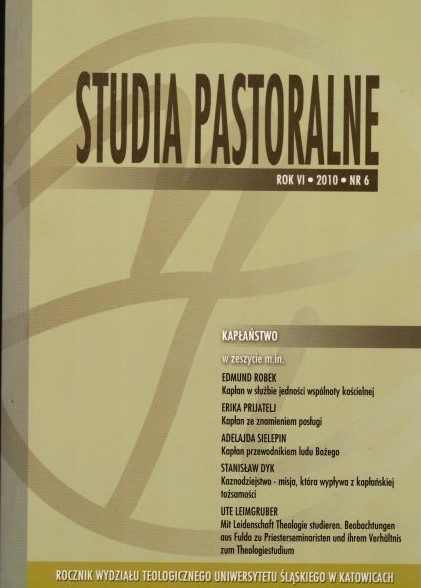
Obierając za punkt wyjściowy sytuację Wydziału Teologicznego w Fuldzie, artykuł zajmuje się wskazaniem na relacje, jakie zachodzą pomiędzy studium teologicznym a kandydatami do kapłaństwa. Oczekiwania studiujących są często inne aniżeli osób uczących. W tym wszystkim chodzić powinno jednak o to, aby studenci dowiedzieli się, że warto z pasją oddać się studium teologii, a to dlatego, iż – obok duchownej zdatności – stanowi to warunek konieczny do tego, by sprostać zadaniom, jakie Sobór Watykański II stawia przed Kościołem i przed podejmującymi się służby kapłańskiej w Kościele. Tekst apeluje do studentów, do wykładających teologię, jak również do odpowiedzialnych za sprawy personalne w diecezjach, aby wysoko cenili oraz wspierali szczególną wartość teologicznego dyskursu w uniwersyteckim kształceniu kandydatów do kapłaństwa
Data publikacji:
05-02-2026
|
Abstrakt
| s. 143-154
The article deals with an important and a subtle dichotomy between the universal priesthood and spiritual motherhood. The first, which is a vocation and Christian heritage by baptism, is to be realized spiritually with the full engagement of one’s mind, love and intention as well as through certain acts which flow from the inspiration of the Holy Spirit. These all create an image of the spiritual motherhood, which is a special mission in the Church, especially for a woman and which finds a number of holy examples throughout history. The ideal of it being Mary, Mother of God, who is to be followed and asked for intercession. Spiritual motherhood plays a magnificent role in relation to priests. The Apostolic See has promulgated official encouragements for it during the Year for Priests.
Data publikacji:
28-12-2010
|
Abstrakt
| s. 155-167
Chrześcijańska koncepcja życia wspólnotowego przesycona jest od zawsze zdrową ambicją fascynowania ludzi swoją receptą na budowanie i umacnianie więzi międzyosobowych. Życie społeczne czasów nam współczesnych charakteryzuje się tym, że odczuwa się w nim zapotrzebowanie na inspirujące propozycje na wspólnotowe przebywanie osób między sobą. Powyższy artykuł zwraca uwagę poszukujących pewnych wskazań czytelników na to, jakie inspiracje o chrześcijańskim rodowodzie możliwe są dziś do naśladowania. Jedna z nich wywodzi się z reguły św. Augustyna i prowadzi po drogach tzw. correctio fraterna, a więc takiej sztuki wspólnego przemierzania po szlakach życia, by realny stawał się fakt coraz doskonalszego otwierania się ludzi na Boga, czynienia Mu odpowiedniego miejsca w ich życiu, a także wzajemnego otwierania się osób na siebie, przez dostrzeganie obecnego w nich Chrystusa, na którym – jak na fundamencie – można budować prawdziwą wspólnotę sióstr i braci zjednoczonych węzłem prawdziwej i dojrzałej miłości, a więc wspólnoty, w której Chrystus jest „wszystkim we wszystkich” (Christus totus). Impulsy dla wspólnego wzrastania w wierze (na sposób zgodny z duchem czasu i odpowiadający misyjnemu powołaniu-posłaniu chrześcijan) płyną również z propozycji P. Jaimego Boneta, nazwanej révision de vie. Zarówno w tej, jak i we wzmiankowanej wyżej propozycji opartej na regule św. Augustyna, jest coś wspólnego, coś mianowicie, co stawia na pierwszym miejscu duchową wartość osoby i eksponuje jej kompetencje jako człowieka, z woli Stwórcy ukształtowanego na wzór i podobieństwo samego Boga, tj. otwartego na braterskie więzi i w przeżywaniu tych więzi kształtującego swą drogę wiary.
Data publikacji:
05-02-2026
|
Abstrakt
| s. 168-182
Relying on the Code of Canon Law which states that „[t]he anointing of the sick can be administered to a member of the faithful who, having reached the use of reason, begins to be in danger due to sickness or old age” (CCL Can. 1004 §1), the author of the present article aims at proving that, from the theological point of view, there are no contraindications against administering this sacrament to seriously ill persons who, with all certainty, haven’t reached the use of reason and whose loved ones ask for it with faith. This problem concerns very small children and the mentally disabled from birth. On the basis of careful biblical, historical and theological analysis, it has become clear that the penitential dimension of Anointing of the Sick is not primary, and as such is not an obstacle to confer this sacrament on those who, having been baptized, have not reached the use of reason and do not bear the personal guilt. The act of faith, which is essential in all sacraments and which is required on the part of the recipients, can be realized through the fact that the sacrament is administered in an environment of faith surrounding ill children or the mentally disabled. The act of conferring this sacrament to them is a sign of their unity with Christ, crucified and risen, and will serve as a spiritual strengthening for their loved ones.
Data publikacji:
05-02-2026
|
Abstrakt
| s. 183-202
Cain selfishly negated differentiation in the world, which was established by God. He lacked an appropriate relationship with himself. He didn’t overcome evil tendencies, didn’t gain control over sin and allowed himself to commit murder. Breaking our relationship with God leads to injustice in relations with others. Even after his sin, God attempts to re-establish dialogue with Cain, who however again turns out to be hardened toward God’s voice. For his sin he is cursed and outcast. God still promises him protection and places a mark upon him. Because He wants the conversion of the sinner more then his death. God gives him a chance for transformation.
Data publikacji:
28-12-2010
|
Abstrakt
| s. 203-216
Nigdzie wierzący człowiek nie znajdzie lepszego źródła ukojenia dla swego życia, niż w modlitwie, a dokładniej mówiąc w pełnej zdumienia modlitwie adoracyjnej. Każdy, kto z podziwem wnika w istotę Boga i adoruje Go, osiąga jasne rozeznanie w tym, co w jego życiu jest najważniejsze, jaki jest jego zasadniczy punkt odniesienia. Podczas adoracji możemy rozpoznać, że z troską otula nas Bóg, że hojnie obdarza nas godnym akceptacji zaufaniem. Stąd adorację musimy pojmować szerzej niż tylko adoracja eucharystyczna. Musimy ją nawet uczynić zasadniczą postawą w naszym życiowym odniesieniu do Boga. Dobrze przeżywana adoracja powinna nas wspomagać w wyzwalaniu się z samych siebie, w wyzbywaniu się zafałszowanego przekonania, że – jako ludzie – jesteśmy w stanie o własnych siłach zdobyć odpowiedź na każde pytanie i osiągnąć życiowe powodzenie. Musimy uczyć się poddania nieograniczonej mocy i woli Boga. Właśnie dlatego zachwyt Jego wielkością i wyżalanie się przed Nim powinny iść w parze, by chwile spędzane na adoracji rzucały światło na nasze codzienne życie, w którym powinniśmy się czuć mocno obecni, krocząc po drogach tego świata. Adoracja bowiem uczy patrzenia na świat przez pryzmat Boga, prowokuje do odpowiedzi na pytanie, przed kim tak naprawdę zginamy w życiu kolana, a przez to stawia tamę wszelakiej ludzkiej zarozumiałości. Akty adorujące Boga strzegą naszą egzystencję przed spłyceniem, obejmują nas całych i przepełniają poczuciem, że już teraz uczestniczymy w dobrach, których pełni doświadczać będziemy w wieczności.
Data publikacji:
28-12-2010
|
Abstrakt
| s. 217-233
Wielu współczesnych chrześcijan angażuje się w życie i duszpasterskie działanie Kościoła, przeznaczając na ten cel sporo swojego „wolnego czasu”. Fakt taki sprawia, że do świadomości Kościoła przenika sygnał o potrzebie podejmowania refleksji nt. wolnego czasu i obejmowania tego obszaru życia chrześcijan specjalną troską duszpasterską. Zaprezentowany wyżej artykuł stara się w sposób krytyczny podejść do takiego zagadnienia, prowokując tym samym do odpowiedzi na pytanie, jak Kościół odczytywał samego siebie i jak rozumiał swoje posłannictwo wtedy, gdy ludzie nie dysponowali w sposób tak oczywisty i jasny jak dziś swym wolnym czasem, jak też nie mieli tak jasnej jak dziś świadomości wolnego czasu. Na kanwie takiego pytania rodzi się również kwestia, czy Kościół – przez utrzymywanie w wigorze owego trendu angażowania się w duszpasterstwo w wolnym czasie – nie przyczynia się do segmentacji życia i czy w ostatecznym rozrachunku nie przysparza sobie dodatkowych problemów, polegających na zaszczepianiu w umysłach wierzących przekonania o tym, że prawdziwe przywiązanie do Kościoła i jego misji ewangelizacyjnej możliwe jest tylko w wolnym czasie. W związku z takim problemem istotną kwestią do rozwiązania pozostaje sprawa wypracowania odpowiednich kryteriów, na bazie których możliwe by było angażowania się Kościołów lokalnych w duszpasterstwo wolnego czasu.




 English
 Italiano
 Język Polski
 Deutsch