


 https://doi.org/10.31261/pr.13529
In the general typology of translation, journalistic texts belong to the group of non-fiction texts, in opposition to literary texts. Non-fiction texts also include specialist, technical and other texts. All these texts have their specific features which also influence their translation into other languages. Depending on the genre and topic, either aesthetic values or specialized vocabulary dominate in journalistic texts. Rendering them into another language requires different approaches and decisions made by translators to recreate the semantic potential. Various types of information are found in a journalistic text, determining translation strategies and the functions of the translated text. Translators make decisions considering the information which must be included in the translated text. Specialist terms which do not pose a problem for a competent translator may complicate the relations of inter-text equivalence, not only in communication, but also in the functioning of the translated text in the new context. With many text modifications, taking into account the recipient’s perspective, as well as the shortening of the text, which always involves omitting some information, certain details and specialist terms may be eliminated or replaced by non-specialist terms, which results in a deviation from the meaning of the original text. An analysis of parallel texts ilustrates this tendency.
Download files
Citation rules
Cited by / Share




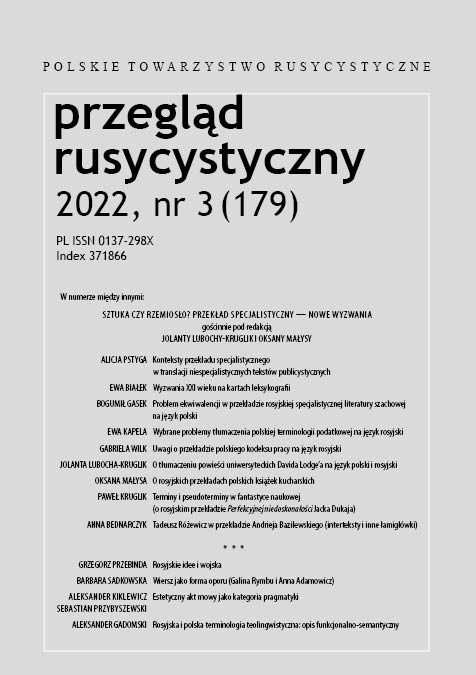
No. 3 (179) (2022)
Published: 2022-09-06
10.31261/pr

 Język Polski
 Русский
 English