
 https://doi.org/10.31261/pr.18198
The paper elaborates on the problem of foregrounding strategies in lyrical discourse. One of them consists in that first some linguistic canon (which may be syntactic, lexical, or pragmatic, and which may be both general, genre-specific or even text-specific) is notoriously violated, but at some later point of the text it still becomes operative; the fragment where such a ‘restitution’ occurs tends to be construed as the foreground. It is argued that this general tendency shows up in the building of information structure of relevant sentences: sometimes the backgrounded parts of the poem contain non-prototypical themes or rhemes, while prototypical ones become articulators of the foreground. Some thought is given to the notion of prototypicality of themes and rhemes; the most salient properties of ‘model’ theme are assumed to be its discourse givenness, explicitness, semantic specificity, high morphosyntactic rank, reference to the first or second person, and the ‘model’ rheme is assumed to display discourse-newness and shortness. Four case studies are offered; those are analyzes of the poems by Georgiy Ivanov. In conclusion, reasons are adduced supporting the claim that the above described ‘rheme redressment’ lies at the core of the whole discourse-building strategy in question, while other relevant devices could be viewed
Download files
Citation rules
Cited by / Share




Licence

This work is licensed under a Creative Commons Attribution-ShareAlike 4.0 International License.
The Copyright Owners of the submitted texts grant the Reader the right to use the pdf documents under the provisions of the Creative Commons 4.0 International License: Attribution-Share-Alike (CC BY-SA). The user can copy and redistribute the material in any medium or format and remix, transform, and build upon the material for any purpose.
1. License
The University of Silesia Press provides immediate open access to journal’s content under the Creative Commons BY-SA 4.0 license (http://creativecommons.org/licenses/by-sa/4.0/). Authors who publish with this journal retain all copyrights and agree to the terms of the above-mentioned CC BY-SA 4.0 license.
2. Author’s Warranties
The author warrants that the article is original, written by stated author/s, has not been published before, contains no unlawful statements, does not infringe the rights of others, is subject to copyright that is vested exclusively in the author and free of any third party rights, and that any necessary written permissions to quote from other sources have been obtained by the author/s.
If the article contains illustrative material (drawings, photos, graphs, maps), the author declares that the said works are of his authorship, they do not infringe the rights of the third party (including personal rights, i.a. the authorization to reproduce physical likeness) and the author holds exclusive proprietary copyrights. The author publishes the above works as part of the article under the licence "Creative Commons Attribution-ShareAlike 4.0 International".
ATTENTION! When the legal situation of the illustrative material has not been determined and the necessary consent has not been granted by the proprietary copyrights holders, the submitted material will not be accepted for editorial process. At the same time the author takes full responsibility for providing false data (this also regards covering the costs incurred by the University of Silesia Press and financial claims of the third party).
3. User Rights
Under the CC BY-SA 4.0 license, the users are free to share (copy, distribute and transmit the contribution) and adapt (remix, transform, and build upon the material) the article for any purpose, provided they attribute the contribution in the manner specified by the author or licensor.
4. Co-Authorship
If the article was prepared jointly with other authors, the signatory of this form warrants that he/she has been authorized by all co-authors to sign this agreement on their behalf, and agrees to inform his/her co-authors of the terms of this agreement.
I hereby declare that in the event of withdrawal of the text from the publishing process or submitting it to another publisher without agreement from the editorial office, I agree to cover all costs incurred by the University of Silesia in connection with my application.
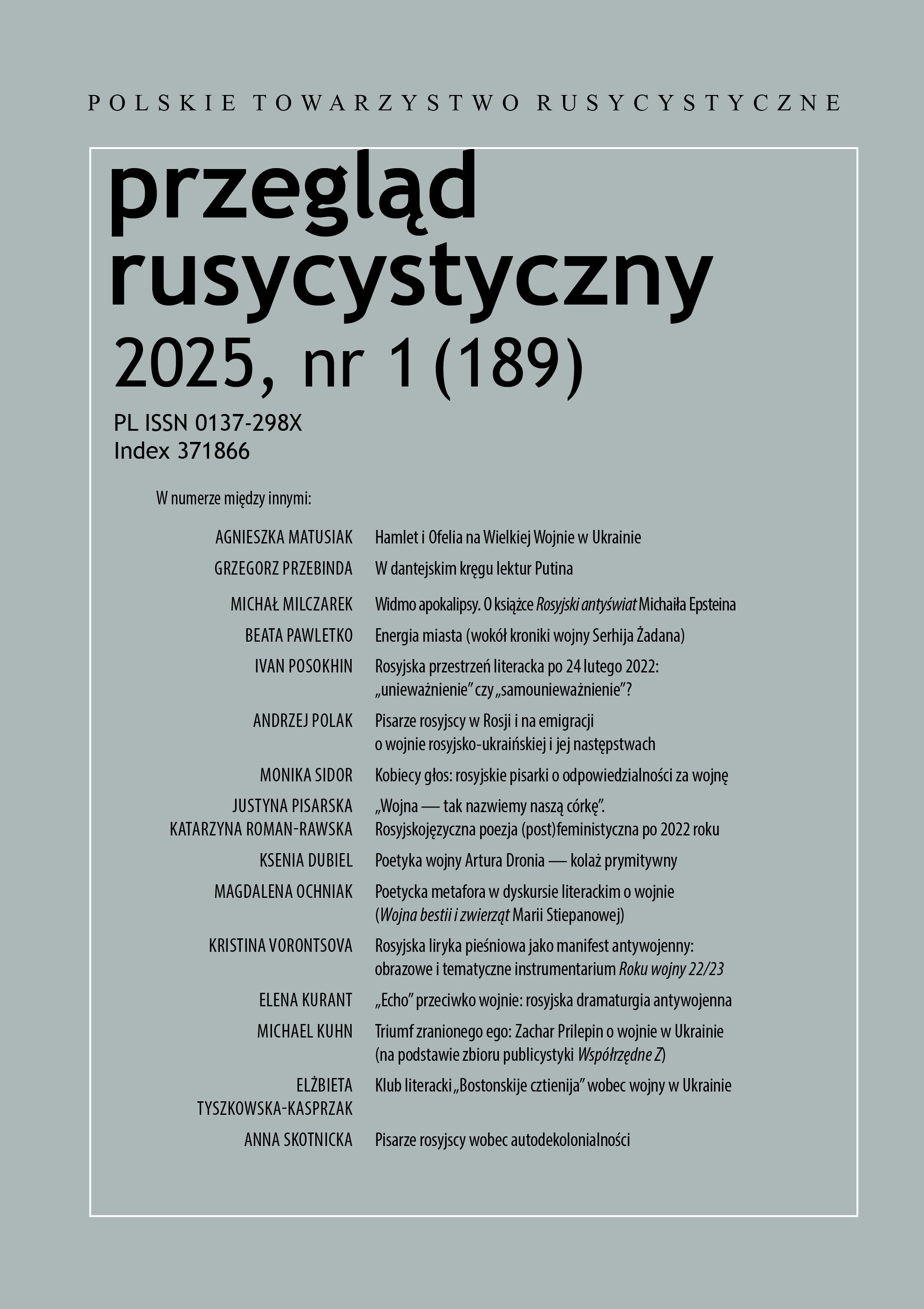
No. 1 (189) (2025)
Published: 2025-03-31
10.31261/pr
This work is licensed under a Creative Commons Attribution-ShareAlike 4.0 International License.

 Język Polski
 Русский
 English