

IMAGES OF SOVIET-AFGHAN WAR
IN FILMS OF ALEKSEI BALABANOV AND NOVEL OF SVETLANA ALEXIEVICH
S u m m a r y
The aim of the article is the interpretation of two films directed by Aleksei Balabanov,
i.e. Cargo 200 and Stoker and the novel Boys in Zinc written by Svetlana Alexievich,
from the point of view of representations of Soviet-Afghan war (1979–1989),
contained in them. The methodological basis of the analysis constitutes the concept
of the allegorical moment, which was worked out by Adam Lowenstein in his book
Shocking Representation: Historical Trauma, National Cinema, and the Modern
Horror Film. It is assumed that one of the most important rules governing the selected
works of art is providing the viewer with the shocking image to replace and
imitate the shock of the traumatic boundary experience. In this context the prose of
the Nobel prize winner serves as a kind of voice-over, the documentary allowing us to
understand and emphasize the meaning of Balabanov’s posttraumatic films.
Скачать файлы
Правила цитирования
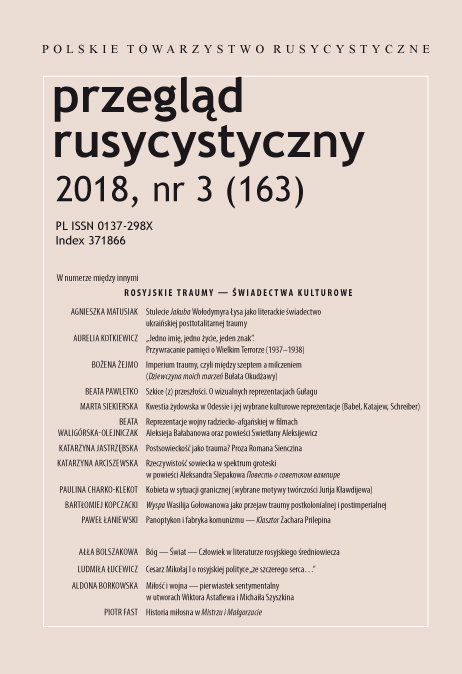
№ 3 (2018)
Опубликовано: 2018-09-23
 10.31261/pr

 Język Polski
 Русский
 English