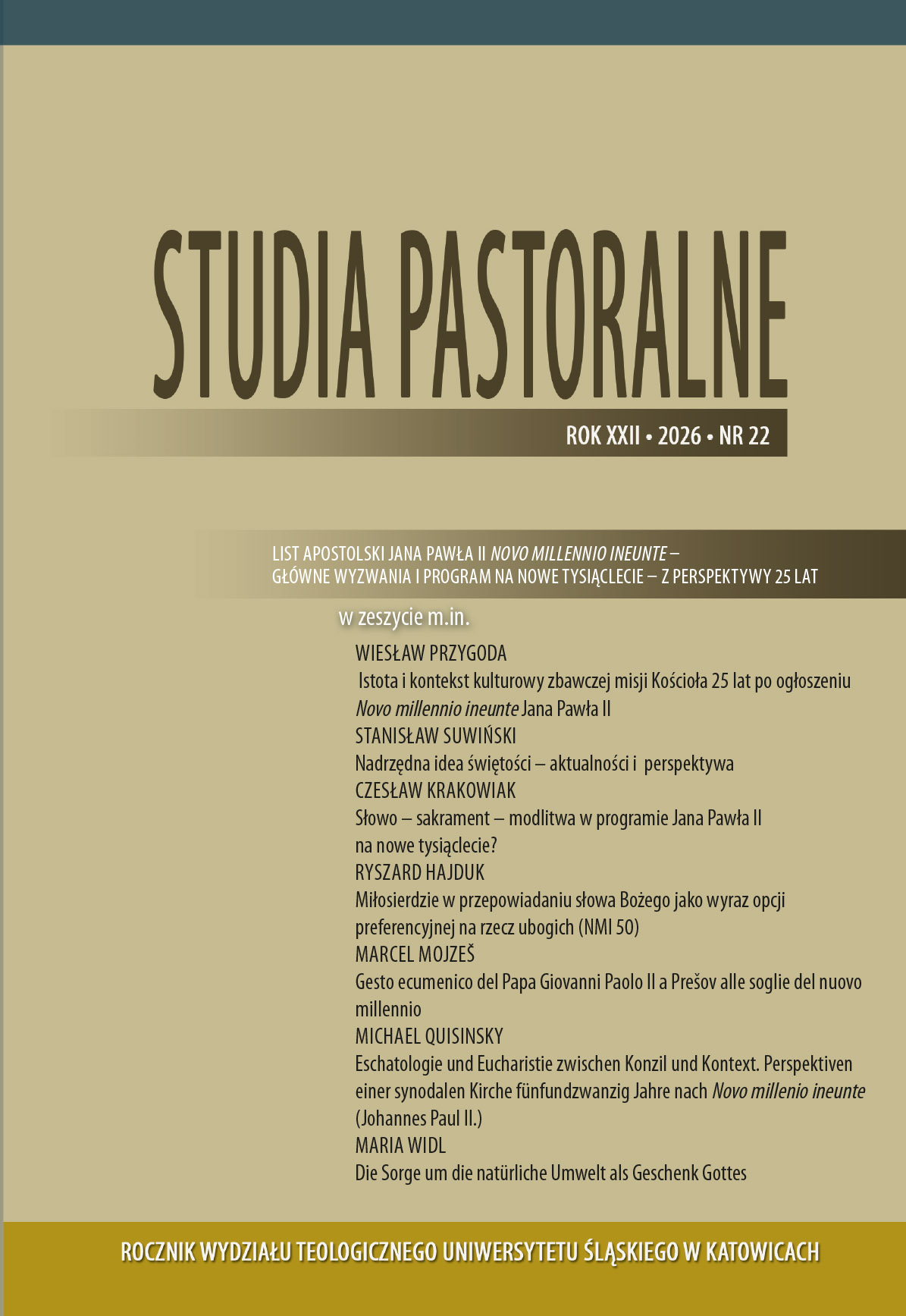
In his programme document for the third millennium of the Church’s mission, Pope John Paul II recognised that the essence of every pastoral programme should be to know, love and imitate Christ. The Church must never stray from this, but at the same time, every programme must take into account „the era and culture in order to enable genuine dialogue and real understanding” [NMI 29]. In view of the above, the aim of this study is first to present a synthetic overview of the unchanging essence of the Church’s salvific mission, then to analyse the most important features of contemporary culture, and finally, using practical theology syllogism, to conclude what pastoral challenges the Church in Poland currently faces. The novelty of this study is guaranteed by the analysis of the cultural context of pastoral care, which has recently undergone dynamic changes that cannot be ignored in the process of building current pastoral models of the Church’s salvific activity. The leading method of this study is the analysis of the content of the documents of the Magisterium Ecclesiae published after 2000, interpreted in the light of contemporary scientific publications, mainly in the field of theological sciences, and indirectly also in the field of philosophical and social sciences.
In 2026, it will be 25 years since the publication of John Paul II”s apostolic letter Novo millennio ineunte (NMI). It was announced at the end of the Great Jubilee (of the Birth of Jesus Christ) in the Year 2000. This document is a preview of the pastoral challenges in the life and ministry of the Church in the new century and millennium, to face the challenges of the future. What deserves special attention in the Letter is the fact that all the Church”s activities should be focused on the universal call to holiness (NMI 30). Assigning it a superior role also means the main and leading idea that dominates other challenges arising from the document and sets the direction of thinking and action of the Church community. The primary ideas are those that have the greatest impact on Christian life, and certainly one of them is the holiness of God. God, as a saint, turns to man, reveals his power in the Incarnation of Christ, redeems humanity and there by reveals to him his calling. Or maybe it”s the case that holiness seems unattractive to some people today. Detached from reality and real life, where being a Christian is a kind of social „burden” where it is difficult to achieve holiness by simply living in the world? This question also sets the goal of the article, or is looking at Christian holiness, taking into account its relevance and perspective in the life of the Church, still a desirable idea? The author will refer, among others, to the teachings of the 21st century popes. However, the main thrust of the author”s thought remains the portrayal of holiness in an unchanging relationship with God, who is the source of the holiness of the Church and its members.
Der Autor dieses Artikels lenkt aus pastoraltheologischer Perspektive die Aufmerksamkeit auf die Bedeutung der Seelsorge für den Menschen auf seinem Weg zur persönlichen Heiligkeit. Er fragt daher, wo die Pastoraltheologie heute einen Ruf zur persönlichen Heiligkeit erkennen kann und wie die Seelsorge, basierend auf den Definitionen des Rufes zur Heiligkeit in Novo millennio ineunte, Lumen gentium und Gaudium et spes, unterstützt werden kann
Twenty-five years after the beginning of the third millennium of Christianity, when another phase of the history of the world and the Church has ended, culminating in the Jubilee of the Year 2025, this article draws on the consistently relevant teaching of John Paul II on Sunday, contained in his Apostolic Letter Novo millennio ineunte – reread in the ever-changing ecclesial and cultural context – addressed to the Church at the conclusion of the Great Jubilee of the Year 2000. The desacralization of the Lord’s Day is progressing at an alarming pace, both in Europe and in Poland. There are many reasons for this process. However, its root lies primarily in a complete misunderstanding of the theological essence of Sunday and a complete failure to recognize and feel the need to observe it as a Christian. Therefore, this essence must be constantly recalled, and the faithful of the Church must be made aware of the obligation, necessity, and reasons for celebrating Sunday, primarily through participation in the Eucharistic assembly.
The author discusses the most important guidelines of John Paul II contained in the Letter Novo millennio ineunte, which constitute a pastoral program for the Church in the third millennium of Christianity: proclaiming the word of God and meditating on it, Sunday Eucharist, the sacrament of penance and reconciliation, striving for holiness and prayer
Novo millenio ineunte (weiter: NMI) steht einerseits im Zusammenhang mit den Bemühungen von Papst Johannes Paul II. um die Rezeption des II. Vaticanums, andererseits bringt der Papst hier mit der Stärkung der sonntäglichen Eucharistie einen zentralen Wunsch zum Ausdruck. Dieser Wunsch ging insofern nicht in Erfüllung, als die Exkulturation des Katholizismus voranschreitet. Der von Papst Franziskus angestoßene synodale Prozess eröffnet hier eine neue Chance, indem er Synode und Eucharistie aufeinander bezieht und dabei auch neue Perspektiven für das Priesteramt eröffnet, die für eine neue Inkulturation hilfreich sind. Bei alledem spielt die von Johannes Paul II. betonte eschatologische Perspektive der Eucharistie eine zentrale Rolle.
In the Apostolic Letter Novo millennio ineunte, John Paul II called, among other things, for a new “ardor in faith.” By this he meant the undertaking of the process of the new evangelization, which became a driving force for the renewal of the Catholic faith. Through the guidance contained in this document, he expressed his deep concern for this dimension of the Church’s life. With concrete directions, he outlined the path along which the community of believers should walk at the threshold of the third millennium. This article addresses this theme on the basis of the documents and statements of John Paul II as well as those of his successors. It also highlights specific institutional and then pastoral initiatives undertaken in Poland and in selected countries around the world.
In the tradition of the Church, there is no formal custom of issuing documents to mark the end of a millennium. However, turning points in history provide opportunities for reflection on the faith and mission of the Church. One such example is John Paul II’s Apostolic Letter Novo Millennio Ineunte. At this symbolic moment in history, the Holy Father reflected on the past and future of the Church, emphasizing the need to deepen Christian formation rooted in the values of the Gospel. The author of this article undertakes the task of presenting education in values from a theological perspective, which ‒ according to the tradition of the Church ‒ is closely linked to the moral and spiritual formation of the human person. Therefore, this study seeks to present the new and timeless challenges of value education as outlined by John Paul II in his Apostolic Letter. In theology, values are identified with the Gospel, and their realization is directly related to the life of Jesus Christ. An analysis of the Apostolic Letter reveals both the principles concerning fundamental values and their practical implications for the life of the entire ecclesial community
In his apostolic letter Novo millennio ineunte, published in 2001, Pope John Paul II speaks of the mercy of words, which demands support and credibility in acts of mercy. Mercy should guide all of the Church’s activities, including the implementation of the “option for the poor”, which is a continuation of Jesus” mission of addressing the Good News to people seeking to meet their spiritual and material needs. This article attempts to answer the question of how to shape the proclamation of God’s Word so that it can be a practice of verbal mercy toward people in need, the excluded, and those marginalized in society. Based on official documents of the Catholic Church and theological publications, the most important aspects of communicating God’s mercy to people will be presented, followed by a characterization of the poor as privileged recipients of the Gospel. This is the basis for drawing practical conclusions regarding the ministry of the word, carried out for the good of those in need and suffering from material poverty, social exclusion and spiritual powerlessness.
The article presents the results of research into the basic assumptions of the religious and moral renewal movement ‒ the Crusade for Human Liberation. This movement was founded by Father Franciszek Blachnicki at the beginning of John Paul II’s pontificate and is an example of „Polish liberation theology” based on the biblical concept of liberation. The Crusade shapes alcohol-free mentality (voluntary abstinence) in order to educate children, adolescents and adults (prevention) towards sobriety and support against substance and behavioral addictions. The research was conducted in the light of John Paul II’s document Novo millennio ineunte introducing the Church into the third millennium of Christianity. The document indicates the need of rejection of violence or a sense of one’s own moral superiority and demands solidarity with people who have been subjected to multiple forms of slavery. The indications of Novo millennio ineunte are implemented in the formation and ministry of the Crusade for Human Liberation, founded two decades earlier and operating fruitfully today in many countries.
The ecumenical gestures of Saint Pope John Paul II accompanied his entire pontificate. They were a practical expression of his deep desire to fulfill the will of God clearly expressed in the words of Jesus Christ: “that they may all be one, as you, Father, are in me and I am in you, that they also may be in us, so that the world may believe that you sent me.” (Jn 17:21). This desire is also reflected in his encyclical Ut unum sint (1995) and in the apostolic letters Tertio millenio adveniente (1994) and Novo millenio ineunte (2001). The article analyzes the historical background and immediate events that preceded the ecumenical gesture of the Our Father prayer at the memorial of the victims of the bloody trial of Caraffa, which Pope John Paul II prayed on July 2, 1995 in Prešov together with the bishop of the Eastern District of the Evangelical Church, confession of Augsburg Ján Midriak and the Greek Catholic Bishop of Prešov, Ján Hirka. On the same day, in the morning, the Pope canonized three martyrs from Košice in Košice and prayed at the monument to 24 Evangelical martyrs in Prešov. This gesture of a joint prayer of the Our Father was much more eloquent than over 500 years of ecumenical dialogue.
Das Apostolische Schreiben Novo Millennio Ineunte erwähnt das Thema Ökologie nur mit einem einzigen Satz. Dieser steht jedoch an prominenter Stelle und formuliert mit Nachdruck. Dies wird näher aufgeschlüsselt und deutlich erweitert durch ausführliche Darlegungen zur Bewahrung der Schöpfung, die Papst Johannes Paul II. anlässlich des Tages des Weltfriedens 1990 formuliert. Schließlich wird das Thema in den Bogen des gesamten Millenniumsprozesses eingeordnet und mit der Dynamik der abschließenden Enzyklika in deren Licht gestellt.
This essay classifies the development of the Church in rural areas by first presenting its socio-economic structural characteristics and then describing its pastoral structural development. With regard to both developments, the article refers to the papal letter Novo Millenio ineunte for guidance on how to proceed, which is then classified theologically. The article concludes with a plea to address the many open questions resulting from the analysis and to begin the theological reception of Novo Millenio ineunte in the German-speaking world.
In recent years, one can easily observe a growing interest in the pre-conciliar form of the Holy Mass commonly called the “tridentine mass”. This interest often concerns people for whom, due to their age, the “tridentine mass” has never been a natural environment for their liturgical formation. Such interest is often encouraged by various critical evaluations of the post-conciliar form of the liturgy, which sometimes go so far as to deny its legality and legitimacy. The author carries out a comparative analysis of the key elements in the structure of the Holy Mass in the “tridentine” rite and the post-conciliar one (novus ordo), in order to examine whether essential elements of the Holy Mass have been altered. The study of the issue will be carried out through the lens of liturgical comparative analysis as well as juridical-liturgical analysis. Using the liturgical texts of the Holy Mass, the author demonstrates the continuity and unchangeability of the essential elements of the Eucharistic celebration despite changes in form. He also shows that the conciliar aggiornamento of the liturgy of the Holy Mass, carried out in part on the basis of ressourcement, did not affect the essence of the liturgy of the Roman Catholic Church.
The aim of this article is to present the pastoral visit, known as a „kolęda”, as a form of pastoral care for people with disabilities. „Kolęda” is the only form of pastoral care in Poland that provides the opportunity to meet with parishioners in their homes. It is sometimes called a pastoral visit to families. A significant advantage of „kolęda” is the opportunity to establish and develop pastoral dialoguewith people with disabilities in their family environment. The article characterizes the phenomenon of disability in Poland. Understanding this phenomenon allows for appropriate pastoral care for such people in parishes. It then highlights the benefits of pastoral conversation with people with disabilities and their loved ones in a family setting. Visits by pastors enable them to establish relationships with new parishioners and deepen bonds with existing ones. The article formulates pastoral proposals as a result of the clergy”s stay in the homes of people with disabilities.
The development of new technologies has led to the emergence of artificial intelligence alongside natural intelligence. The meaning of „intellect” has also changed. Until now, it meant the totality of human mental abilities, but now intellect has been reduced to knowledge resources in digital form circulating on the internet. The humanisation (humanisation) of intelligence and intellect can be aided by applied theology, which focuses on the human being and seeks to redefine him or her in the light of external conditions. These conditions create a new context for human life in its personal, communal and social dimensions. However, true Christian humanisation should draw inspiration from God”s merciful action. From the perspective of applied theology, this is primarily the task of the members of the contemporary Church, who should rediscover the beauty of this inspiration and contribute to the progress of humanity with renewed evangelical enthusiasm.




 English
 Italiano
 Język Polski
 Deutsch