
The funerary customs in Christian Egypt did not differ much from those practiced in other parts of the Christian world: the grave and the body itself were located on the east-west axis and the head of the dead person was situated on the western side; the burial equipment was absent or scarce; the commemoration of the dead was celebrated on fixed dates. However, the influence of the local ancient tradition was still strong. The ancient Egyptian form of mummification was not practiced anymore, but in many cases pieces of natron were observed on the bodies. Some of the literary sources confirm the fact that preserving the body of the dead person in its integral condition was still an important issue. Crux ansata – one of the most popular symbols used in the decoration of funerary stelae – takes its shape from the ancient Egyptian sign ankh. The visions of the netherworld as described in apocrypha resemble the old Egyptian pictures of hell. Some of the Christian customs – like the ritual lamentation – are similar to those known in ancient Egypt but should be considered more as part of the Middle Eastern or Mediterranean tradition.
Download files
Citation rules
Licence

This work is licensed under a Creative Commons Attribution-NonCommercial-NoDerivatives 4.0 International License.
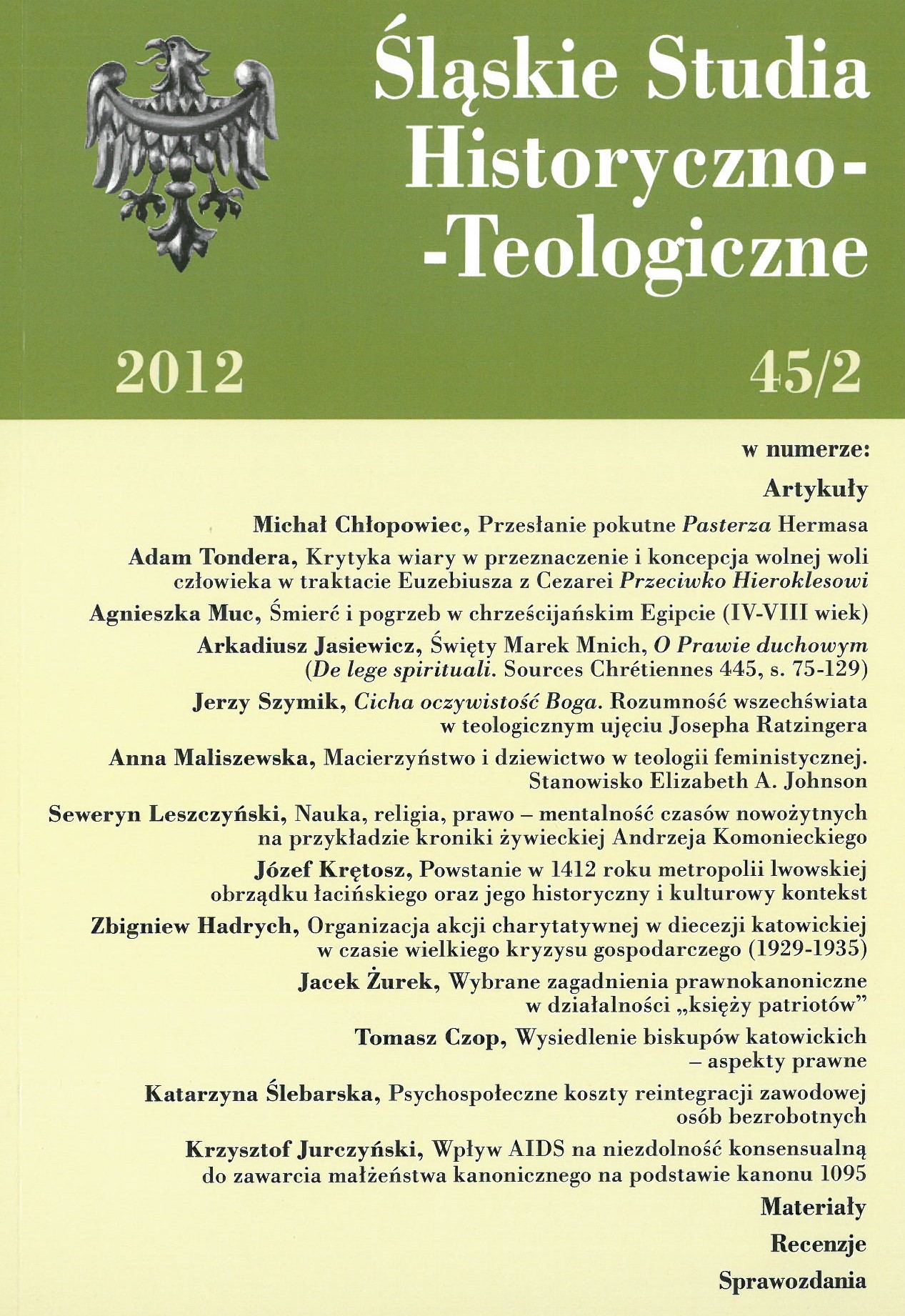
Vol. 45 No. 2 (2012)
Published: 2012-12-31
This work is licensed under a Creative Commons Attribution-NonCommercial-NoDerivatives 4.0 International License.

 English
 Język Polski