

 https://doi.org/10.31261/SSHT.2019.52.2.02
The process of deconstruction of philosophy initiated by post-modern thinkers is aimed not only at philosophy, but also at European culture and the role philosophy has hitherto played in its formation. It is a process which Roger Scruton calls “the devil’s work”, one intending to eliminate the influence of Christian culture on present day society. The paper has four parts. In the first, the author introduces the problem and indicates certain instances illustrating how the present state of contemporary philosophy was reached by the disregard and culpable ignorance of mediaeval philosophy by those who are professed Christians. (Roman Ingarden’s example). Anselm of Canterbury is the counter-example given as one whose adherence to the Catholic faith inspired him not only to seek a more meaningful understanding of what he professed by faith, but also to make use of free philosophical speculation and Christian doctrine in order to contemplate reality and make philosophy more meaningful. The quest for truth, pursued by Anselm in the Middle Ages, is re-enacted in modern times by John Henry Newman and Edith Stein: two converts to the Roman Catholic Church. The second part considers Roger Scruton’s attempt to denounce the evil of Jacques Derrida’s idea of the deconstruction of philosophy, taking also into account the role nihilism and relativism play in this procedure. In the third part, the author of the paper refers to the thought of G.K. Chesterton and contemporary Polish philosophers: J.M. Bocheński, S. Swieżawski, B. Skarga, who by their appreciation of metaphysics, the Christian heritage of Europe and mediaeval thought, point out the benefit of these, not only for the human spirit, but also for the safeguarding of philosophy from the menace of disintegration present in the global ideology of political correctness and the ideas of post-modern “quasi-philosophers”. Lastly, in the fourth part, Ludwig Wittgenstein's thought and example are considered as one whose radicalism is aimed at philosophy and religion, one endowed with a sense of mission as regards saving philosophy and religion from absurdities which hinder the proper functioning of these two pillars of culture. The author concludes by suggesting that a “back to basics and common sense” approach is necessary, if we are not to succumb to the “devil’s work” of irrationalism. He also advocates the reading of philosophical classical texts both ancient and mediaeval, especially Boethius’ The Consolation of Philosophy and Chesterton’s Orthodoxy.
Download files
Citation rules
Cited by / Share




Licence

This work is licensed under a Creative Commons Attribution-NonCommercial-NoDerivatives 4.0 International License.
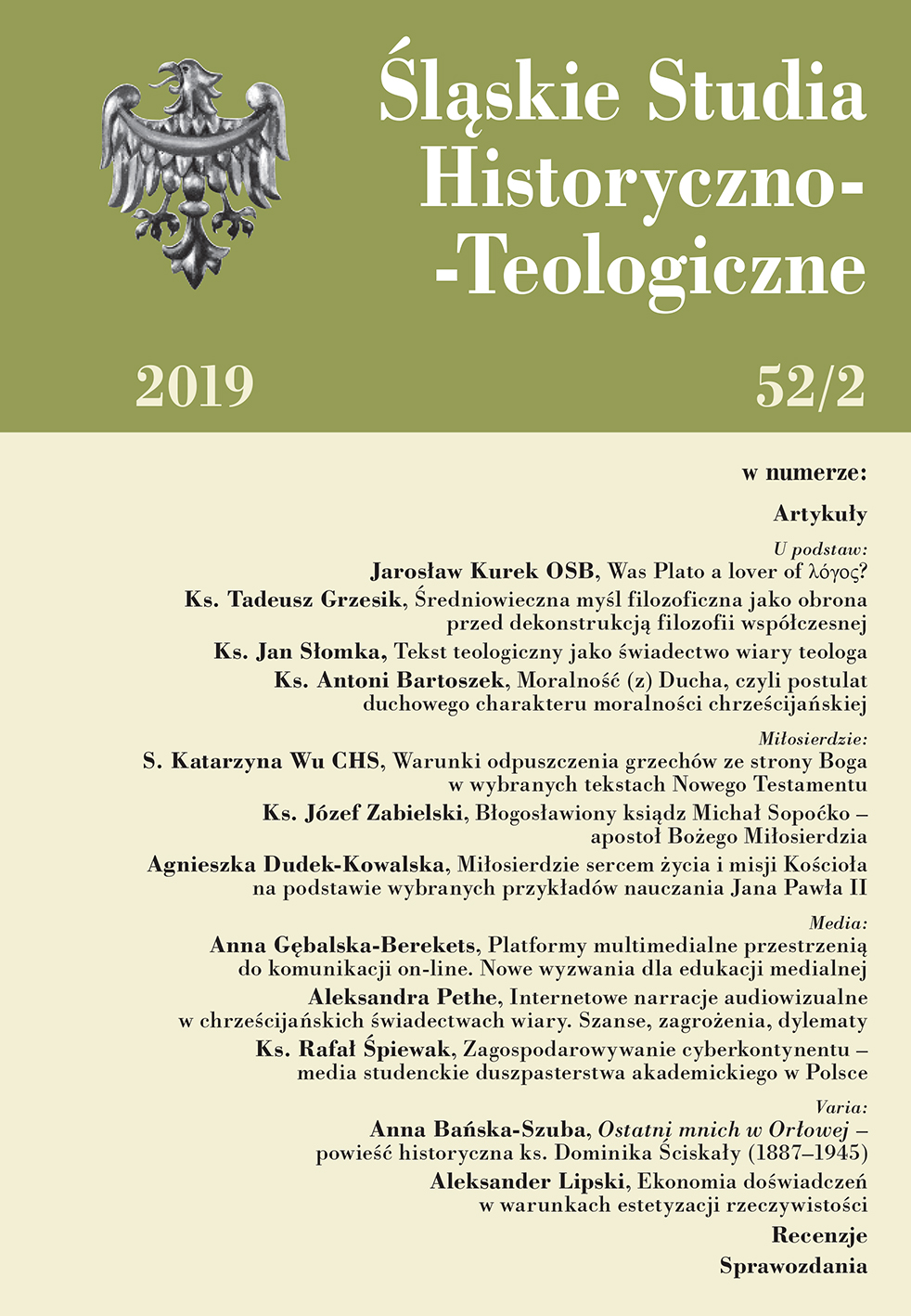
Vol. 52 No. 2 (2019)
Published: 2020-09-29
This work is licensed under a Creative Commons Attribution-NonCommercial-NoDerivatives 4.0 International License.

 English
 Język Polski