
 https://doi.org/10.31261/CHOWANNA.2010.35.12
Technological development, which can be observed over the last years, has changed forms and methods of distance learning to a large extent. An opportunity of bidirectional communication plus contact with audience and an opportunity to verify knowledge and skills learnt have contributed substantially to a new form of education called e‑learning. The field of e‑learning has been developing dynamically as it is a very convenient form, which is attractive in use and transfer of knowledge based not only on text information but on multimedia as well. This form of learning has got many advantages, still a number of disadvantages or drawbacks can be listed. This is, among others, a lack of opportunities for complete interaction among students participating in this process of education, which is particularly visible in relations observed unconsciously during the group work in the real background of the classroom. Difficulties derived from limitations of e‑learning and its traditional techniques are mainly noticeable in art education, which depends largely on a master‑student relation. It seems that an implementation of virtual reality in didactics might be a technical solution to disadvantages mentioned earlier. This form permits to use visual and verbal techniques of communication. Virtual reality used in education enables teachers to catch and keep young people’s attention and gives an opportunity for support in active learning. Implementation of virtual environments can change more a style of learning than activities in the frame of formal structure in the classroom. The present paper describes techniques and methods of virtual reality that may be implemented in art education.
Download files
Citation rules
Cited by / Share



Licence

This work is licensed under a Creative Commons Attribution-ShareAlike 4.0 International License.
The Copyright Owners of the submitted texts grant the Reader the right to use the pdf documents under the provisions of the Creative Commons 4.0 International License: Attribution-Share-Alike (CC BY SA). The user can copy and redistribute the material in any medium or format and remix, transform, and build upon the material for any purpose.
1. License
The University of Silesia Press provides immediate open access to journal’s content under the Creative Commons BY-SA 4.0 license (http://creativecommons.org/licenses/by-sa/4.0/). Authors who publish with this journal retain all copyrights and agree to the terms of the above-mentioned CC BY-SA 4.0 license.
2. Author’s Warranties
The author warrants that the article is original, written by stated author/s, has not been published before, contains no unlawful statements, does not infringe the rights of others, is subject to copyright that is vested exclusively in the author and free of any third party rights, and that any necessary written permissions to quote from other sources have been obtained by the author/s.
If the article contains illustrative material (drawings, photos, graphs, maps), the author declares that the said works are of his authorship, they do not infringe the rights of the third party (including personal rights, i.a. the authorization to reproduce physical likeness) and the author holds exclusive proprietary copyrights. The author publishes the above works as part of the article under the licence "Creative Commons Attribution-ShareAlike 4.0 International".
ATTENTION! When the legal situation of the illustrative material has not been determined and the necessary consent has not been granted by the proprietary copyrights holders, the submitted material will not be accepted for editorial process. At the same time the author takes full responsibility for providing false data (this also regards covering the costs incurred by the University of Silesia Press and financial claims of the third party).
3. User Rights
Under the CC BY-SA 4.0 license, the users are free to share (copy, distribute and transmit the contribution) and adapt (remix, transform, and build upon the material) the article for any purpose, provided they attribute the contribution in the manner specified by the author or licensor.
4. Co-Authorship
If the article was prepared jointly with other authors, the signatory of this form warrants that he/she has been authorized by all co-authors to sign this agreement on their behalf, and agrees to inform his/her co-authors of the terms of this agreement.
I hereby declare that in the event of withdrawal of the text from the publishing process or submitting it to another publisher without agreement from the editorial office, I agree to cover all costs incurred by the University of Silesia in connection with my application.
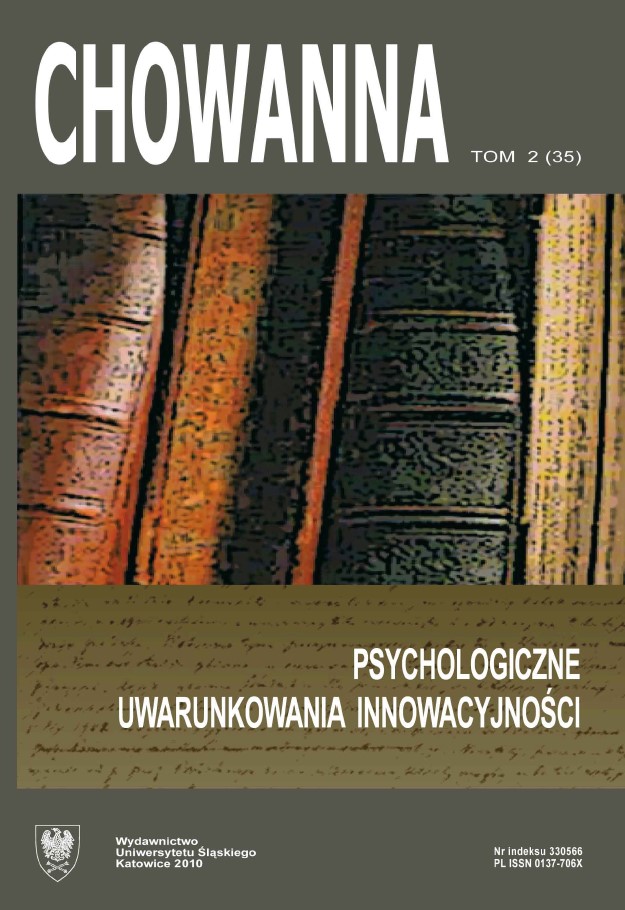
No. 2 (35) (2010)
Published: 2025-08-28
This work is licensed under a Creative Commons Attribution-ShareAlike 4.0 International License.

 English
 Język Polski