

 https://doi.org/10.31261/pr.22845
This paper focuses on the interpretation of Oksana Vasyakina’s novel Wound. The analysis is methodologically based on Ewa Domanska’s original concept of necros. In the process of close reading the Russian writer’s text, the author creatively adapts Domanska’s scholarly observations, which are presented in her monograph Necros: An Introduction to the Ontology of the Dead Body. This approach addresses three thematic areas that correspond with three main parts of the paper, i.e. the agency of the dead body, the cyclical nature of life and the taboo of death, and the problem of space. Taking advantage of the concept of necros in the process of interpretation allows the author to treat the literary text as a potential “rescue history”, to consider the dead body from the point of view of ecological materialism, and to rethink dominant discourse on death. In the conclusion, the author notes that by referring to intimate memories, Vasyakina domesticates the topic of death and changes its previous taboo status, thereby linking the novel with the ideas associated with the geological and postsecular turns. The tangibility of textures and the materiality of descriptions found in the Russian novel allow us to imagine the past differently and understand culture as the cultivation, care and protection of natural resources.
Download files
Citation rules
Cited by / Share




Licence

This work is licensed under a Creative Commons Attribution-ShareAlike 4.0 International License.
The Copyright Owners of the submitted texts grant the Reader the right to use the pdf documents under the provisions of the Creative Commons 4.0 International License: Attribution-Share-Alike (CC BY-SA). The user can copy and redistribute the material in any medium or format and remix, transform, and build upon the material for any purpose.
1. License
The University of Silesia Press provides immediate open access to journal’s content under the Creative Commons BY-SA 4.0 license (http://creativecommons.org/licenses/by-sa/4.0/). Authors who publish with this journal retain all copyrights and agree to the terms of the above-mentioned CC BY-SA 4.0 license.
2. Author’s Warranties
The author warrants that the article is original, written by stated author/s, has not been published before, contains no unlawful statements, does not infringe the rights of others, is subject to copyright that is vested exclusively in the author and free of any third party rights, and that any necessary written permissions to quote from other sources have been obtained by the author/s.
If the article contains illustrative material (drawings, photos, graphs, maps), the author declares that the said works are of his authorship, they do not infringe the rights of the third party (including personal rights, i.a. the authorization to reproduce physical likeness) and the author holds exclusive proprietary copyrights. The author publishes the above works as part of the article under the licence "Creative Commons Attribution-ShareAlike 4.0 International".
ATTENTION! When the legal situation of the illustrative material has not been determined and the necessary consent has not been granted by the proprietary copyrights holders, the submitted material will not be accepted for editorial process. At the same time the author takes full responsibility for providing false data (this also regards covering the costs incurred by the University of Silesia Press and financial claims of the third party).
3. User Rights
Under the CC BY-SA 4.0 license, the users are free to share (copy, distribute and transmit the contribution) and adapt (remix, transform, and build upon the material) the article for any purpose, provided they attribute the contribution in the manner specified by the author or licensor.
4. Co-Authorship
If the article was prepared jointly with other authors, the signatory of this form warrants that he/she has been authorized by all co-authors to sign this agreement on their behalf, and agrees to inform his/her co-authors of the terms of this agreement.
I hereby declare that in the event of withdrawal of the text from the publishing process or submitting it to another publisher without agreement from the editorial office, I agree to cover all costs incurred by the University of Silesia in connection with my application.
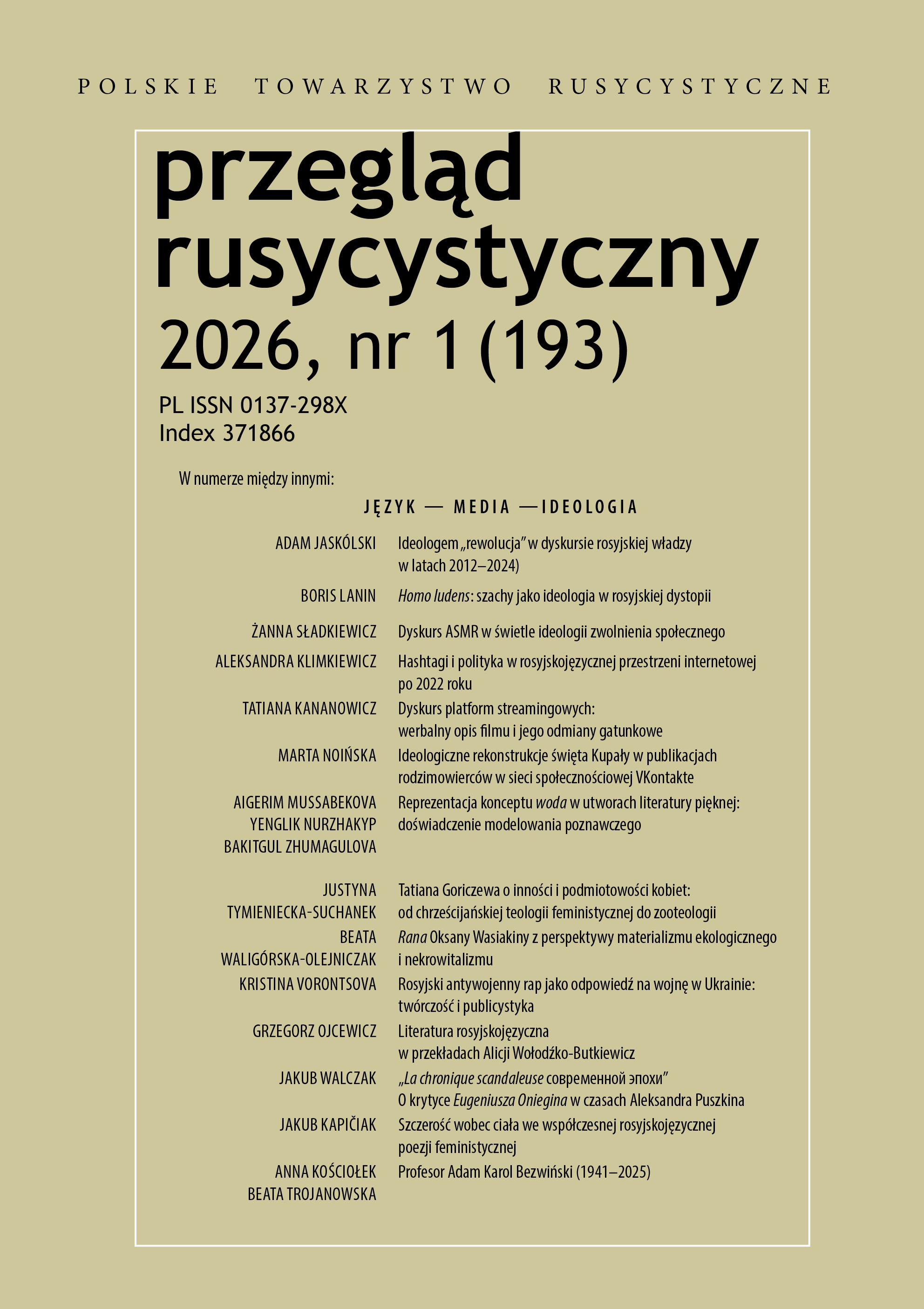
Vol. 193 No. 1 (2026)
Published: 2026-03-29
10.31261/pr
This work is licensed under a Creative Commons Attribution-ShareAlike 4.0 International License.

 Język Polski
 Русский
 English