

 https://doi.org/10.31261/pr.7716
The illusionist in Mikhail Shishkin’s novel The Taking of Izmail and in Vladimir Nabokov works appears in reference to the Platonic tradition, in the context of creative efforts, which, in turn, are associated with the divine creation of the world (the Creator - illusionist – writer triad). Therefore, the character of the magus often functions as a metaphor of the author of the text: he also has the ability to create something out of nothing; he can make something disappear or undergo transformations. Both Shishkin and Nabokov (e.g. in King, Queen, Knave, and Pale Fire) compare the creation of literary worlds to the art of illusion, which is especially associated with the origin of the universe in contemporary prose writers. An important motif related to the art of illusion is the disappearance / death of heroes (The Potato Elf, and The Luzhin Defense by Nabokov), which has its roots in the tradition of Russian literature and is connected with emphasizing the role of the author of the text as the driving force for the development of the story.
Download files
Citation rules
Cited by / Share




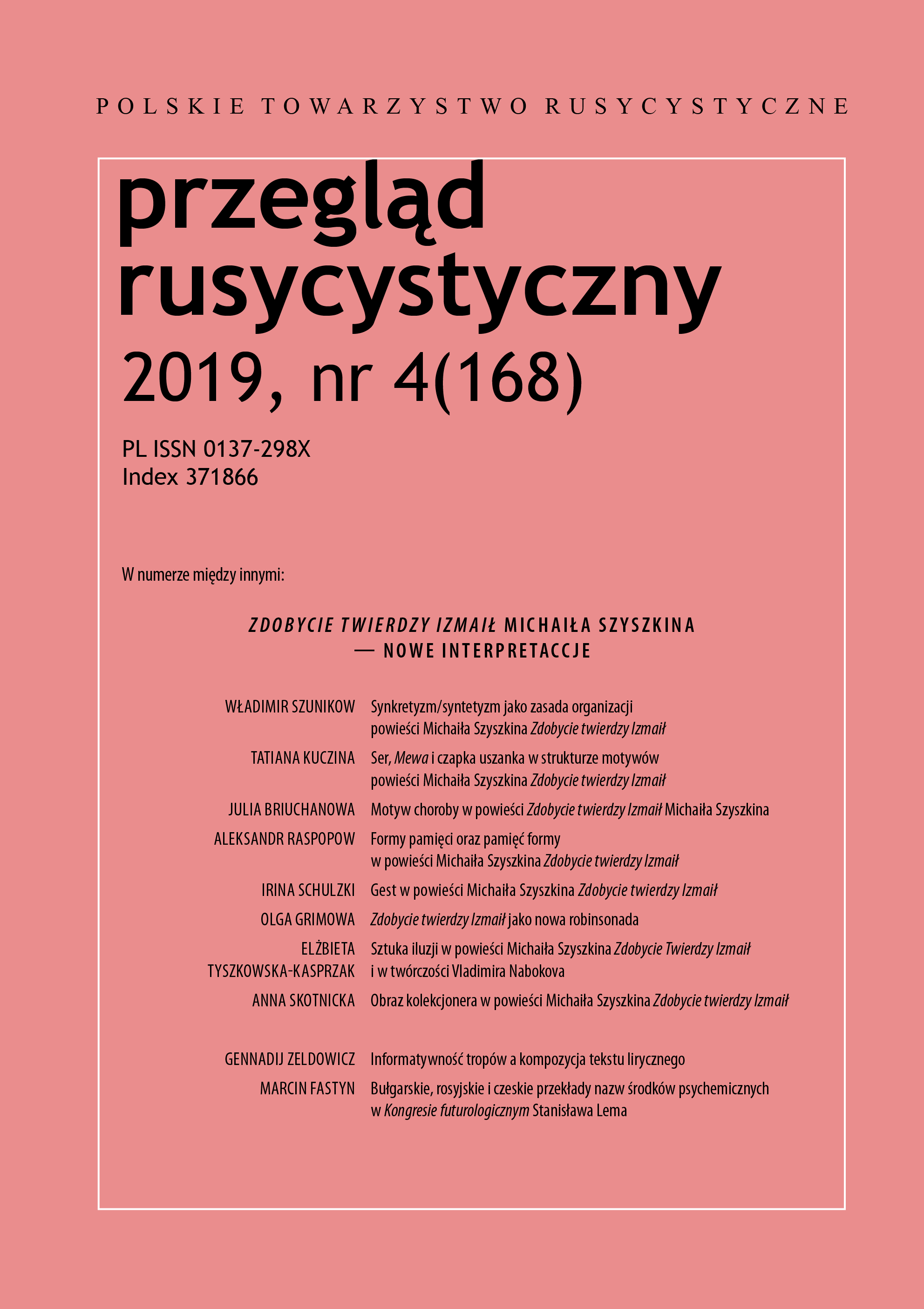
Vol. 2019 No. 4 (2019)
Published: 2019-09-19
10.31261/pr

 Język Polski
 Русский
 English