

Anselm states “God, as it is said, ‘causes peace and creates evil’ ” in Concordia. The expression ‘God creates evil’ contradicts itself and it cannot be said that the omniscient and omnipotent God creates evil. This paper considers why Anselm made such an expression, i.e. why Anselm believed that God created evil, what it means in his ethics, and what this point of view tells us about how to live in peace with each other. The expression ‘causes peace and creates evil’ is believed to have been taken from the book of Isaiah. Evil created by God is in order to try and purify just people and to punish unjust people. God creates evil to correct the evil of humans, which in turns brings about peace. Evil committed by humans (i.e. sin) is opposed to the ‘rule of charity (regula caritatis)’ which Anselm writes of. God creates evil so that our behaviour comes to accord with that rule. True love, i.e. charity, is required for peace, and justice is required to carry out deeds of charity. Recovering distorted love to the bond of charity is the path to peace. In Anselm’s way of thinking, peace is brought about by following the rule of charity, and peace is broken when we live without and outside this rule of charity.
Download files
Citation rules
Licence

This work is licensed under a Creative Commons Attribution-NonCommercial-NoDerivatives 4.0 International License.
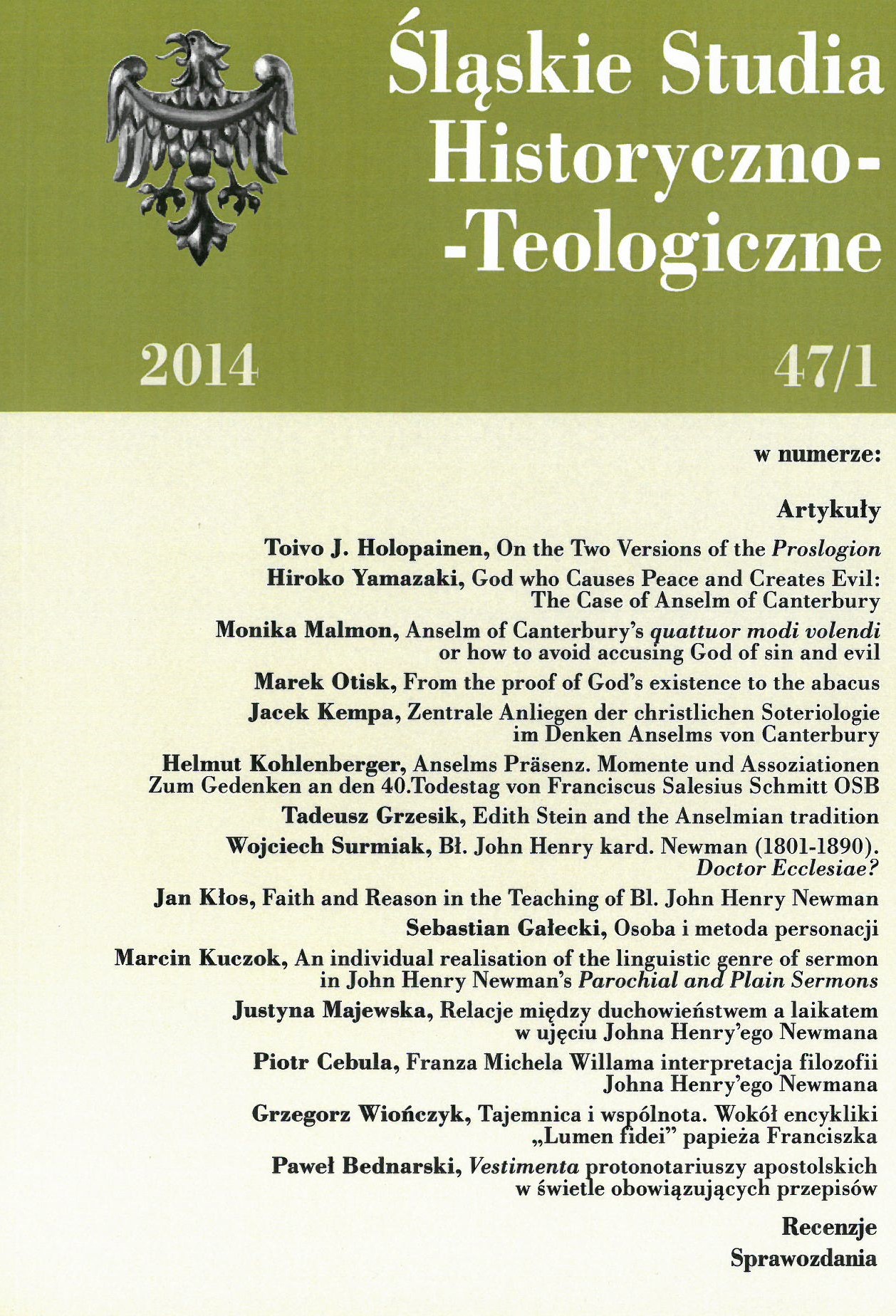
Vol. 47 No. 1 (2014)
Published: 2014-06-30
This work is licensed under a Creative Commons Attribution-NonCommercial-NoDerivatives 4.0 International License.

 English
 Język Polski