

The Second Vatican Council in the Dogmatic Constitution Dei Verbum provided exegetic guidelines on the interpretation of the Scripture. Post-council exegesis focused mainly on the historical-critical method which analyses the human dimension of the Holy Scripture. Therefore, Benedict XVI reminded of the necessity of using theological principles in the exegesis and showed their indepth theological basis. The hermeneutics of faith postulated by the pope includes three criteria that allow to grasp the divine dimension of the Bible; two of them were discussed in this article. “Canonical exegesis” takes into consideration the unity of the Holy Scripture, while the “analogy of faith” enables the believing exegete to interpret properly the text written by the believing author. The article also deals with Joseph Ratzinger’s (Benedict XVI’s) comprehension of the Revelation, as well as the differences between the Revelation and the Holy Scripture. It is hermeneutics of faith that enables one to rise above the “letter” and reach the “spirit” of the inspired texts.
Download files
Citation rules
Licence

This work is licensed under a Creative Commons Attribution-NonCommercial-NoDerivatives 4.0 International License.
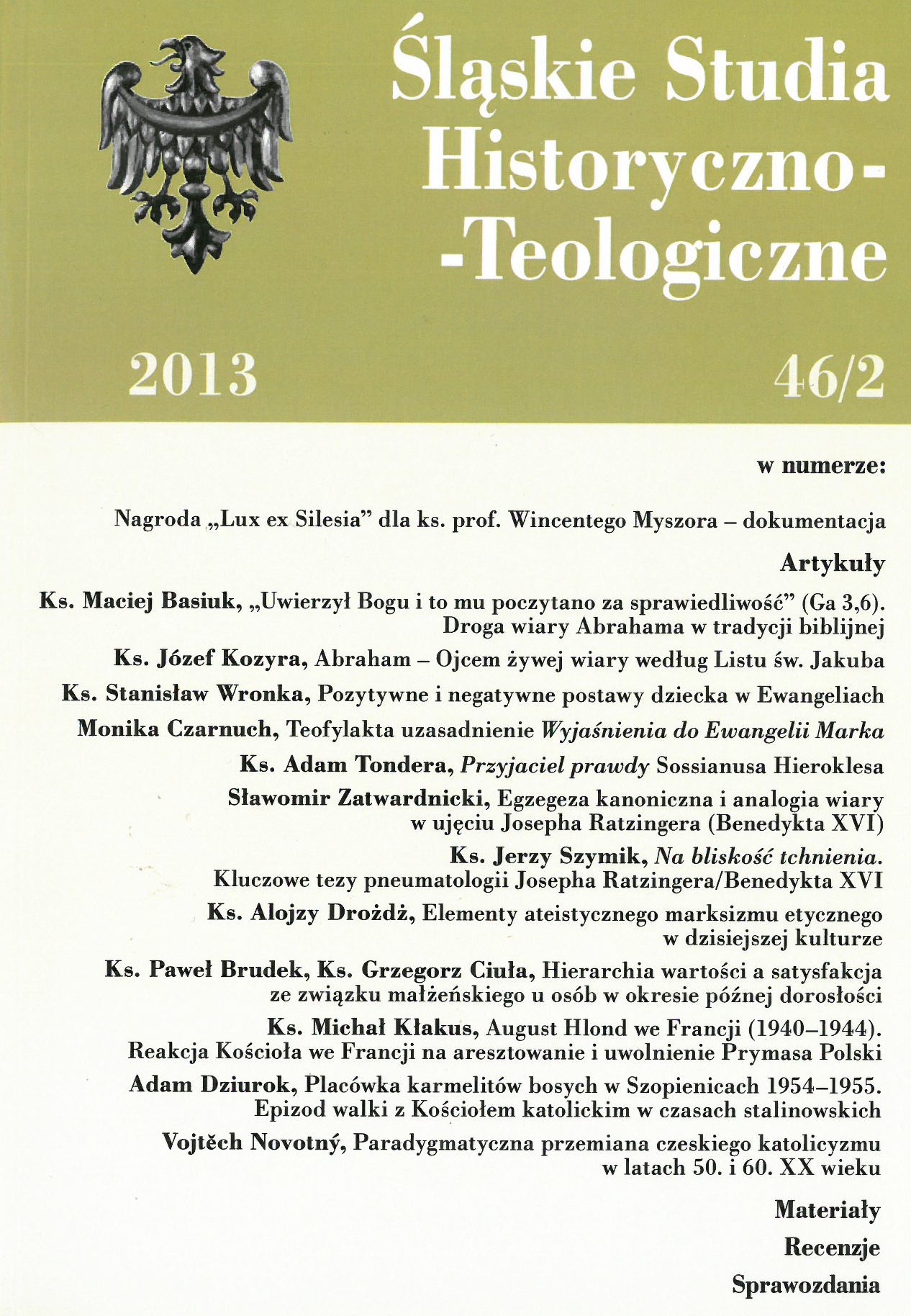
Vol. 46 No. 2 (2013)
Published: 2013-12-31
This work is licensed under a Creative Commons Attribution-NonCommercial-NoDerivatives 4.0 International License.

 English
 Język Polski