
Published: 2026-03-25

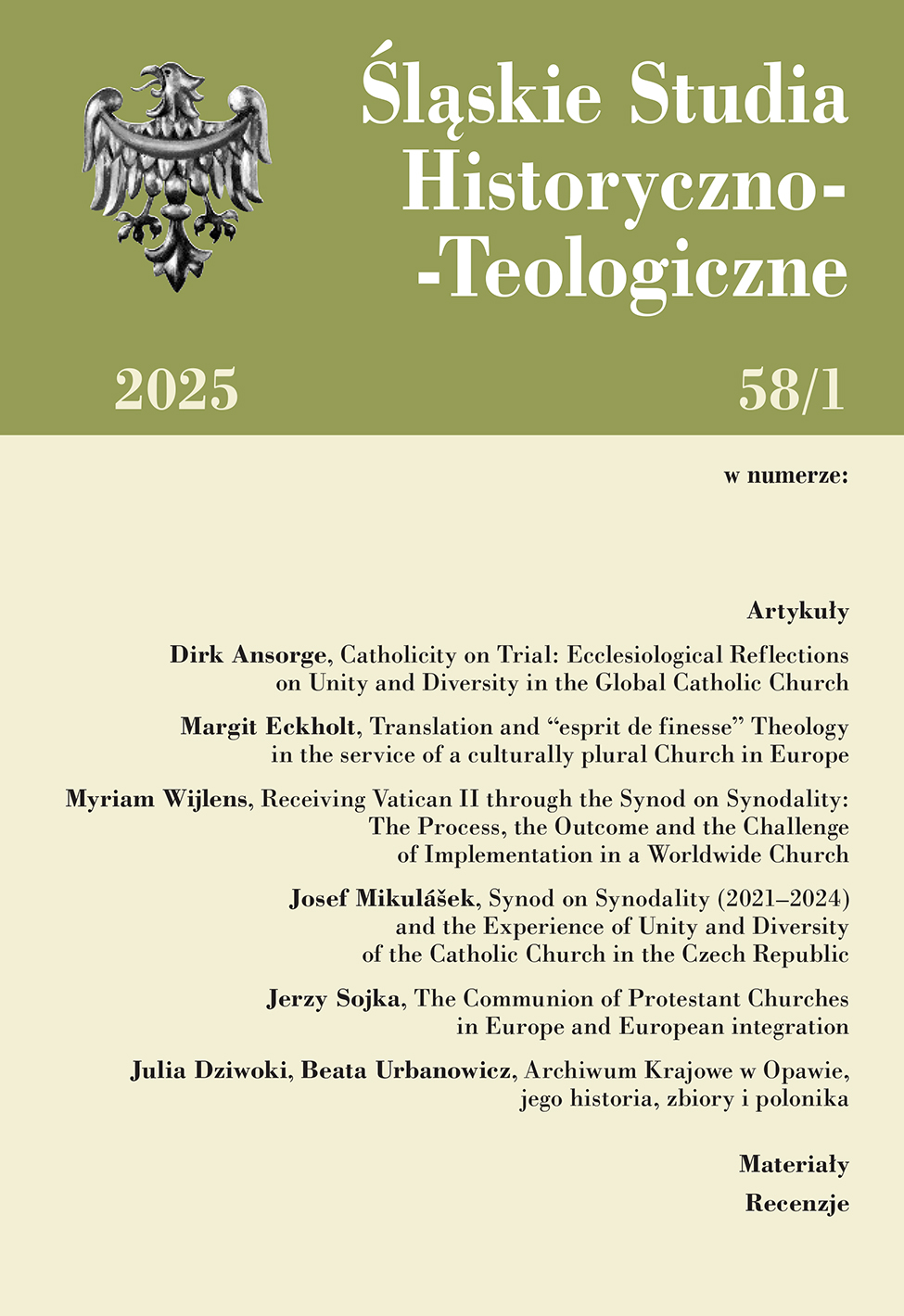
Catholicity on Trial: Ecclesiological Reflections on Unity and Diversity in the Global Catholic Church

Dirk Ansorge Logo ORCID

Abstract

During the period of European colonialism, the Catholic Church underwent a process of global expansion which was characterised by a tendency towards uniformity dominated by the Latin Church and its capital, Rome. However, the end of colonialism and the subsequent Second Vatican Council saw the Church become inculturated into diverse religious and social contexts, making the issue of unity and diversity within the Catholic Church imperative. The key questions are: how much unity is necessary, and how much diversity can be tolerated, to preserve the unity of the Catholic Church on a global scale? Focusing on ecclesiological reflections, this essay analyses the Final Document of the 16th Ordinary Synod of Bishops in terms of its attitude towards unity and diversity within the Catholic Church. What possible consequences might the Synodal Journey of the global Church have for its institutions and structures? Since, according to Lumen Gentium, the Church is a complex reality consisting of institutional and spiritual elements (LG 8), the relationship between the truth of the Gospel and the identity of the Church can be examined from a sociological perspective in order to develop a comprehensive understanding. The article argues that that the sacramental structure of the Church (LG 1) justifies the implementation of “secular” elements into its structures, when enabling it to fulfil its mission of spreading the Gospel into different cultures more effectively.

Download files

Citation rules

Ansorge, D. (2026). Catholicity on Trial: Ecclesiological Reflections on Unity and Diversity in the Global Catholic Church. Silesian Historical and Theological Studies, 58(1), 9–22. https://doi.org/10.31261/SSHT.2025.58.1.01

Cited by / Share

Licence

Creative Commons License

This work is licensed under a Creative Commons Attribution-ShareAlike 4.0 International License.


The Copyright Owners of the submitted texts grant the Reader the right to use the pdf documents under the provisions of the Creative Commons 4.0 International License: Attribution-Share-Alike (CC BY-SA). The user can copy and redistribute the material in any medium or format and remix, transform, and build upon the material for any purpose.

1. License

The editorial board provides immediate open access to the journal’s content under the Creative Commons BY-SA 4.0 license (http://creativecommons.org/licenses/by-sa/4.0/). Authors who publish with this journal retain all copyrights and agree to the terms of the above-mentioned CC BY-SA 4.0 license.

2. Author’s Warranties

The author warrants that the article is original, written by stated author/s, has not been published before, contains no unlawful statements, does not infringe the rights of others, is subject to copyright that is vested exclusively in the author and free of any third party rights, and that any necessary written permissions to quote from other sources have been obtained by the author/s.

If the article contains illustrative material (drawings, photos, graphs, maps), the author declares that the said works are of his authorship, they do not infringe the rights of the third party (including personal rights, i.a. the authorization to reproduce physical likeness) and the author holds exclusive proprietary copyrights. The author publishes the above works as part of the article under the licence "Creative Commons Attribution-ShareAlike 4.0 International".

ATTENTION! When the legal situation of the illustrative material has not been determined and the necessary consent has not been granted by the proprietary copyrights holders, the submitted material will not be accepted for editorial process. At the same time the author takes full responsibility for providing false data (this also regards covering the costs incurred by the Publisher and financial claims of the third party).

3. User Rights

Under the CC BY-SA 4.0 license, the users are free to share (copy, distribute and transmit the contribution) and adapt (remix, transform, and build upon the material) the article for any purpose, provided they attribute the contribution in the manner specified by the author or licensor.

4. Co-Authorship

If the article was prepared jointly with other authors, the signatory of this form warrants that he/she has been authorized by all co-authors to sign this agreement on their behalf, and agrees to inform his/her co-authors of the terms of this agreement.

I hereby declare that in the event of withdrawal of the text from the publishing process or submitting it to another publisher without agreement from the editorial office, I agree to cover all costs incurred by the Publisher in connection with my application.

SSHT 58,1(2025)

Vol. 58 No. 1 (2025)
Published: 2026-03-25


ISSN: 0137-3447
eISSN: 2956-6185

Publisher
Instytut Gość Media/Księgarnia św. Jacka

Licence CC Creative Commons License

This work is licensed under a Creative Commons Attribution-ShareAlike 4.0 International License.

This website uses cookies for proper operation, in order to use the portal fully you must accept cookies.