
Published: 22003-12-31 — Updated on 2025-07-08

Versions

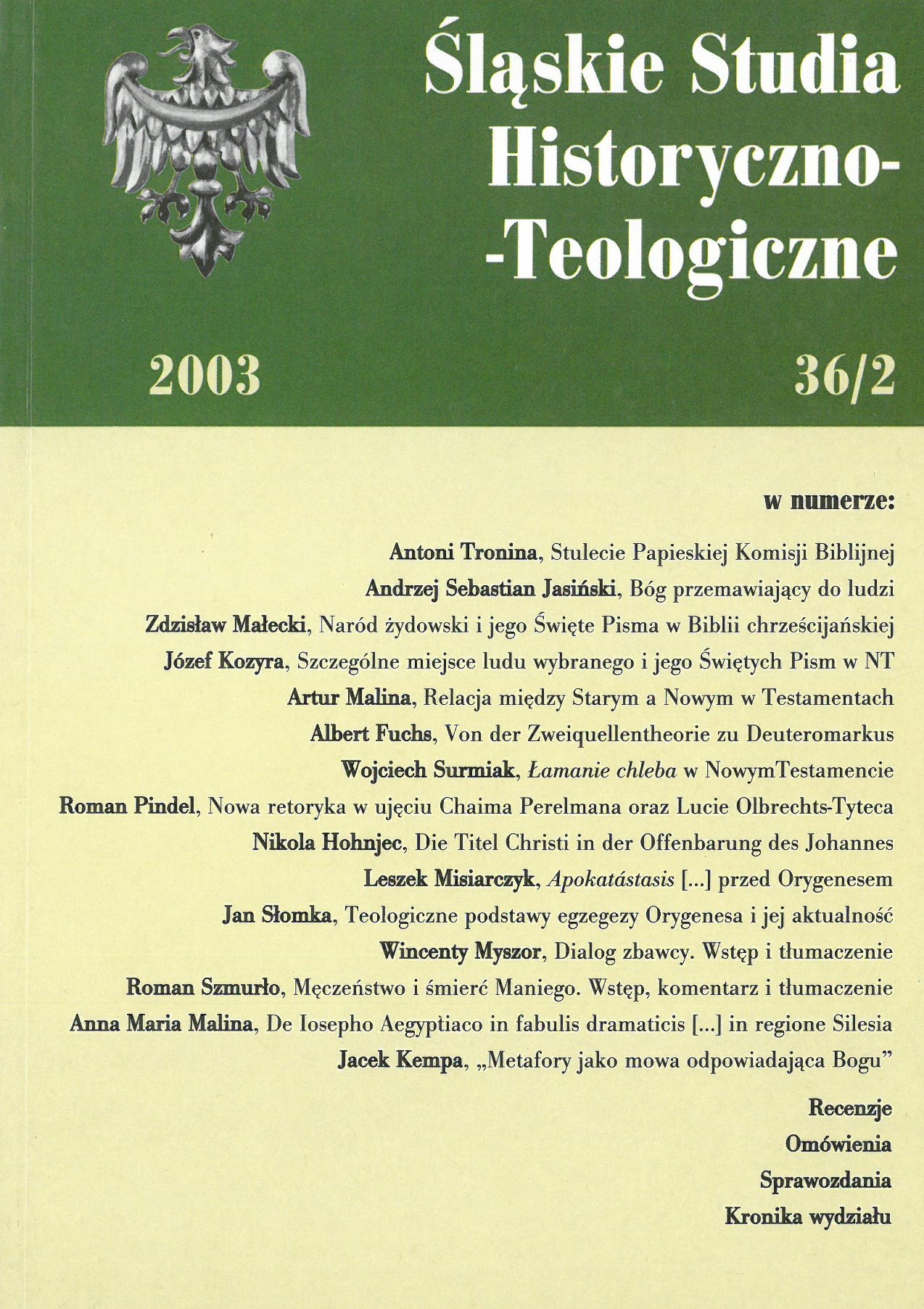
Frazione del pane nel Nuovo Testamento (Lc 24,35 e At 2,42)

Wojciech Surmiak

Abstract

L’Eucarestia viene spesso definita come frazione del pane. Il termine ha delle proprie origini nella tradizione biblica. Alle soglie del cristianesimo quel gesto di spezzare il pane, caratteristico per il mondo semitico, era soprattutto il segno della particolare stima verso il dono di Dio, ma portava pure il significato di apertura, di fraternità, di giustizia, di ospitalità e di compassione. Per gli Ebrei essere in possesso del pane era un visibile segno della benedizione di Dio e la possibilità di spezzarlo con qualcuno simboleggiava l’amicizia e la comunità. Sia gli storici di liturgia che gli esegeti finora hanno dei dubbi se quella formula possa essere considerata come il termine tecnico dell’Eucarestia. La difficoltà di concordare diverse opinioni sta anche nel fatto che quel termine viene usato nel Nuovo Testamento soltanto due volte e soltanto nell’opera lucana. Il riconoscimento di Gesù Risuscitato dai discepoli di Emmaus nel gesto di „frazione del pane” pare una costruzione letteraria di Luca. Se fosse proprio così, non sarebbe più importante se Gesů poteva celebrare l’Eucarestia ad Emmaus, ma solo se Luca aveva intenzione di parlarci di Eucarestia in quel momento. Sembra evidente che l’autore del Vangelo volesse far riferimento alla pratica di celebrazione della Cena del Signore nei suoi tempi. Questo sarebbe il senso generale della scena descritta. L’espressione klasis tou artou ha un significato particolare per Luca. La usa per indicare un ricordo di passione e di Rissurezione di Gesù Cristo, celebrato nei suoi tempi. I primi cristiani si incontrano in comunità: ascoltano la Parola di Dio e spezzano il pane (Atti 20,7–12). Si riuniscono il primo giorno dopo il sabato (verso 7), cioè la domenica, e il luogo di riunione è la casa – domus ecclesiae. Dunque questi tre elemeti: il rito (ascoltare la Parola di Dio e spezzare il pane), il tempo cioè il giorno d’incontro (domenica) e il luogo di riunione (casa) diventano la caratteristica della prima Chiesa di Gesù Cristo. Nei testi dei Padri della Chiesa sostanzialmente troviamo l’interpretazione eucaristica della formula fractio panis. Per S. Agostino e per S. Beda Venerabile fu evidente che si parlasse di Eucarestia. Pure S. Gerolamo sostenendo che la casa di Cleopa ad Emmaus venne cambiata in Chiesa, afferma la continuazione dello stesso rito nello stesso posto. Sembra anche che la riscoperta della bellezza letteraria e teologica di quella pericope abbia causato l’inserimento dei suoi elementi nei canoni eucaristici nella liturgia dopo il Concilio Vaticano II (Preghiera Eucaristica V).

Download files

Citation rules

Surmiak, W. (2025). Frazione del pane nel Nuovo Testamento (Lc 24,35 e At 2,42). Śląskie Studia Historyczno-Teologiczne, 36(2), 404–413. Retrieved from https://journals.us.edu.pl/index.php/ssht/article/view/19295 (Original work published December 31, 2003)

Licence

Creative Commons License

This work is licensed under a Creative Commons Attribution-ShareAlike 4.0 International License.


The Copyright Owners of the submitted texts grant the Reader the right to use the pdf documents under the provisions of the Creative Commons 4.0 International License: Attribution-Share-Alike (CC BY-SA). The user can copy and redistribute the material in any medium or format and remix, transform, and build upon the material for any purpose.

1. License

The University of Silesia Press provides immediate open access to journal’s content under the Creative Commons BY-SA 4.0 license (http://creativecommons.org/licenses/by-sa/4.0/). Authors who publish with this journal retain all copyrights and agree to the terms of the above-mentioned CC BY-SA 4.0 license.

2. Author’s Warranties

The author warrants that the article is original, written by stated author/s, has not been published before, contains no unlawful statements, does not infringe the rights of others, is subject to copyright that is vested exclusively in the author and free of any third party rights, and that any necessary written permissions to quote from other sources have been obtained by the author/s.

If the article contains illustrative material (drawings, photos, graphs, maps), the author declares that the said works are of his authorship, they do not infringe the rights of the third party (including personal rights, i.a. the authorization to reproduce physical likeness) and the author holds exclusive proprietary copyrights. The author publishes the above works as part of the article under the licence "Creative Commons Attribution-ShareAlike 4.0 International".

ATTENTION! When the legal situation of the illustrative material has not been determined and the necessary consent has not been granted by the proprietary copyrights holders, the submitted material will not be accepted for editorial process. At the same time the author takes full responsibility for providing false data (this also regards covering the costs incurred by the University of Silesia Press and financial claims of the third party).

3. User Rights

Under the CC BY-SA 4.0 license, the users are free to share (copy, distribute and transmit the contribution) and adapt (remix, transform, and build upon the material) the article for any purpose, provided they attribute the contribution in the manner specified by the author or licensor.

4. Co-Authorship

If the article was prepared jointly with other authors, the signatory of this form warrants that he/she has been authorized by all co-authors to sign this agreement on their behalf, and agrees to inform his/her co-authors of the terms of this agreement.

I hereby declare that in the event of withdrawal of the text from the publishing process or submitting it to another publisher without agreement from the editorial office, I agree to cover all costs incurred by the University of Silesia in connection with my application.

Vol. 36 No. 2 (2003)
Published: 2021-02-10


ISSN: 0137-3447
eISSN: 2956-6185

Publisher
Księgarnia św. Jacka

Licence CC Creative Commons License

This work is licensed under a Creative Commons Attribution-ShareAlike 4.0 International License.

This website uses cookies for proper operation, in order to use the portal fully you must accept cookies.