
Published: 2002-12-31

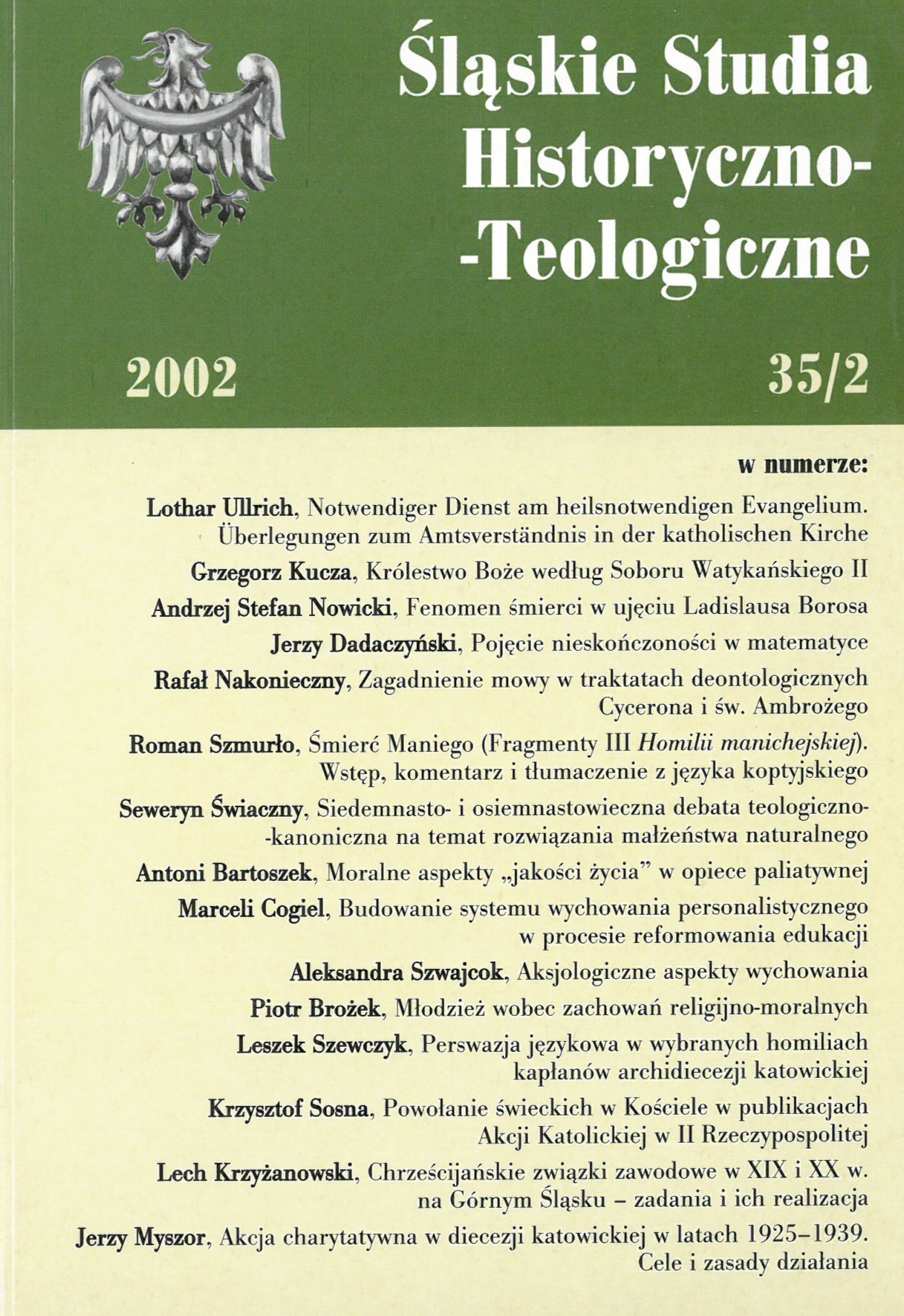
Moralische Aspekte der „Lebensqualität” in der Palliativpflege

Antoni Bartoszek

Abstract

Sowohl in der Palliativpflege als auch im gesamten Leben der Gesellschaft gibt es ein großes Interesse an der „Lebensqualität”. Im Hintergrund der heutigen Sorge um die hohe „Lebensqualität” stehen verschiedene Konzepte der menschlichen Person. Eine reduzierende Sicht der menschlichen Person hat einen verengten Begriff der „Lebensqualität” zur Folge. Aus einem umfassenden Konzept der menschlichen Person resultiert hingegen ein integrales Konzept der „Lebensqualität”.
Der Ausgangspunkt für ein reduzierendes Konzept der „Lebensqualität” ist die materialistische Sicht des Menschen, die keine geistige Dimension im Menschen anerkennt. Die „Lebensqualität” wird hier in den Kategorien der ökonomischen Leistung, des ungeordneten Konsums, des Spaßes und des Genusses interpretiert. Dabei werden tiefere – geistige und religiöse – Dimensionen der Existenz vergessen. Der verengte Begriff der „Lebensqualität” führt in bestimmten Fällen zur Überzeugung, dass das Leben eines behinderten Kindes oder eines sterbenden Greises seine Würde verliere, weil es eine niedrige „Qualität” habe, und deshalb ihm ein Ende (Euthanasie) gesetzt werden könne. Angesichts einer solchen Auffassung über die „Lebensqualität” ist ein persönlicher und gesellschaftlicher Widerstand notwendig.
Das integrale Konzept des Menschen, aus dem sich die rechte Sicht der „Lebensqualität” ergibt, beinhaltet die Wahrheit über die Heiligkeit und die Unantastbarkeit des menschlichen Lebens. Das Leben des Menschen ist heilig, d.h. es ist ein von der „Lebensqualität” unabhängiger Wert. Die „Lebensqualität” gehört nicht zu seinem Wesen und konstituiert es nicht. Das integrale Konzept der „Lebensqualität” erfordert auch die Berücksichtigung der transzendenten Dimension der Menschlichkeit. Es wird postuliert, dass bei der Untersuchung der „Lebensqualität” der sog. „interne Parameter” berücksichtigt wird, der aus der geistigen Natur des Menschen kommt, die in sich Beziehung zur Wahrheit, zum Guten, zu Gott, zum anderen Menschen beinhaltet. In der geistigen Dimension des Menschseins haben ebenso die Fragen nach dem Sinn der Lebens, des Leidens, des Todes ihren Ort.
Für die Palliativpflege, für alle Aktivitäten, deren Ziel die Sicherung einer hohen „Lebensqualität” ist, wird das integrale Konzept zum bleibenden Fundament, das vor einer eingeengten Sicht des menschlichen Lebens schützt und die Achtung vor der Würde der menschlichen Person gewährleistet. Die Begleitung des Sterbenden und die Palliativbehandlung, die die geistigkörperliche Einheit des Menschen berücksichtigen, dienen dem Wachstum der integral verstandenen „Lebensqualität” und leisten deren reduzierenden Sicht Widerstand.

Download files

Citation rules

Bartoszek, A. (2002). Moralische Aspekte der „Lebensqualität” in der Palliativpflege. Śląskie Studia Historyczno-Teologiczne, 35(2), 309–330. Retrieved from https://journals.us.edu.pl/index.php/ssht/article/view/19406

Licence

Creative Commons License

This work is licensed under a Creative Commons Attribution-ShareAlike 4.0 International License.


The Copyright Owners of the submitted texts grant the Reader the right to use the pdf documents under the provisions of the Creative Commons 4.0 International License: Attribution-Share-Alike (CC BY-SA). The user can copy and redistribute the material in any medium or format and remix, transform, and build upon the material for any purpose.

1. License

The University of Silesia Press provides immediate open access to journal’s content under the Creative Commons BY-SA 4.0 license (http://creativecommons.org/licenses/by-sa/4.0/). Authors who publish with this journal retain all copyrights and agree to the terms of the above-mentioned CC BY-SA 4.0 license.

2. Author’s Warranties

The author warrants that the article is original, written by stated author/s, has not been published before, contains no unlawful statements, does not infringe the rights of others, is subject to copyright that is vested exclusively in the author and free of any third party rights, and that any necessary written permissions to quote from other sources have been obtained by the author/s.

If the article contains illustrative material (drawings, photos, graphs, maps), the author declares that the said works are of his authorship, they do not infringe the rights of the third party (including personal rights, i.a. the authorization to reproduce physical likeness) and the author holds exclusive proprietary copyrights. The author publishes the above works as part of the article under the licence "Creative Commons Attribution-ShareAlike 4.0 International".

ATTENTION! When the legal situation of the illustrative material has not been determined and the necessary consent has not been granted by the proprietary copyrights holders, the submitted material will not be accepted for editorial process. At the same time the author takes full responsibility for providing false data (this also regards covering the costs incurred by the University of Silesia Press and financial claims of the third party).

3. User Rights

Under the CC BY-SA 4.0 license, the users are free to share (copy, distribute and transmit the contribution) and adapt (remix, transform, and build upon the material) the article for any purpose, provided they attribute the contribution in the manner specified by the author or licensor.

4. Co-Authorship

If the article was prepared jointly with other authors, the signatory of this form warrants that he/she has been authorized by all co-authors to sign this agreement on their behalf, and agrees to inform his/her co-authors of the terms of this agreement.

I hereby declare that in the event of withdrawal of the text from the publishing process or submitting it to another publisher without agreement from the editorial office, I agree to cover all costs incurred by the University of Silesia in connection with my application.

Vol. 35 No. 2 (2002)
Published: 2021-02-10


ISSN: 0137-3447
eISSN: 2956-6185

Publisher
Księgarnia św. Jacka

Licence CC Creative Commons License

This work is licensed under a Creative Commons Attribution-ShareAlike 4.0 International License.

This website uses cookies for proper operation, in order to use the portal fully you must accept cookies.