
The origins of Catholic youth organisations in Upper Silesia date back to 1871 when Father N. Bonczyk founded the St. Aloisius Society (known as the Society of Aloisians) in Bytom, which grouped young workers and craftsmen. The activity of the Societies was directed towards a cultural, educational and religious advancement of youth under the supervision of patron priests. In 1897 G. Koop, the bishop of Wrocław, decreed the dissolution of St. Aloisius Societies. At that time thirty seven societies of this type were operating in Silesia. Some of them survived and at the beginning of the 20th century were transformed into extramural youth organisations. However, during the First World War most of those independent organisations either disintegrated or were suspended. In the years 1919–1934 parish organisations for young men and women assumed the name of Polish Youth Associations (SMP – stowarzyszenia młodzieży polskiej). On December 12, 1920 the Silesian Union of Polish Youth Associations came into being, which incorporated both male and female youth organisations. Union Councils and the Secretariat General formed the leadership of the Union. The Union Council for Silesia included the following committees: educational and editorial, financial, agricultural, for religious upbringing, teetotal, and auditorial. The seat of the Secretariat for the Silesian Union was initially in Królewska Huta (Chorzów), and later in Mikołów. In November 1927 the Silesian Union was divided into two separate unions – male and female. The headquarters of the Union of male organisations were in Mikołów (from 1929 in Katowice), while those of the female Union in Katowice. Following the reorganisation in 1934, both diocesan headquarters adopted the names: Young Men’s Catholic Association (KSMM) and Young Women’s Catholic Association (KSMŻ), respectively. The patronage system was also given up in 1934. This was connected with the incorporation of youth organisations into the Catholic Action and the ensuing change of statutes. Priests continued to perform the functions of Secretaries General, but the diocesan boards were headed by lay presidents. In 1938 the diocesan board of the male organisations grouped 277 local organisations with a total of 13 707 regular members and over 2000 auxiliaries. Youth from rural areas made up only 20,8% of the entire membership. In 1938 Young Men’s Catholic Association in Upper Silesia was the second largest in Poland, preceded only by KSMM in the Great Poland (Wielkopolska) province. The area of the Katowice diocese was divided into districts which grouped the parish organisations in the vicinity. In 1938 the Zaolzie district was incorporated where 23 branches of KSMM were created. In order to integrate all the members of the Union conventions and meetings of young associates were organised annualy. The aim of KSMM was the religious formation of young men by organising special events, annual celebrations in honour of St. Stanisław Kostaka, the patron saint of youth, and closed retreats. The diocesan board also encouraged various cultural movements by organising conferences for librarians in particular districts, recommending accessible plays which could be staged by amateur theatricals, booking once a month a performance at the Polish Theatre in Katowice, renting a cine projector, and by propagating tourism. In addition, the Union published a monthly titled „Okólnik” („The Circular”). Catholic organisations for young women developed slower. Initially there were eleven of them. On May 30, 1926 the first congress of delegates of the Silesian organisations took place in Panewniki. On October 9, 1927 during the congress in Katowice it was decreed that the female organisation was to be separated from the male one. The female organisations realised the same aims as the male ones. Their activities focused on religious and cultural education.
Download files
Citation rules
Licence

This work is licensed under a Creative Commons Attribution-NonCommercial-NoDerivatives 4.0 International License.
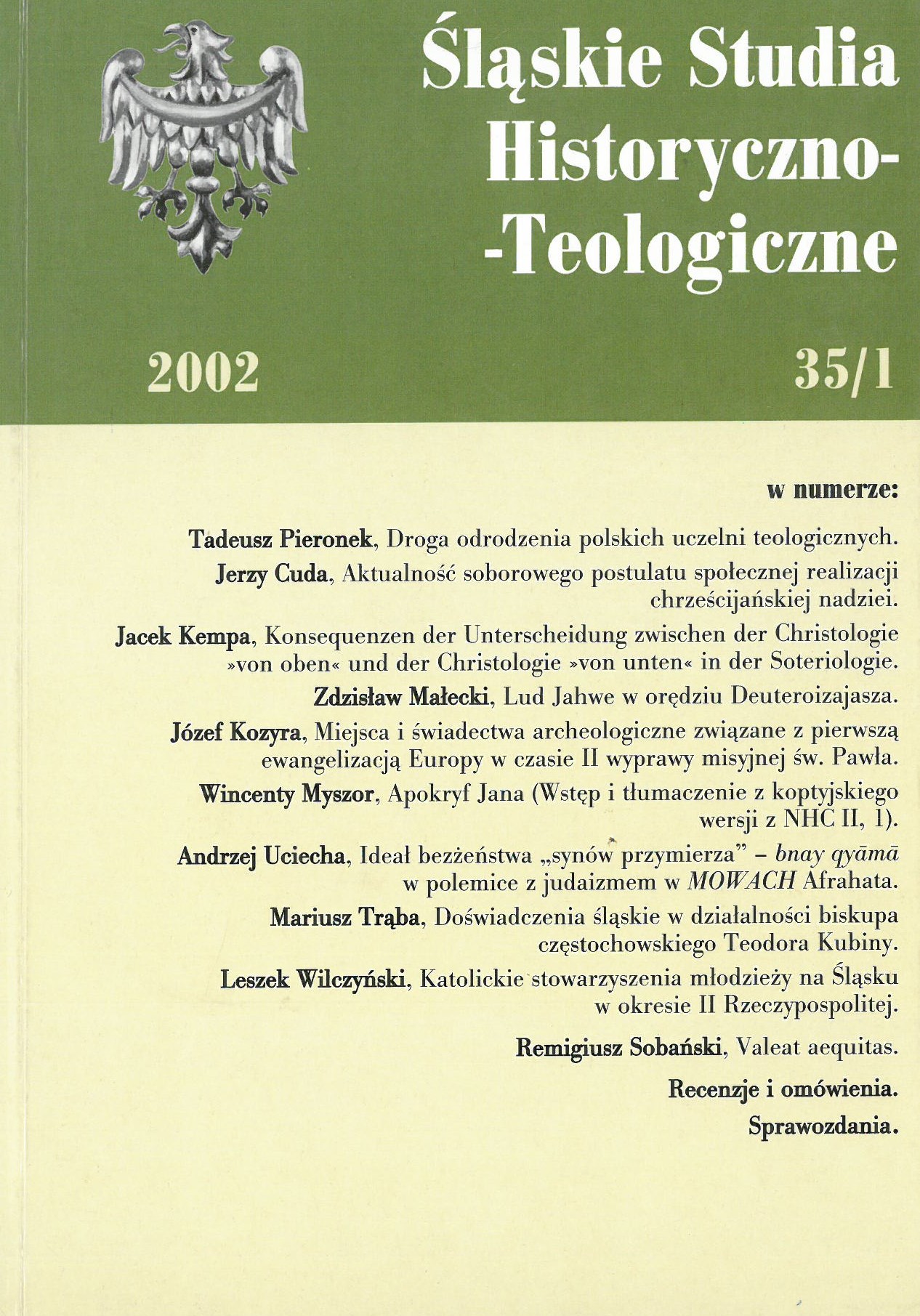
Vol. 35 No. 1 (2002)
Published: 2002-06-30
This work is licensed under a Creative Commons Attribution-NonCommercial-NoDerivatives 4.0 International License.

 English
 Język Polski