
Published: 2004-06-30

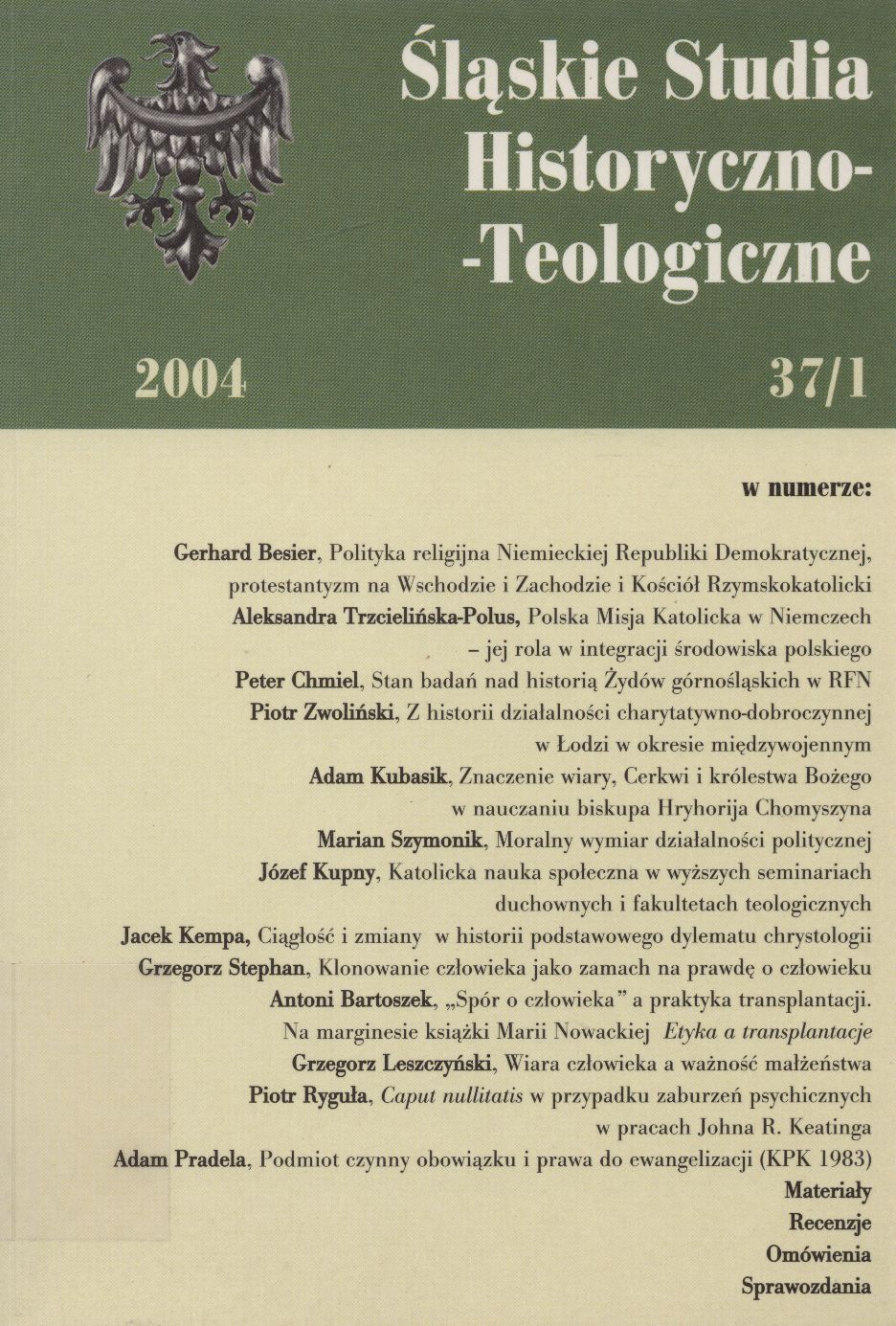
Caput nullitatis en los casos de los trastornos mentales (un poco de historia del actual canon 1095)

Piotr Ryguła

Abstract

La incapacidad consensual está regulada actualmente por un precepto nuevo – que no aparecía en el Código de 1917 – de modo explícito por el texto del canon 1095. Por la expresión „precepto nuevo” no se quiere decir, sin embargo, que el autor de este texto no ha acogido una serie de criterios que la doctrina y la jurisprudencia ha ido perfilando a lo largo de muchos ańos.
En este artículo no vamos a analizar, sin embargo, el texto del nuevo canon. Lo han hecho y lo están haciendo muchos autores. En nuestro estudio vamos a detenernos en una etapa concreta de la historia de la reflexión jurídica sobre la capacidad humana de contraer el vínculo matrimonial válido, en el caso de trastorno metal ocurrido. Al concretizar todavía más, vamos a estudiar los textos de John R. Keating, un autor de lengua inglesa, quien fue uno de los primeros, en ocuparse del tema de la influencia de dichos trastornos en la validez del matrimonio. El autor, prácticamente desconocido fuera de la cultura de habla inglesa, en su tiempo fue uno de los precursores más destacados del tema mencionado, preguntando y poniendo de relieve unas ideas nuevas en cuanto a la influencia de los trastornos mentales en la validez del matrimonio. Creemos, que por este artículo vamos a despertar de nuevo el interés por la cuestión resuelta por ahora por medio de las nuevas regulaciones del Código de 1983.

Download files

Citation rules

Ryguła, P. (2004). Caput nullitatis en los casos de los trastornos mentales (un poco de historia del actual canon 1095). Śląskie Studia Historyczno-Teologiczne, 37(1), 139–152. Retrieved from https://journals.us.edu.pl/index.php/ssht/article/view/21593

Licence

Creative Commons License

This work is licensed under a Creative Commons Attribution-ShareAlike 4.0 International License.


The Copyright Owners of the submitted texts grant the Reader the right to use the pdf documents under the provisions of the Creative Commons 4.0 International License: Attribution-Share-Alike (CC BY-SA). The user can copy and redistribute the material in any medium or format and remix, transform, and build upon the material for any purpose.

1. License

The University of Silesia Press provides immediate open access to journal’s content under the Creative Commons BY-SA 4.0 license (http://creativecommons.org/licenses/by-sa/4.0/). Authors who publish with this journal retain all copyrights and agree to the terms of the above-mentioned CC BY-SA 4.0 license.

2. Author’s Warranties

The author warrants that the article is original, written by stated author/s, has not been published before, contains no unlawful statements, does not infringe the rights of others, is subject to copyright that is vested exclusively in the author and free of any third party rights, and that any necessary written permissions to quote from other sources have been obtained by the author/s.

If the article contains illustrative material (drawings, photos, graphs, maps), the author declares that the said works are of his authorship, they do not infringe the rights of the third party (including personal rights, i.a. the authorization to reproduce physical likeness) and the author holds exclusive proprietary copyrights. The author publishes the above works as part of the article under the licence "Creative Commons Attribution-ShareAlike 4.0 International".

ATTENTION! When the legal situation of the illustrative material has not been determined and the necessary consent has not been granted by the proprietary copyrights holders, the submitted material will not be accepted for editorial process. At the same time the author takes full responsibility for providing false data (this also regards covering the costs incurred by the University of Silesia Press and financial claims of the third party).

3. User Rights

Under the CC BY-SA 4.0 license, the users are free to share (copy, distribute and transmit the contribution) and adapt (remix, transform, and build upon the material) the article for any purpose, provided they attribute the contribution in the manner specified by the author or licensor.

4. Co-Authorship

If the article was prepared jointly with other authors, the signatory of this form warrants that he/she has been authorized by all co-authors to sign this agreement on their behalf, and agrees to inform his/her co-authors of the terms of this agreement.

I hereby declare that in the event of withdrawal of the text from the publishing process or submitting it to another publisher without agreement from the editorial office, I agree to cover all costs incurred by the University of Silesia in connection with my application.

Vol. 37 No. 1 (2004)
Published: 2021-02-10


ISSN: 0137-3447
eISSN: 2956-6185

Publisher
Księgarnia św. Jacka

Licence CC Creative Commons License

This work is licensed under a Creative Commons Attribution-ShareAlike 4.0 International License.

This website uses cookies for proper operation, in order to use the portal fully you must accept cookies.