

Gradual desacralization is one of distinctive features of our world. Nevertheless, men who decide to lead the lay life cannot free themselves totally from religion. Recent sociological studies prove without doubt that young Poles are strongly influenced by the religious doctrine resulting from the deeply-rooted Catholic tradition which plays an important role in forming one’s outlook on life.
In 1997 a questionnaire was given to pre-graduates, the total number being 378 students, in two high schools in Lublin. This particular age group seems to be of special importance since their opinions are fairy established already. The analysis of religious and moral attitudes shows that acts against truth and one’s own self are the most disapproved ones. Some acts against conjugal morality and faith are approved. Liberalization connected with sexual attitudes is demonstrated mainly when pre-marital sexual relations are concerned; these are definitely approved by the majority of young people. On the other hand a greater part of the respondents accepts a necessity of being married at least at a church wedding as a basic condition of being a wife and a husband. Almost three third of the students are against abortion but only a half of them are for banning it altogether. The students coming from the intelligentsia families are characterized by greater acceptance of liberal attitudes. Few of them condemn acts against conjugal morality and religious faith, pre-marital sexual relations or a total ban on abortion and they rarely perceive a necessity of having a church or civil marriage certificate. Students who come from big cities often choose unorthodox answers. They approve of self abuse, acts against faith, pre-marital sexual freedom, civil weddings and accept abortion unconditionally. Answers given by female students stress a necessity of having a church and civil marriage certificate to be lawfully married. They also more often express the opinion that terminating a pregnancy should be banned altogether. On the basis of the conducted analyses it can be concluded that coming from the intelligentsia may result in moral attitudes incompatible with the teachings of the Church. Similar conclusion can be drawn concerning people born in big cities. These relations, however, are statistically irrelevant. The same can be said about the sex of respondents. Girls are prone to behave in a more orthodox manner than boys. The results of the research show the influence of socio-cultural pluralism on the dominance of selective attitudes. What is crucial, however, is the fact that there exists a group of people who present the accommodative attitude, i.e. accepting the relevant aspects of the teaching of the Church, whereas those who refuse to comply with the teachings of the Church altogether are a marginal group. This may testify to continuity of the attitudes showing acceptance of moral attitudes as proposed by the Church which, despite competition of other outlooks and lifestyles, will not lose their identity in the attitudes of generations to come. The presented results are obviously limited to a specific community and a precisely determined group of people. Therefore it seems advisable that further research be conducted taking into consideration other communities and social groups.
Pobierz pliki
Zasady cytowania
Licencja

Utwór dostępny jest na licencji Creative Commons Uznanie autorstwa – Użycie niekomercyjne – Bez utworów zależnych 4.0 Międzynarodowe.
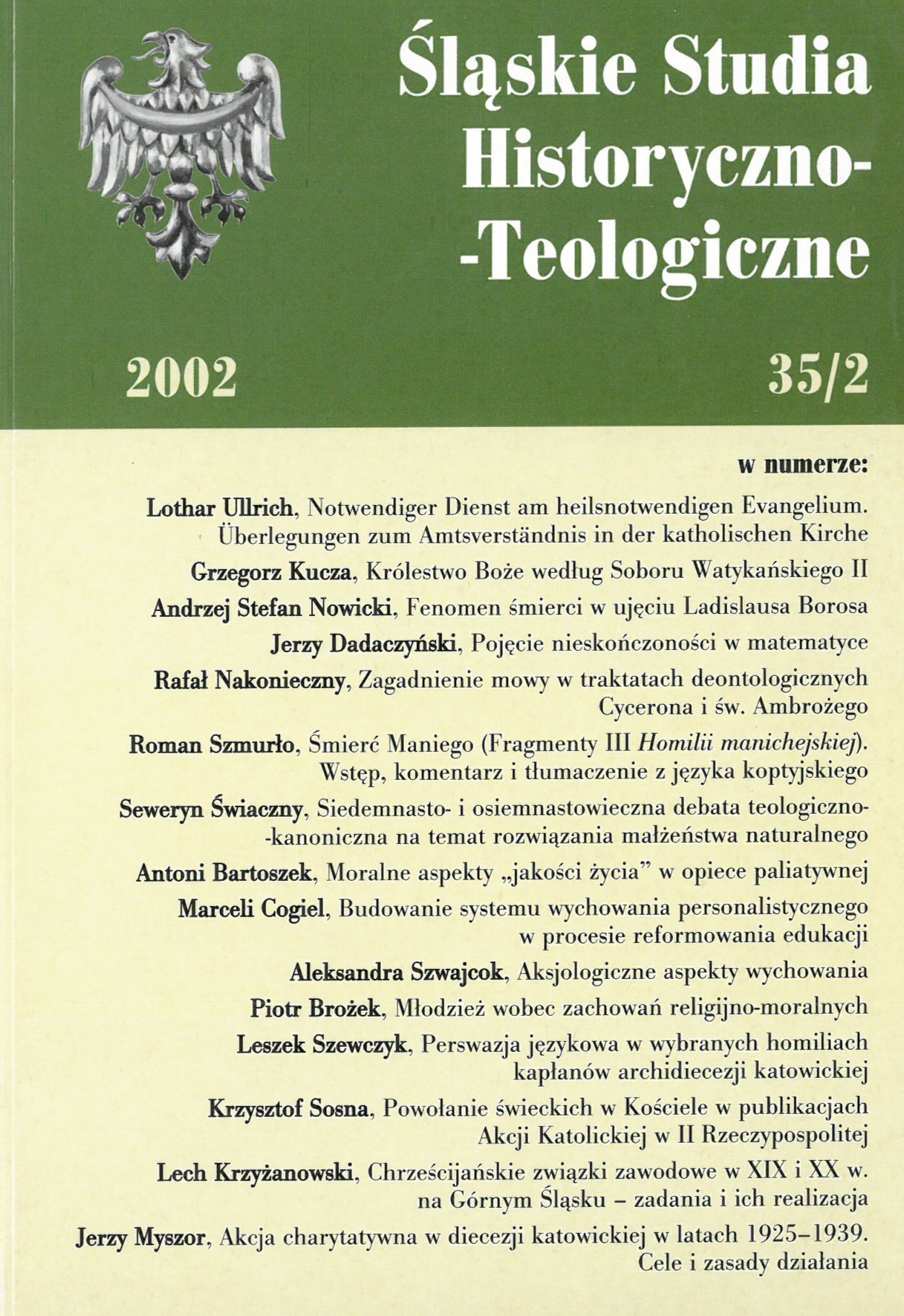
Tom 35 Nr 2 (2002)
Opublikowane: 31.12.2002
Utwór dostępny jest na licencji Creative Commons Uznanie autorstwa – Użycie niekomercyjne – Bez utworów zależnych 4.0 Międzynarodowe.

 English
 Język Polski