
 https://doi.org/10.31261/SSHT.2018.51.2.02
Descartes introduced a new method of thinking, which became a binding paradigm of modern science. This method replaced Aristotle's physics and in practice invalidated his metaphysics. The main thesis of the article is a statement that the Cartesian way of thinking is unable to "see" human beings in their humanity. It perceives a human being as a complicated mechanism – a machine. Therefore, theology cannot accept Cartesian assumptions as the basis of its reflection. It has to find other rational foundations and ways of thinking. Certainly, it is not a right way for theology to attempt to revoke or disregard the Cartesian revolution and return to scholasticism. Theology receives assistance in this quest from the European philosophy of the twentieth century, which also tries to break free from the Cartesian paradigm. In this context, the article indicates the twentieth century philosophical reflection on the language: semiotics and hermeneutics, and the reflection of E. Levinas, as especially useful in these theological quests. Offering theological and spiritual reflection beyond the Cartesian paradigm is increasingly important, due to the rapid development of technology, especially the so-called "artificial intelligence".
Download files
Citation rules
Cited by / Share




Licence

This work is licensed under a Creative Commons Attribution-NonCommercial-NoDerivatives 4.0 International License.
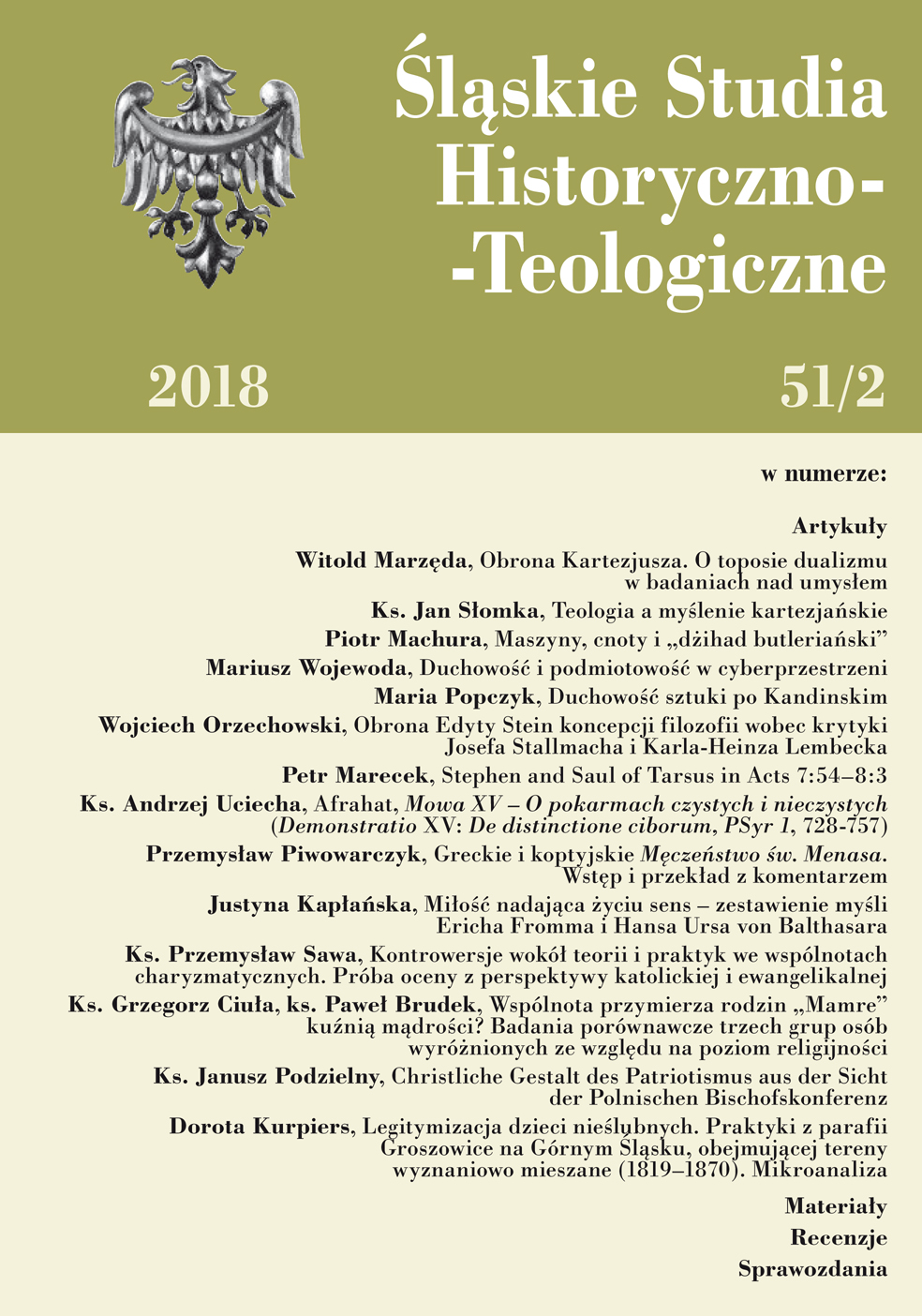
Vol. 51 No. 2 (2018)
Published: 2018-12-31
This work is licensed under a Creative Commons Attribution-NonCommercial-NoDerivatives 4.0 International License.

 English
 Język Polski