
 https://doi.org/10.31261/SSHT.2016.49.2.02
In his commentary on Genesis, Ishodad of Merv, while following the practice commonly used in the 8th and 9th century, adapts and compiles various exegetical texts. The work of this bishop and theologian, regarded by Nestorians as one of the most prominent, includes the fragments of the earlier studies of Syrian and Greek exegetes, especially those of Theodore of Mopsuestia, Ephrem the Syrian, Henana of Adiabene (+610), Dadisho Qatraya (7th century), Basil of Caesarea and John Chrysostom. Ishodad also uses Jewish exegesis of the time. His positive view of anthropological and social position of a woman is relative: Eve is no longer Adam’s slave, yet she does not have such authority as he does. She is and will remain only half of a man. They both constitute a whole, and to create such a whole, one needs the other.
Download files
Citation rules
Cited by / Share




Licence

This work is licensed under a Creative Commons Attribution-NonCommercial-NoDerivatives 4.0 International License.
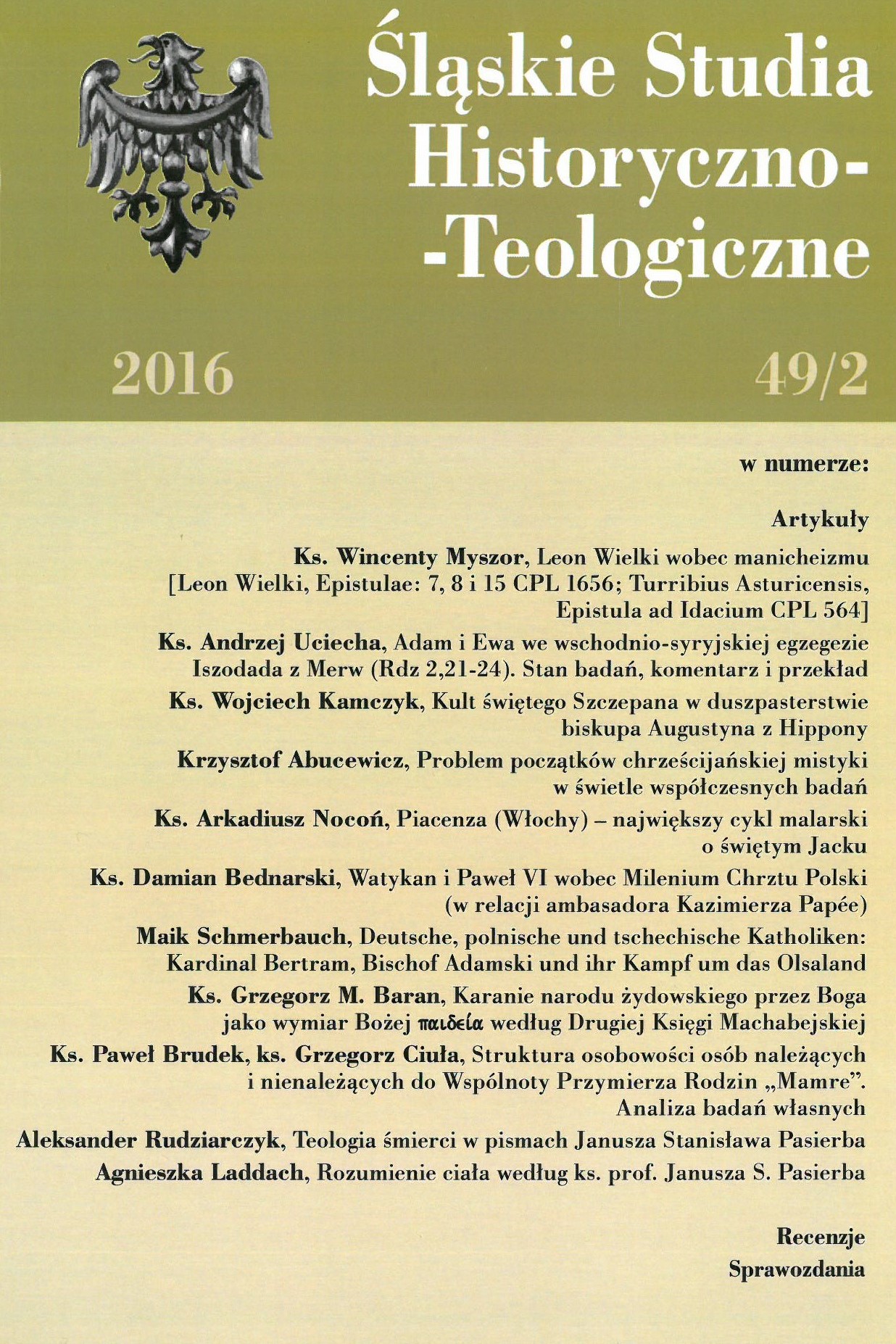
Vol. 49 No. 2 (2016)
Published: 2016-12-31
This work is licensed under a Creative Commons Attribution-NonCommercial-NoDerivatives 4.0 International License.

 English
 Język Polski