
Published: 2002-12-31

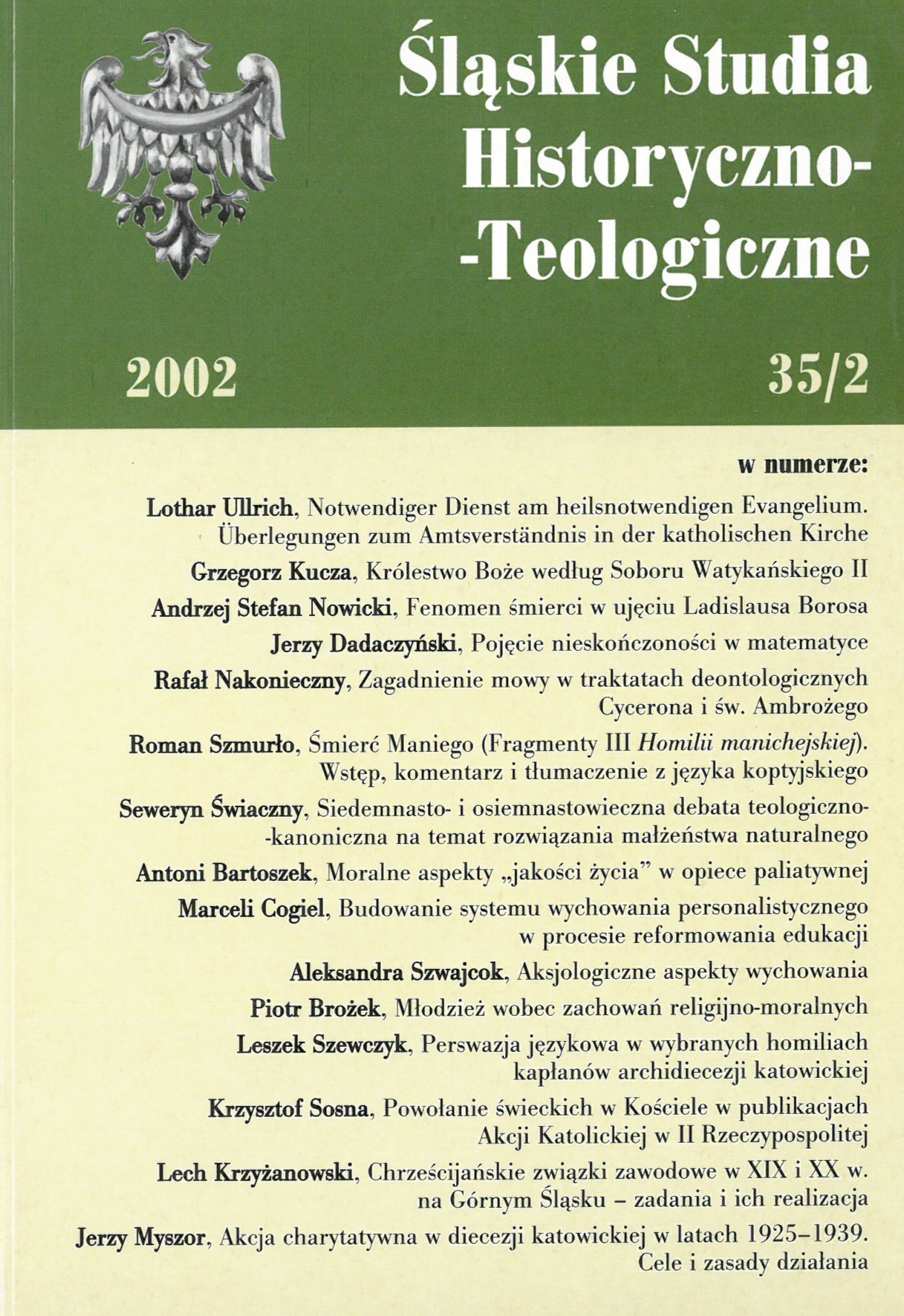
Sprachliche Persuasion in ausgewählten Homilien der Priester Kattowitzer Erzbistums

Leszek Szewczyk

Abstract

Der Begriff „Persuasion” stammt vom lateinischen „persuadere”; er bedeutet Überreden, Zureden und erfuhr viele Definitionsversuche. Polnische Wörterbücher der Nachkriegszeit erklären diesen Begriff mit der funktionellen Wortbedeutung; französische und englische Wörterbücher dagegen zeigen den Zusammenhang des Begriffes „Persuasion” mit dem Glauben, mit den Systemen der Überzeugung.
Den Stil einer Überredung kennzeichnen die Intensität typischer Ausdrücke und auch die stilistischen Bemühungen, welche sich als Ziel den Empfang der Aussage setzen. Meistens sind das abschätzende, schematisierende, ermutigende und befehlende Worte, sowie eine inhaltliche Tendenz der Worte in dieser Richtung oder gemeinsam vorkommende Worte ähnlicher Funktion.
Der Wortschatz ist sicher das am meisten verbreitete Mittel zur Bildung der Anschauung und in Konsequenz auch zur Bildung der Einstellung der Hörer. Die geeignete Auswahl der Worte in jeder Art der Kommunikation, auch in der verkündigten Predigt, hat große Bedeutung; unter anderem kann sie die Funktion der Überredung erfüllen, welche die meistverbreitete Form ist, eine Einstellung und die Ansicht der Empfänger zu beeinflussen.
Morphologische Mittel können der Aussage einen überredenden Charakter geben. Ein besonders charakteristisches Beispiel für die Beeinflussung durch Überredung ist die geeignet benutzte zeitwörtliche Kategorie der Person und die Benutzung der Zukunftsform. Auch syntaktischen Strukturen kann man persuasorischen Wert beimessen. Syntaktische Konstruktionen, welche persuasorischen Wert enthalten, haben meistens die Form eines Umstandssatzes mit Zweck und Bedingung. Eine große persuasorische Bedeutung haben auch Fragen. Im vorliegenden Artikel werden 33 Homilien von Priestern des Erzbistums Kattowitz analysiert. Diese Priester nutzten in ihren Predigten die Mittel der Persuasion. Eine Antwort darauf, in welchem Ausmaße sie bewusst handelten und ob sie absichtlich die Vorschriften der rhetorischen Kunst ausnutzten, erfordert die Durchführung einer Forschung im Bereich der Rezeption rhetorischen Kenntnisse der oben erwähnten Priester.

Download files

Citation rules

Szewczyk, L. (2002). Sprachliche Persuasion in ausgewählten Homilien der Priester Kattowitzer Erzbistums. Śląskie Studia Historyczno-Teologiczne, 35(2), 359–376. Retrieved from https://journals.us.edu.pl/index.php/ssht/article/view/19410

Licence

Creative Commons License

This work is licensed under a Creative Commons Attribution-ShareAlike 4.0 International License.


The Copyright Owners of the submitted texts grant the Reader the right to use the pdf documents under the provisions of the Creative Commons 4.0 International License: Attribution-Share-Alike (CC BY-SA). The user can copy and redistribute the material in any medium or format and remix, transform, and build upon the material for any purpose.

1. License

The University of Silesia Press provides immediate open access to journal’s content under the Creative Commons BY-SA 4.0 license (http://creativecommons.org/licenses/by-sa/4.0/). Authors who publish with this journal retain all copyrights and agree to the terms of the above-mentioned CC BY-SA 4.0 license.

2. Author’s Warranties

The author warrants that the article is original, written by stated author/s, has not been published before, contains no unlawful statements, does not infringe the rights of others, is subject to copyright that is vested exclusively in the author and free of any third party rights, and that any necessary written permissions to quote from other sources have been obtained by the author/s.

If the article contains illustrative material (drawings, photos, graphs, maps), the author declares that the said works are of his authorship, they do not infringe the rights of the third party (including personal rights, i.a. the authorization to reproduce physical likeness) and the author holds exclusive proprietary copyrights. The author publishes the above works as part of the article under the licence "Creative Commons Attribution-ShareAlike 4.0 International".

ATTENTION! When the legal situation of the illustrative material has not been determined and the necessary consent has not been granted by the proprietary copyrights holders, the submitted material will not be accepted for editorial process. At the same time the author takes full responsibility for providing false data (this also regards covering the costs incurred by the University of Silesia Press and financial claims of the third party).

3. User Rights

Under the CC BY-SA 4.0 license, the users are free to share (copy, distribute and transmit the contribution) and adapt (remix, transform, and build upon the material) the article for any purpose, provided they attribute the contribution in the manner specified by the author or licensor.

4. Co-Authorship

If the article was prepared jointly with other authors, the signatory of this form warrants that he/she has been authorized by all co-authors to sign this agreement on their behalf, and agrees to inform his/her co-authors of the terms of this agreement.

I hereby declare that in the event of withdrawal of the text from the publishing process or submitting it to another publisher without agreement from the editorial office, I agree to cover all costs incurred by the University of Silesia in connection with my application.

Vol. 35 No. 2 (2002)
Published: 2021-02-10


ISSN: 0137-3447
eISSN: 2956-6185

Publisher
Księgarnia św. Jacka

Licence CC Creative Commons License

This work is licensed under a Creative Commons Attribution-ShareAlike 4.0 International License.

This website uses cookies for proper operation, in order to use the portal fully you must accept cookies.