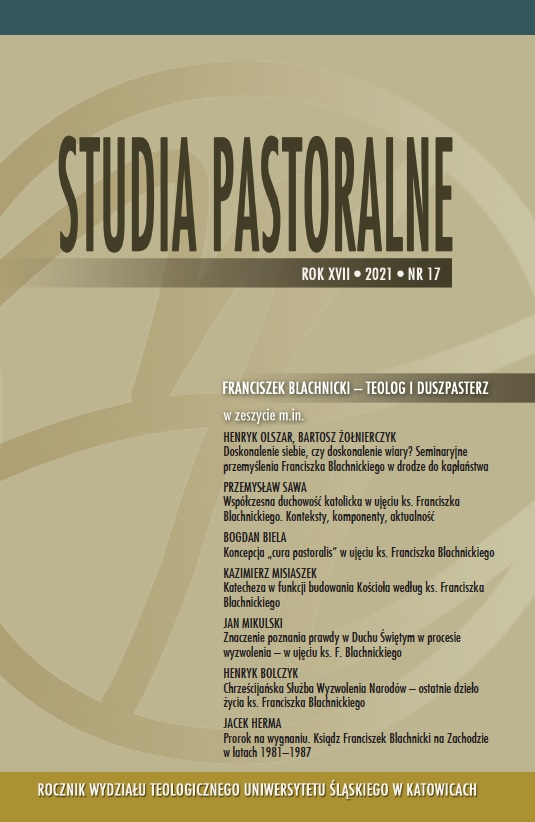
In this article Author describes this stage of rev. Franciszek Blachnicki’s life during his studying in The Silesian High Theological Seminar in Krakow (1945–1950). It was that place, where he assigned himself some tasks which constantly realize in his path to the priesthood. He noticed an early missed opportunities, which were awake his gaining of knowledge desire, but also need to get closer to the God by the spiritual path. His diary entries from that time explained his spiritual struggle. He asked himself: „Should I perfect myself or should I perfect my faith?”. After short hesitation he stood up for perfecting his faith.
Fr. Franciszek Blachnicki put the teaching of the Second Vatican Council into practice. Rooted in his personal conversion (experience of the living Jesus), the formation of the baptized he proposed was based on the example of the catechumenate and took the form of the Light-Life Movement, which offers a way of spiritual growth still followed by many groups of believers. The work of Fr. Blachnicki may be an inspiration for the universal Church, especially with respect to the significance of a personal spiritual encounter with the risen Jesus, inner life being set in active participation in the liturgy, personal prayer based on the Bible, commitment to a small community of growth, and service in various areas of the Church’s life, particularly evangelization. It is therefore worthwhile to discover the depth of the spiritual and pastoral heritage of Fr. Blachnicki. His guidelines may be very helpful in responding to the challenges the Church is facing now.
One of the most important practical suggestions resulting from ecclesiological deduction of the pastoral theology was the suggestion of a shift from pastoral ministry to evangelization, which Blachnicki called ”a Copernican revolution”. The process of realization of the Church starts with evangelization, which initiates liberating processes in both individuals and entire communities. The next stage of the process is introduction – through a catechumenal formation – to living in the ecclesiastical community. Therefore, for Fr. Blachnicki the principal conclusion drawn from the fact that the Church realizes itself in specific communities is a postulate that the entire pastoral ministry should be reshaped to serve the formation of basic communities of Christian life within the parish. Hence it is necessary to implement the introduction of a model of the communal parish. A dilemma that emerges from this context is how to introduce a post-conciliar model of the parish, if it is impossible to build a living community of the Church without mature ecclesial communities. To solve this dilemma, the founder of Light-Life Movement pointed to the role and opportunity offered by movements based on comprehensive and catechumenal formation within the contemporary Church.
For Fr. Franciszek Blachnicki, the catechesis was in close relationship with the Church. The most appropriate place for the catechesis as the fundamental formation of Christians (adults, youth and children) is in the Church which is both the subject, goal and subject of catechesis. The task of catechesis is, in the first place, the introduction and experience of the Church. The nature of catechesis stems from the concept of the Church. Therefore, if the Church is a community, the aim of catechesisis to introduce it to the faithful so that they may not only participate in it, but above all create it. It is important that catechesis also serves the process of Christian initiation, discovering the Church as a place of fulfilling the mystery of life, salvation and healing. Therefore Therefore, Fr. Blachnicki put a strong emphasis on the relationship between the liturgy and catechesis, because the most complete process of initiation takes place in the liturgy. Another task of catechesis is its function of awakening and developing faith. For faith is the foundation for the Church and the primary goal for catechesis. It is to be both personalistic and social in nature. Father Blachnicki claimed that cathechesis educated faith was not an individual faith but the faith of the Church. Many Christians, even including those most zealous, live their Christian lives alongside the life of the Church, but not in the Church. In the meantime, every Christian is the Church, because the Church is the whole Christ, the head and members, and we are its members. For that reason, the life of the Church grows in so far as the life of faith of each member grows.
In the first part of his paper the author refers to texts by father Blachnicki which were published in Tygodnik Powszechny in 1973. This inspired a wide-ranging discussion on an actual condition of the Polish Catholicism. Referring to results of a sociological research on Polish religiousness made by father Piwowarski, Blachnicki pointed at weaknesses of a traditional ministry and existing forms of catechesis of these times. At the same time he suggested four major directions of a renewal in the conciliar spirit. According to Blachnicki the said measures should be taken to reach the following aims: renewal of catechesis, renewal of Polish families, organization of a catechesis for the grown-ups and a renewal of a liturgy. In his paper the author tries to look at the said issues in a spirit of pastoral and scientific searches of father Blachnicki. The aim is to look at the range of topics from a contemporary ministry perspective and point at the tasks which, in spite of genuine efforts of the past years, still call for their final accomplishment.
Speaking about the role of knowing the truth in the liberation process, Fr. Blachnicki emphasized the experience of God’s action that brings liberation through Jesus Christ in the Holy Spirit. According to him, freedom in its deepest essence is dependence – however, it is a dependence that has been voluntarily accepted. For the human will is free only in so far as it consciously chooses what reason reveals as truth and value. The perfection of man and his liberation consists in the inner harmony between the will and the truth that has been recognized; therefore, no one can deprive a man of freedom but himself when he closes himself off to love and truth. A person who voluntarily surrenders his/her life to the truth he/she has recognized remains free even in the face of the greatest danger. The experience of freedom awakens in man a desire to serve and live for others, above all in matters concerning their salvation. Such existence, which is pro-existence, is possible for man in the Holy Spirit. Nature contaminated by sin focuses man on his own ”self”, while the Holy Spirit pours into his heart the dynamics of love, which consists in having himself in self-giving. The more one submits oneself to the Holy Spirit, the more fully one realizes one’s call to freedom as a child of God.
The Christian Service for Human Liberation is the ultimate life work of Fr. Franciszek Blachnicki. It was established abroad, in the Federal Republic of Germany, in 1982. The Creator of the Light-Life Movement was forced to stay abroad due to martial law imposed in the Polish People’s Republic. Searching for the meaning of this dramatic event, Fr. Blachnicki turned to faith for the answer. His speeches and activities made him known as an outstanding expert in the ongoing socio-political processes, including the assessment of communist ideology, which destroyed human freedom by means of lies and violence. He preached the doctrine, based on the gospel, that liberation is a process given by Jesus Christ who, while taking away the sins of the world, restores in man inner freedom on which social freedom can be built and in which the liberation of nations can be achieved. He expressed the wisdom in three notions: Truth, the Cross and Liberation.
Father Franciszek Blachnicki lived the last five years of his life in the International Centre for the Evangelisation of Light-Life Movement “Marianum”, which he founded in Carlsberg, Germany. The study of the last years of Father Blachnicki’s life reveals many themes related not only to his evangelising work. It points to various difficulties and obstacles, coming not only from the different state system in which he found himself, but also from the multiple influences of the Polish communist authorities who tried to discredit him and to disintegrate the environment he created. Despite these difficulties, the Servant of God managed to read many signs of the times during those years. Father Franciszek Blachnicki treated his stay outside Poland as an act of Divine Providence and a call to serve not only the Church but also the Homeland. He left behind a personal example of consistent faith and organised a thriving formation centre that had an apostolic impact, especially on Polish communities. He was convinced of the approaching collapse of the communist system. From this perspective, he spoke about the postsovieticum stage and the need to prepare Catholic elites who, based on Catholic social teaching, would undertake service for the common good.
The Jesuit theologian, Cardinal Jean Daniélou, was not only the author of numerous books and articles, the founder of the patristic and theological collections (Sources Chrétiennes, Théologie Historique), but also a popular speaker and retreat-giver for the Paris academic and artistic circles. Therefore, it is not surprising that these comprehensive intellectual interests and intense pastoral activities were reflected in his patristic and theological works and gave it a specific flavour that is not easy to be rendered in a single compact system. This article aims to present briefly the figure of J. Daniélou as an outstanding patrist and theologian, academic lecturer and pastor, whose life and deeds were totally coherent with the testimony of faith in the Risen Jesus Christ, firmly rooted in living Tradition and lived out and celebrated in the community of the Church at the present stage of salvation history.
The author performs an analysis of what position should the parish pastoral ministry take on a problem of receiving migrants in the period of rising migration movements. He recalls sample data on the number of migrants in Poland in order to present the scale of the problem. On the basis of selected biblical texts and the teachings of the Church the author presents theological motives of pastoral care for migrants, which are, among other things, imitation of Godʼs love for people, dignity of each man created in the image and likeness of God and unity of the human family. Moreover, he emphasises that the Church and hence every single parish is a Catholic community, which means universal, thus open to each believer regardless of race and place of origin. It is to be “home open to everyone”, also a hospitable environment for people from beyond Christianity and to create “a culture of encounter”. Important pastoral tasks are telling the truth about the situation of migrants and overcoming barriers impeding their reception, further acknowledging abundant wealth, which they can bring to the life of the Church and the society. The author provides with examples of practical pastoral initiatives, which a parish can and should undertake for the admission of migrants. These are, among other things, raising this problem in preaching and catechesis, involving incomers in liturgical and prayer life, inviting them to parish groups meetings in order to witness to each other.
Franciszek Blachnicki (1921–1987), following Antoni Graf, who as first drew attention to the necessity to derive the deduction of pastoral theology from the essence of the Church, emphasized that the subject of this scientific reflection is more clearly defined as the “Church”, therefore, instead of pastoral theology, if we wish to be more precise, we can speak of “pastoral ecclesiology”. In his opinion, this name not only means, but also adequately designates, the science that is being discussed here. The first part of the term specifies its “material object”, whereas the second part points at the “formal object” of this discipline. Blachnicki believed that the terms “pastoral ecclesiology” and “theology of the living Church” can be used interchangeably. He was of the opinion, however, that it would be better to use the term “theology of the living Church” in an explicative sense in relation to the name “pastoral ecclesiology”. Therefore, if we want to explain what the subject of “pastoral ecclesiology” is, one should say: “Pastoral ecclesiology is the theology of the living Church”. A living Church, i.e. a Church understood as a living and concrete being, would therefore be the proper subject of this discipline.
The key theological concepts describing Fr F. Blachnicki’s ecclesiological reflection include the terms: koinonia, the Living Church Movement and ecclesiastical movement. In terms of content – as Fr Blachnicki notes – they are closely related to the term: Kingdom of God, which is one of the main themes of Christ’s teaching. Hence, according to the author of this article, the following postulates may be derived for pastoral actions within the framework of the post-conciliar renewal of the Church. In describing the necessary pastoral actions – especially those undertaken in collaboration with the laity – it is important to move from theological terms to symbolic language, using, for example, the language of evangelical parables. By using such language, pastoral activity can be moved from the level of academic reflection to that of the spiritual life. In initiatives aimed at the renewal of the Church, it is also worth applying an analogous way of looking at the spiritual life, as in the so-called “Open-eyes’ search” – an educational method developed by Fr Blachnicki. The idea of integral ecology, which Pope Francis often reminds us of, can also be used for this purpose. Fr Blachnicki’s postulate concerning the so-called organic, rather than organisational, style of pastoral activities undertaken in the Church remains valid.
Fr. Blachnicki’s interest in research in the field of the contemporary psychology resulted, on the one hand, in obtaining a solid scientific basis for the system of formation work with altar boys that he was creating, and on the other, it confirmed the correctness of the direction of searching for an effective form of educational work, which was to become the level system method. By analyzing the development of the basic manifestations of a child’s mental life in the period of pre-adolescence, using studies in the fields of psychology of education and psychology of religion, Blachnicki obtained premises for formulating the basic principles of the functioning of the ministry of altar boys in Poland.
This reflection is a brief contribution to showing the ecclesial character of the Christian faith. The point is never to lose sight of the inner connection between the experience of the Christian faith professed, celebrated and practiced and the mediation of the Church. At the starting point of any authentic reflection on the Christian faith, one should recognize its three constitutive and inseparable aspects: kerygmatic, sacramental and existential. This means that, from a Christian perspective, the recognition of salvation in Jesus Christ and its realization cannot be achieved without the Church in which the preaching of the Word of God, the celebration of the sacraments and the experience of community and fraternal life come together both realistically and effectively.
The experience of the pandemic has affected practically all spheres of social life, including the religious sphere. In the Christian religion it has become a part of special time, namely in experiencing the most important holiday, which is Easter, preceded by the Holy Week. At the same time, the lights of hope were born from the night of that experience. Among them, a new way of living the Christian faith, made possible by means of social communicators, quickly became apparent. These reflections will be a presentation of one of these ideas, which grew out of the very centre of the epidemic experience, and which has become a kind of guidebook and guideline for the spiritual experience of the Holy Week and Easter Sunday. The author of this article is the author of that guidebook. The guidebook was called The Home Ritual for the Holy Week during the epidemic. The article has a similar title. However, it is not an ordinary copy of the guide, but is set on theological reflection. Both The Home Ritual... itself and theological reflection are created from the perspective of the teaching of the Catholic Church and at the same time take into account Polish customs concerning Easter and the period directly preceding it.
The article covers issues related to St. Bernard of Clairvaux and his sermons praising the Virgin Mary. The intention was to analyze the collection of sermons by St. Bernard of Clairvaux about the Blessed Virgin Mary and show the image of the Mother of the Savior that can be deduced from these sermons. Showing the image of Mary on the basis of the sermons of Bernard is of a profound importance for a better understanding of the Middle Ages and the development of Marian devotion in the Catholic Church.
The figure of Archbishop Antoni Baraniak is still hardly recognizable among Polish hierarchs active in the second half of the 20th century. The presented analysis – based on source materials from the Archdiocesan Archives of Warsaw and the Archdiocesan Archives in Gniezno – allows for a fuller discovery of his ecclesial and pastoral involvement at the Polish Episcopal Conference and its specialist commissions. The activities of the Metropolitan of Poznań as a member of the Commission/Main Council of the Polish Episcopate seem to be particularly important. Being a member of this strictly governing body, for many years he was a trusted advisor, reliable confidant and the closest associate of the Polish Primate, Cardinal Stefan Wyszyński. He also played a huge role as the chairman of the Council/Commission for the Implementation of the Resolutions of the Second Vatican Council. He co-decided about the preparations for the Council, coordinated the participation of Polish hierarchs in this event, and then set the directions and pace of implementation of postconciliar reforms.




 English
 Italiano
 Język Polski
 Deutsch