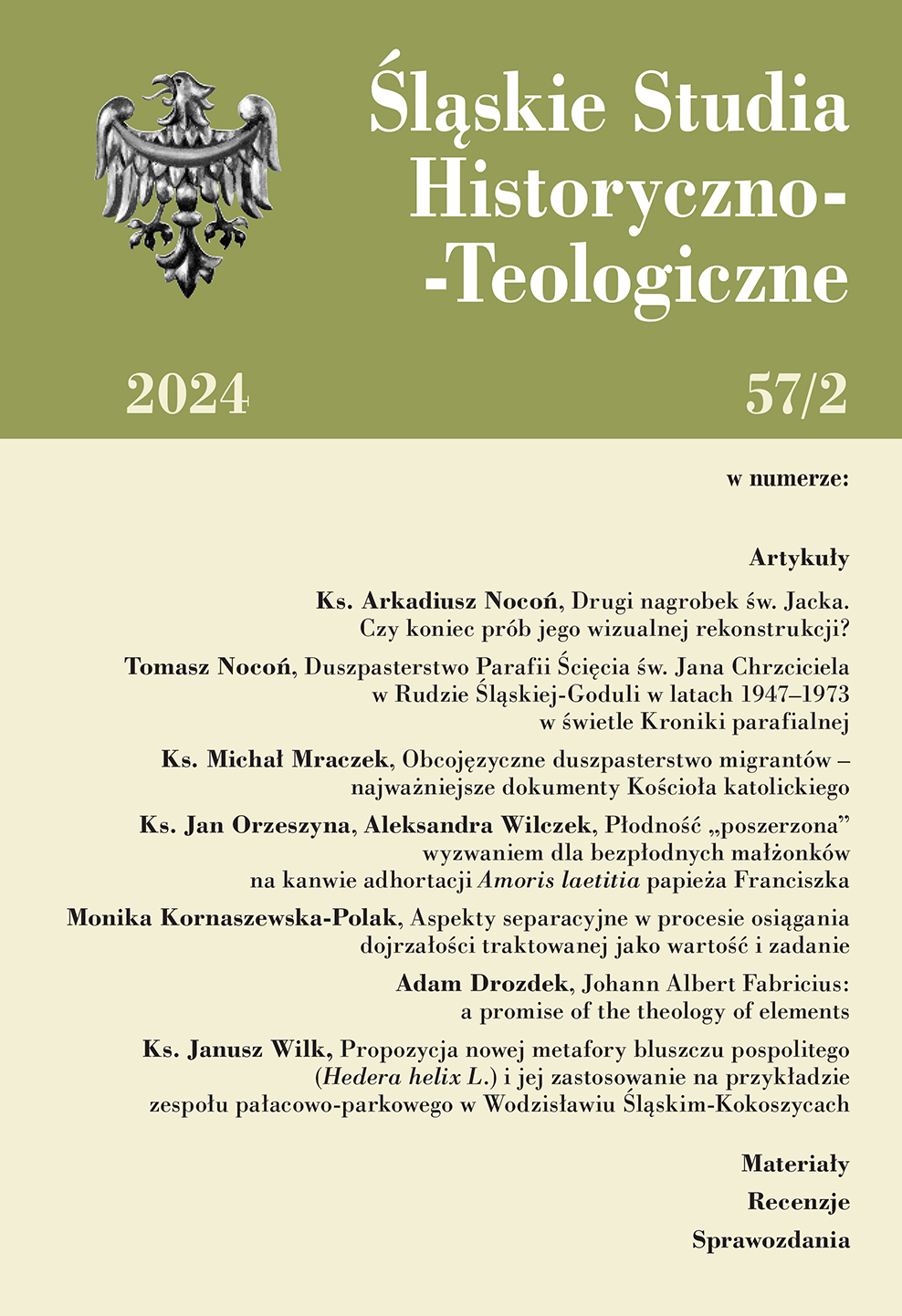
The figure of Saint Hyacinth arouses constant interest. This includes the Saint's life and works, but also his ‘fate’ after his death: his cult, his relics, his presence in popular piety and in art. This article deals with a subject at the intersection of cult and art; more specifically, the author addresses the second tombstone of Saint Hyacinth in the context of a recent discovery in the archives of the Dicastery for the Causes of Saints. The design of tombstone of 1589 allows us to supplement our previous knowledge of the Krakow monument built in 1583. It has survived for less than 50 years, yet it continues to arouse the interest of scholars because, in their unanimous opinion, it was an outstanding work of Polish artists with no parallel in Poland. The discovered drawing, from the time of the tombstone's existence, does not close the research on its final appearance, however, it allows to verify the hitherto attempts of its visual reconstruction and constitutes an important step on the way to a better understanding of this ‘pearl of the Polish Renaissance’, which was the second tombstone of Saint Hyacinth.
The text presents the history of pastoral care in the parish of Godula during the years 1947–1973, based on the records of the "Parish Chronicle", whose manuscript is stored in the parish archives. The chosen time frame covers the period when Fr. Józef Szubert served in the parish. He was the fifth priest to lead the parish, first as an administrator and later as pastor, working alongside other priests for the benefit of the parishioners entrusted to him. The article outlines both ordinary and extraordinary forms of pastoral care that have long been practiced in the parishes of Upper Silesia. It will also provide a list of priests who worked in Godula and cover topics such as the administration of sacraments, preaching, and canonical visitations conducted in the parish. Additionally, the activities of the lay faithful will be presented, using the participation of parishioners in pilgrimages and peregrinations as examples.
The article presents the most important documents of the Church on the foreign-language pastoral care of migrants. The phenomenon of migration itself has existed since the beginning of mankind, and we find many references to it in both the Old and New Testament. From the very beginning, the Church has seen in migrants the face of Christ Himself, and hence has provided them with special care over the centuries. Interestingly, the first document to deal comprehensively with the pastoral care of migrants was created only in 1952, followed by others in 1969 and 2004. Their analysis unequivocally confirms the right of migrants to special pastoral care in their mother tongue. Among other things, one can clearly see: consecutive evolution of these documents towards a shift of responsibility for this pastoral care to the level of the local churches, an increasing number of proposed structural solutions and a deepening of cooperation between churches of origin and churches receiving immigrants.
Fertility and procreation are generally considered as completely evident and natural phenomena. The desire of most married couples is to have children. This desire to have a child is intensified in the cases of married couples affected by infertility or sterility. Many questions arise then: Are such spouses exempt from the realization of marital fertility? Will they be able to resist the temptation of in vitro fertilization? Or maybe there is still a chance for them?
The aim of this article is to draw attention to the meaningful problem of spouses who wish offspring but cannot have them due to permanent infertility and do not want to undergo the in vitro procedure. First, the painful experience of infertility in marriage will be briefly described. Next, the issue called by Pope Francis "extended" fertility, involving adoption and foster care, will be deliberated. Finally, attention will be drawn to other forms of realizing "extended" fertility, namely, the perspective of the spouses' life without a child. The realization of "extended" fertility therefore appears as a challenge for infertile spouses. The inspiration for the undertaken issues is Pope Francis' exhortation "Amoris laetitia".
The article addresses the important issue of young people separating in early adulthood from the values, norms and behavioral styles of the older generation. Separation processes can be treated as young people’s rebellion or contestation against socially accepted rules of conduct, as well as the Christian system of values. At the background of the young people’s separation are processes related to achieving maturity and independence. This maturity is currently perceived differently, and thus the ability to create lasting and stable bonds, such as marriage and family ties, is often an impossible task. The consequences of lack of personal maturity are assumed to be the breakdown of close relationships and a growing sense of loneliness among young people. As a result, we observe an increasing number of relationships such as cohabitation, but also decisions to live alone (being single). In the longer term, such choices can have serious implications for the dynamics of social life.
Johann Albert Fabricius was an eighteenth-century philologist and theologian. He contributed to the then popular physico-theology by authoring three synopses which aimed at the theology of the basic physical elements: hydro-theology, pyro-theology, and aero-theology, possibly also contemplating geo-theology. However, only one third of full version of hydro-theology appeared which is very rich in scholarly contents and rather thin with theological presentations.
A metaphor as a device attempts to teach a person to see a text, an object, or an event from a twofold perspective. The article is a contemporary attempt at demonstrating this within a concrete natural and historical setting. The vehicle (object) of the proposed metaphor is the common ivy (hedera helix), while its subject is habit or addiction. The metaphor is situated and discussed in the context of the 19th-century Palace and Park Complex in Wodzisław Śląski-Kokoszyce.




 English
 Język Polski
 https://doi.org/10.31261/SSHT.2024.57.2.01