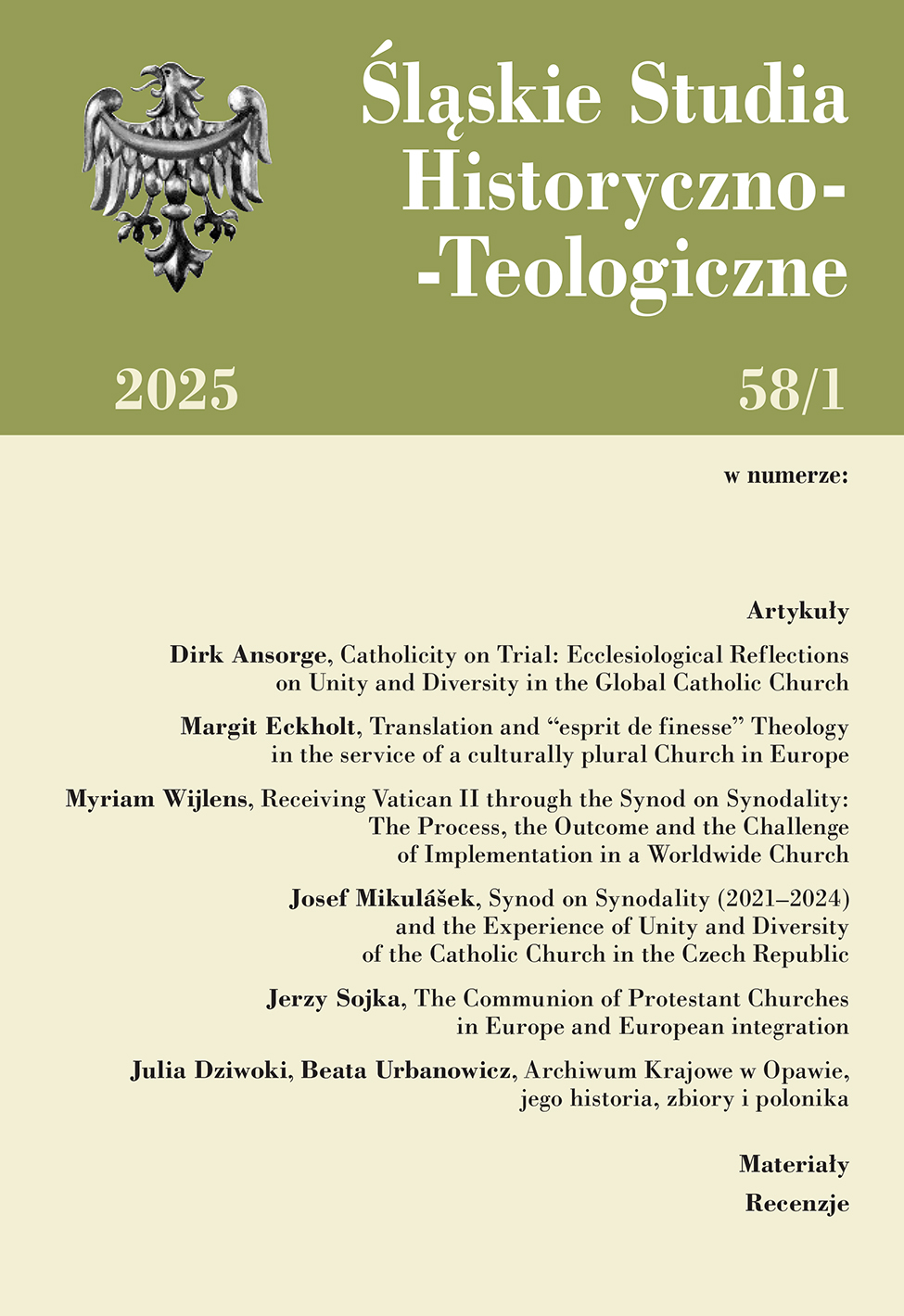
During the period of European colonialism, the Catholic Church underwent a process of global expansion which was characterised by a tendency towards uniformity dominated by the Latin Church and its capital, Rome. However, the end of colonialism and the subsequent Second Vatican Council saw the Church become inculturated into diverse religious and social contexts, making the issue of unity and diversity within the Catholic Church imperative. The key questions are: how much unity is necessary, and how much diversity can be tolerated, to preserve the unity of the Catholic Church on a global scale? Focusing on ecclesiological reflections, this essay analyses the Final Document of the 16th Ordinary Synod of Bishops in terms of its attitude towards unity and diversity within the Catholic Church. What possible consequences might the Synodal Journey of the global Church have for its institutions and structures? Since, according to Lumen Gentium, the Church is a complex reality consisting of institutional and spiritual elements (LG 8), the relationship between the truth of the Gospel and the identity of the Church can be examined from a sociological perspective in order to develop a comprehensive understanding. The article argues that that the sacramental structure of the Church (LG 1) justifies the implementation of “secular” elements into its structures, when enabling it to fulfil its mission of spreading the Gospel into different cultures more effectively.
The following article reflects on a redefinition of theological work in Europe in times of synodality. The new synodal processes make it clear that theology cannot be anything other than “local”; it grows out of the various places where theologians are active. In the plurality of these places, in continuous processes of inculturation, theology must reflect the message of faith, and so its task includes the “art of translation” in and between the diverse spaces. Theology thus places itself at the service of a Church that is a “sacrament of the peoples”, an emblematic image from the Second Vatican Council that requires fresh expression in this era of synodality.
In this sense, the article addresses the question of a theology in the service of a culturally plural Church in Europe. The philosophical approach of Paul Ricoeur is – on a methodological level – the reference for the approach to cultural pluralism in Europe and the search for a Christian unity. Theology can only address the question of the identity and truth of Christian faith by means of translation and recognition and with an “esprit de finesse.” These are the foundations for the current search for a theology that traces synodal paths.
Sixty years after the promulgation of the Dogmatic Constitution on the Church Lumen gentium, pope Francis convoked the Synod on Synodality. With the Synod the church has entered into a new phase of its reception. Possibly one of the most relevant fruits of the synod was the transformation from a static church with occasional modifications to a church characterized by a permanent flow leading to a continuous circularity. This was given shape in the interaction of the local church with the church universal which in turn was expanded by an awareness of the catholicity of the church in which there is an exchange of gifts. The process created an awareness of context and diversity beneath which there is a deep sensed unity. The formal closing of the Synod in 2024 coincides with the inauguration of the implementation. Canonical provisions have a specific task in this. The study attends to synodal participative bodies at all levels of the church. Special consideration is given to the diocesan pastoral council, episcopal conferences and plenary and provincial councils.
With the conclusion of the 2nd Session of the Synod on Synodality, the Catholic Church worldwide enters the implementation phase of synodal conversion, as presented in the Final Document of the 2nd Session of the Synod (October 2024). The consultation of the People of God and the Final Document emphasise the concept of the Church as a communion of local churches and, thus, the essentially synodal nature of the Church. In this article, I examine the progress and outcomes of the first (diocesan and national) stage of the synodal process in the Catholic Church in the Czech Republic as a partial contribution of the communion of local Churches towards the two sessions of the Synod on Synodality (2023 and 2024). After an initial description of the socio-cultural context of the Catholic Church in the Czech Republic, I evaluate the course of the consultation of the People of God in the local churches and then analyse several impulses of the National Synthesis for the synodal conversion of the Catholic Church.
The Communion of Protestant Churches in Europe (CPCE) is currently a communion of 96 Protestant Churches of various traditions from over 30 European countries, representing over 50 million Christians in Europe and beyond, including South America. In its founding document – the Leuenberg Agreement – it declared the realization of the Church communion, in three areas: continuing theological conversation, ecumenical, witness and service. The aim of this article is to present how the topic of European integration is being reflected on in these three areas of CPCE work. The analysis will be supplemented by a review of the references to European integration in the programmatic documents adopted by the highest governing body of the CPCE – its general assemblies.
The National Archives in Opava is one of the oldest institutions of this type in the Czech Republic. Due to the constantly increasing archival resources, Opava has become the central historical archive for the Moravian-Silesian and Olomouc administrative regions these lands. In this institution there are collections and records, land, city, national, judicial, political, occupation, church, school, unions, organizations and social associations. One should also pay attention to the fact of the rich resource concerning the role and importance of the Polish diaspora in Opavian-Moravian Silesia. The Opava archive is also actively responding to the needs of contemporary researchers, as in 2007 it began working on digitization and making the resource available on its websites. Thus, entering into the Polish-Czech intellectual, scientific and cultural dialogue.



 English
 Język Polski
 https://doi.org/10.31261/SSHT.2025.58.1.01