

The article deals with Polish cinema after the year 1989. Starting with the characteristics of Polish cinema before the period of transformations, the author continues with an analysis of the new cinema to distinguish four currents: “works of mourning” encompassing films which were meant as settling accounts or reconciliation with World War II and communism; “cinema of testimony” with special interest in films by Marcel Łoziński, but also mentioning others such as Kazimierz Karabasz and Jacek Blawut; “filmmakers young and old” based on three strategies of authorship, namely those of a fabulator (e.g. Krzysztof Kieślowski), a mythbiographer (e.g. Andrzej Kondratiuk, Marek Koterski and Marcin Koszałka), and an artist (e.g. Andrzej Barański, Dorota Kędzierzawska and Lech J. Majewski); and “popular cinema” with its four basic genres: action cinema, comedy, literary adaptation and romantic comedy.
Download files
Citation rules
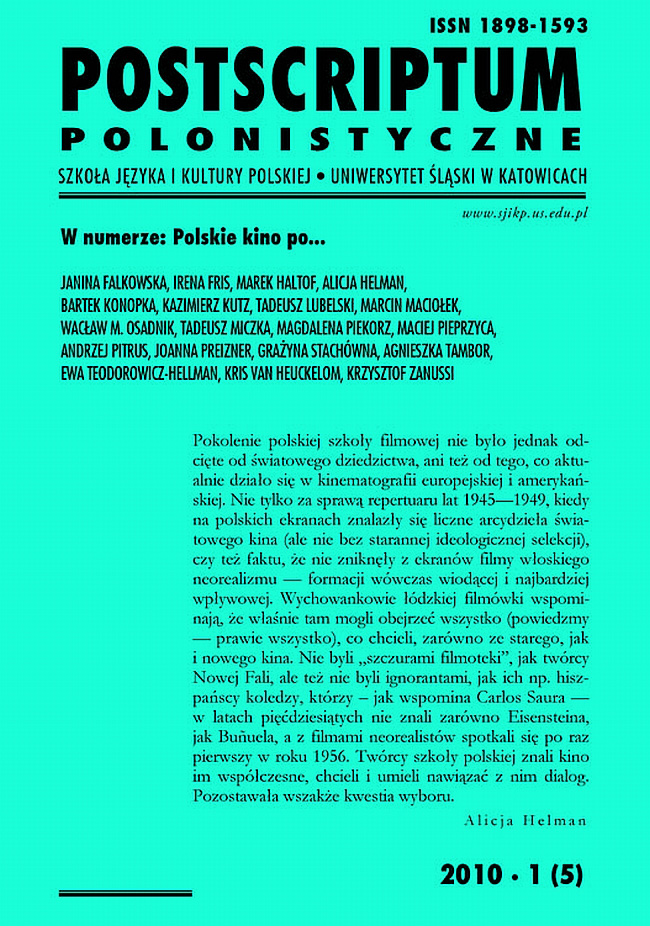
Vol. 5 No. 1 (2010)
Published: 2021-01-05
 10.31261/PS_P

 English
 Język Polski