Tekst informuje, że numer 2/2025 jest ostatnim wydanym przez dotychczasową redakcję „Postscriptum Polonistycznego” i podsumowuje wieloletni rozwój pisma – od biuletynu Szkoły Języka i Kultury Polskiej UŚ do międzynarodowego czasopisma naukowego indeksowanego w Scopusie. Zapowiada także przekazanie redakcji nowemu zespołowi.
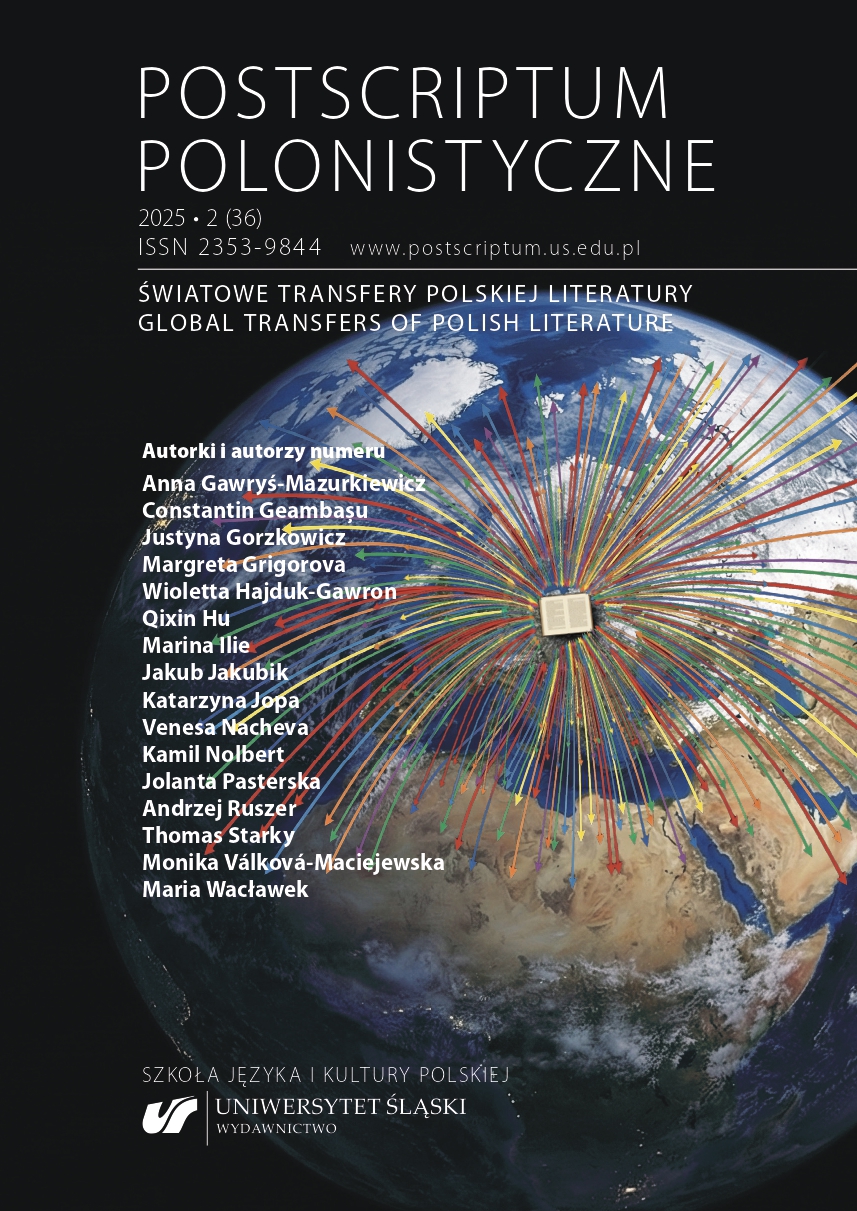
The latest issue of “Postscriptum Polonistyczne” is the result of the 9th edition of the international academic conference “Polish Literature in the World: Global Transfers of Polish Literature”, which took place on 19–20 November 2024 at the Faculty of Humanities of the University of Silesia in Katowice. The subject matter of the volume is broadly understood cultural transfers – from translation and reception to institutional, memorial and didactic forms of presence of Polish literature in the world, as well as the way it functions in the global circulation of culture. The first part titled Presences, Transfers, covers studies on the work of Józef Mackiewicz, also known as Cassandric literature, the autobiographical narrative of Adam Czerniawski, the activities of the London-based Union of Polish Writers Abroad, the archives of Aleksander Wat, and the diplomatic and literary activities of Stanisław Baliński. The second part titled, The Benefits and Drawbacks of Linguistic and Cultural Transfer, addresses issues related to the translation of Krzysztof Kamil Baczyński’s poetry, the presence of Polish literature in Norway, the reception of Polish poetry in Romania, the translations of Henryk Sienkiewicz’s texts into Esperanto, and the difficulties of translating Jerzy Ficowski’s poetry into English. The third part, Glottodidactics as an Area of Cultural Transfer, highlights the role of literature in teaching Polish as a foreign language and inspires further research and academic discussions.
Based on the translation of the novel Nie trzeba głośno mówić [You Mustn’t Speak Aloud] by Józef Mackiewicz, whose action takes place during the Second World War, mainly in the eastern territories known in Polish as Kresy Wschodnie, the author of the article analyzes several terms that pose special challenges to the translator: Rzeczpospolita, Kresy, kresowość, krajowość. The very notion of Rzeczpospolita (Republic) is a paradox: the name of a republic for a state entity headed by a monarch. Behind this concept lies the Sarmatian myth, an essential component of Polish cultural history, without which the translator cannot penetrate the deeper layers of the narrative. The term Kresy cannot be rendered in Romanian by a single lexeme but only through periphrasis: Ținuturi de Margine or Ținuturi Răsăritene (Borderlands or Eastern Territories). It is not so much the name itself that is important, but rather its multinational and multicultural character, which is strongly reflected in the pages of the novel. In the second part of the article, the author also discusses the issue of historical and cultural transfer of certain terms that have long been integrated into the European lexicon but, in the Polish writer’s vision, undergo modifications: kraj, naród, rewolucja, historia. The article highlights the importance, for the translator, of knowing the cultural history of the country from which they are translating.
The text presents the way Bulgarian research projects create a new and double reception field (research and translation) for the Cassandric texts of Polish literature from the interwar and WWII periods. The project titled The World of Yesterday – Seen Through the Crisis of 1939. The Feeling for a Threatened Europe in the Cultures and Literatures of Bulgaria, Ukraine, Poland and Czechoslovakia lays the foundations of the following paper.The crucial aim of this text is to explain the conceptual transition from a published Polish monograph to the complete anthology, their parallelism and new elements of reception. The term Cassandric texts is used here in reference to texts of a prognostic, prophetic, catastrophic nature, containing warnings about the approaching war, and those written during the war. The term Cassandric is based on the motif of Cassandra present in Czesław Miłosz’s essay Śmierć Kassandrze (1945) and Jerzy Stempowski’s Esej dla Kassandry / Essay for Cassandra (1950). We search for records of these warnings in literary, journalistic and historical texts, as well as in the testimonies sent from Poland to the Allied countries via dangerous routes.
The article is an attempt to discuss the memoirs entitled Scenes from a Disturbed Childhood of the Polish émigré poet Adam Czerniawski, published in Polish in 1995. The work concerns the early stage of the future artist’s life, marked by the wartime wanderings of his family from Warsaw to the Middle East and England. The analysis of the text was focused on those elements that indicate the moments of shaping the young poet’s identity. The considerations draw attention to the strong biographical element that shapes the structure of the work. Not only the restrained depiction of the wartime wandering and postwar attempts to settle in a foreign country, but above all the ways of self-creation are subject to a detailed review. Within these contexts, Scenes from a Disturbed Childhood can be read as an important text complementing the author’s literary œuvre.
The article analyses the activities of the Union of Polish Writers Abroad (ZPPnO) in London. The subject has been taken up in order to show the role of this organisation in shaping Polish literary culture outside the country, protecting and archiving the output of emigrant authors and popularising their works. The analysis is inspired by Jorge Luis Borges’ metaphor of the infinite library, which symbolises literary dispersion and the attempt to organise and integrate the emigrant creative output. The article presents three main issues. The first is literary identity in an intercultural context – how emigrant literature builds links between Poland and the global circulation of ideas. The second aspect is the role of literary prizes and the publishing activities of the ZPPnO, with particular emphasis on the Literary London Journal. The third and final element of consideration is the research on emigration literature, the documentation and archiving of works by the Research Centre on the Legacy of Polish Migration. The analysis is based on an interdisciplinary approach, combining literary studies, migration studies and cultural theory. In particular, reference is made to Homi Bhabha’s concept of third space, which emphasises the hybridity of identity and literature emerging at the intersection of different cultures. The research takes into account the analysis of historical documents, archival testimonies and publications of the ZPPnO and refers to the existing literature on the subject. In conclusion, the article emphasises that emigrant literature is a ‘literature in motion’ – dynamic, crossing borders and constantly redefining its place in the cultural space. ZPPnO acts as a kind of guide, sorting out the scattered traces of emigrant creative works and integrating them into the global literary heritage.
This article takes the issue of transfers of Polish literature literally – as the physical transfer of writers’ archives from place to place, to archives located in different countries and on different continents. Aleksander Wat’s legacy is treated as a synecdoche of the fate of the archives of other émigré writers, such as Czesław Miłosz, Zbigniew Herbert or Witold Gombrowicz. These considerations are complemented by the presentation of archival typescripts and manuscripts, as well as a never-published transcript of a conversation between Ola and Andrzej Wat, the then heirs to the legacy of the author of Mój wiek [My Age], and the stakeholders of institutions such as the Museum of Literature in Warsaw, the Ossolineum Library in Wrocław or the Polish Library in Paris (Jacek Trznadel, Krzysztof Rutkowski and Marek Prokop, among others), who debated in the 1980s about the future of the archive. The juxtaposition between the conversation, held under specific political conditions, and the further fate of the archive is interesting. This very specific issue then becomes a trigger for a more general reflection on the history of Polish archives – doomed to these transfers – in a situation of permanent historical uncertainty. It seems that the fate of our archives reflects the uncertainty of the fate of the entire nation.
The article examines the diplomatic activity of the poet Stanisław Baliński in Harbin between 1928 and 1932, drawing on source material excerpted from the Polish expatriate press in Harbin – „Tygodnik Polski” (“The Polish Weekly”) and „Listy Harbińskie” (“Harbin Letters”). Baliński is presented as a versatile figure: diplomat, teacher, cultural organizer, poet, reporter, and social activist. The cited press materials document, among other aspects, his involvement in organizing general education courses, support for a boarding house for Polish children, participation in the activities of the Polish Inn (Gospoda Polska), his reportage work during the Japanese occupation of Manchuria, as well as initiatives aimed at fostering closer relations between Poles and representatives of other national communities residing in Harbin. The article expands biographical knowledge of Baliński, revealing lesser-known facts from his life and reconstructing the everyday realities of the Polish community in Harbin – its efforts to sustain national identity, promote education, and maintain contact with the homeland. It also situates Baliński’s activity within a broader historical context, including the consequences of the Japanese occupation of Manchuria, which affected both his diplomatic mission and his later émigré literary output. In this respect, the article serves as a commentary on Wojciech Wencel’s recently published biography Baliński. Smutny młodzieniec [Baliński. The Sad Young Man] and constitutes an important contribution to studies on the presence of Poles in the Far East.
L’Insurrection angélique (Angelic Insurrection) and Testament de feu (Testament of Fire) are the first and so far only stand-alone volumes of selected poems by Krzysztof Kamil Baczyński, published in French translation in 2004 and 2006 respectively, in a joint translation by Claude-Henry du Bord and Krzysztof Jeżewski. The scant critical and literary reception of Baczyński’s poetry in France prompts us to consider the publishing context of the aforementioned translations and to examine the translation strategy employed in them. The aim of this article is to look at this native poetry through the prism of the translation and its paratextual frame (consisting, among other things, of the titles given to these selections of poems, prefaces, and translators’ footnotes), in order to answer the question of how the translation decisions taken by du Bord and Jeżewski, in the broadest sense of the term, may affect the French reader’s reception of the Polish poet’s poetry. The author of the article also devotes attention to some aspects – concerning the book market in France and the translation space – (un)conducive to a wider popularisation of Baczyński’s poetry in France.
This article deals with a so far undescribed publishing period (2008–2024) of translations from Polish into Norwegian. It deepens the understanding of historical and contemporary publishing trends and indicates the reasons for their occurrence by grouping and characterising the items published during this period. It shows the persistence of publishing trends towards the publication of Witold Gombrowicz, the disappearance of interest in the reportages of Ryszard Kapuściński and the growth of interest in the works of Olga Tokarczuk, Andrzej Sapkowski and Berenika Kolomycka. The author discusses the unsuccessful attempt to introduce Polish detective stories to the Norwegian market – the case of Marek Krajewski’s books; he describes the unexpected trend of publishing Polish literature written in the period around the Second World War (Zofia Nałkowska, Krzysztof Kamil Baczyński, Witold Pilecki). The aim of the text is, among other things, bibliographic accommodation and guidance for further research for subsequent researchers. Furthermore, the text characterises the Norwegian market, conditioned by the level of readership. It presents the historical development of interest in Polish literature in Norway. It distinguishes translators historically and contemporarily important for the development of interest in Polish literature in Bokmål and Nynorsk (Ole Michael Selberg, Jan Brodal, Agnes Banach, Anna Walseng, Julia Więdłocha, Knut Andreas Grimstad, Knut Inge Andersen). It arranges the prizes awarded to Polish translators and forecasts the chances for further interest in Polish literature.
Translations of Polish poetry into Romanian over the past two decades have been characterized by increasing dynamism and a diversity of poetic voices – from classic to contemporary authors. This trend is reflected not only in translation practices but also in local reception, indicating a significant improvement compared to the previous century, when poetic translations were relatively scarce in relation to other literary forms. Since 2000, several anthologies, over forty single-author volumes, and numerous poem selections published in journals have appeared. These publications – accompanied by critical commentaries – provide a solid basis for summarizing the current state of knowledge and identifying key trends and challenges that shape future translation efforts and their reception within the Romanian literary field. The article explores the evolving landscape of contemporary Polish poetry and highlights the role of the translator, who not only selects and renders poems but also crafts accompanying texts (introductions, afterwords, critical essays) that significantly shape how translated works are perceived. The study adopts an analytical-documentary approach, incorporating both quantitative and qualitative analysis of Polish poetry translated into Romanian. The conclusions drawn from this bibliographic review may serve as a starting point for future research and syntheses on literary transfers between Poland and Romania. For broader context, the article includes an appendix listing translations from 2000 to 2024, limited to single-author volumes and anthologies.
The article, through a micro-analysis of second-hand translation (from the Polish original into Esperanto and then into contemporary Chinese), seeks to familiarise the reader with the topic of transfer between distant literatures. It focuses on the literary strategy of re-writing Asian mythological legends, specifically, it presents the transfer of motifs from Henryk Sienkiewicz’s short story Two Meadows, re-written on the basis of Indian legends, through Kazimierz Bein’s translation into Esperanto to Zhou Zuoren’s Chinese translation, and on to the later work by Lu Xun (actually Zhou Shuren, Zhou Zuoren’s older brother). The article demonstrates the effectiveness (as well as sometimes the lack thereof) of Ludwik Zamenhof’s artificial language as a means of literary transfer on the example of selected fragments of the translation of the short story Two Meadows. The method used in the article is a close reading of fragments in Polish, Esperanto and Chinese. Finally, it presents an example of Chinese ancient legends rewritten (the legend 补天 [To mend the sky]) from Lu Xun’s late works, which are inspired by the translations of his younger brother’s works that he edited. The text is situated in the realm of literary studies and translation studies.
The author of this article examines previous translations of Jerzy Ficowski’s poems into English, traces their reception and compares the translation strategies adopted by the translators. The reason for taking up the chosen topic is the conviction that it is necessary to re-evaluate Ficowski’s place in the canon of Polish post-war poetry. Despite the growing number of works on Ficowski’s poetry in recent years and the interest shown in him by critics and other poets, he still remains an artist who is widely unknown and underestimated by readers both in Poland and abroad. While for the first group, it is difficult to clearly indicate the reason for Ficowski’s omission, the poet’s absence from the consciousness of foreign readers has its source in the small number of translations (the exception is A Reading of Ashes, which has been translated many times, also into English, a volume collecting works on the Holocaust written over many years). One of the reasons for the lack of interest on the part of the translators was, in turn, probably the exceptional difficulties posed to them by the language of Ficowski’s poems. After years of the writer’s residual presence in English, which was also influenced by the non-inclusion of Ficowski’s works in Czesław Miłosz’s Postwar Polish Poetry, only the recent publication of a selection entitled Everything I Don’t Know (2021), prepared by Jennifer Grotz and Piotr Sommer, has opened up the possibility for readers to take a closer look at the poet’s work. The research carried out, based on an analysis of Ficowski’s texts and their translations, as well as on a comparison of translation strategies, shows that although the translations often simplify the poet’s language, the translators sometimes manage to preserve certain features of Ficowski’s poetic imagination, such as his typical tendency to question the prevailing hierarchies.
The article explores the works of Stefan Grabiński, regarded as one of the leading representatives of Polish horror and fantasy fiction, along two parallel lines. On the one hand, it analyses the reception of Grabiński’s prose – its critical appraisal, intertextual connections with various cultural texts, and the context of cultural transfer through translations of his works into foreign languages. On the other hand, the article examines Grabiński’s œuvre in terms of its glottodidactic potential. The discussion is grounded in the belief that introducing texts by a writer who addresses universal themes into the teaching of Polish as a foreign language – while highlighting the significance of his literary heritage – can enhance the author’s international recognition and simultaneously support the development of learners’ linguistic and intercultural competences. The study employs textual analysis as well as qualitative and quantitative research methods, which made it possible to identify the key narrative elements in Grabiński’s short stories and to assess the reception of his work both in Poland and abroad. The article further proposes the use of Grabiński’s short story Problemat Czelawy [The Czelawa Problem] as glottodidactic material for developing linguistic and mediatory skills through the use of artificial intelligence (AI) tools. This study forms part of a broader inquiry into the reception of Polish literature worldwide and its role in teaching Polish language, literature, and culture to foreign audiences.
The metaphor of the world as theatre (theatrum mundi) shows the primordiality of theatrical activities in human life, which is reflected in language. Among other things, the text refers to the instruments of cultural linguistics. Literature and art can be a source of knowledge and understanding of Polish culture for a foreigner. In Ferdydurke, Witold Gombrowicz refers to Polish culturemes as well as creating new ones. Glottodidactic theatre brings a variety of linguistic, cultural and personal benefits. In glottodidactics, transfer is an activity that serves to transfer linguistic and cultural capital from one cultural text to another. This happens, for example, when adapting for foreigners an excerpt from Ferdydurke to be staged as a puppet theatre. The author adapted Gombrowicz’s Polish language lesson scene, which depicts the anachronism and schematic nature of school education in a grotesque way. The adaptation consisted of shortening the text of the original, then adding supplements and making changes (e.g. a clear division of the text into main and side texts or feminisation of the characters). Glottodidactic adaptation is a form of upcycling, it is an activity that is not only about assimilating non-native culture more fully, but also about reflecting on one’s own culture and searching for one’s third place.
The aim of this paper is to present the factors dominating various literary studies on the norm (here: readings) of literature and to juxtapose them with the expectations and reception of the same by foreigners in the history of modern Polish literature classes. In the course of the argument, we will focus first of all on the assumptions of structuralism, where we will try to point out and comment on the relevant passages, which could be useful in the process of preparing literature block classes, and then juxtapose them with contemporary reflections on the way the same literature is approached and presented to a non-Polish audience. The author starts from the premise that the reading and critical reception of a literary work in a foreign environment is often different from the reception in a native environment because the recipient’s habits and experiences are different. This statement was confirmed by the reality of the university: the latest Polish literature was juxtaposed with the reception of the Other in lectures and exercises at the Collegium Polonicum in Słubice (course for the third year of bachelor degree studies for Polish Studies). The article answers the question of what the history of literature is today (a constellation, a lens, a window on the world?) for a foreigner.
The article aims to analyze the use of Czesław Miłosz’s emigration literature in teaching Polish as a foreign language in China, emphasizing its didactic and cultural potential. The study is based on three main reasons. First, the emigration experience was crucial for Miłosz’s work after 1939. Miłosz’s three emigrations shaped his reflections on identity and internal cultural conflicts. Second, the theme of emigration and Miłosz’s identity is one of the key issues that interest Chinese readers. After the introduction of Miłosz’s work to China in the 1980s, the initial interpretation of his works focused mainly on political aspects. Still, it gradually shifted towards recognizing the literary complexity of his writing. Third, Miłosz’s emigration literature presents the complex historical and cultural context of Eastern Europe as a multi-national and multilingual region. It addresses topics, such as religion, war, and emigration, which helps develop intercultural skills among students. The article focuses on the analysis of the essay Native Realm from a lexical, cultural, and literary perspective, pointing out both challenges (such as the complexity of historical and religious terms) and benefits (e.g., descriptions of daily life, the multiculturalism of Eastern Europe) associated with using the text in classes. Additionally, the article proposes solutions to the problems related to teaching Polish literature in China.

 10.31261/PS_P


 English
 Język Polski