

 https://doi.org/10.31261/ZOOPHILOLOGICA.2021.08.11
Phytonyms are an extremely interesting category of lexis and they contain the significant semantic properties of the Polish language. Trying to recreate the nomination process of individual species, we see how much it depends on the perception of man and observation of the surrounding reality. The meanings contained in the colloquial, dialectical and botanical names of plants reveal to us an extremely rich and colorful world observed by man. Detailed semantic analysis of names such as jaskółcze ziele, kaczeniec, kurzyślad, kacze pyski, rdest ptasi, ptasie oczko and others leads to surprising conclusions – plant names often carry metaphorical content based on sensory perception and experience, and also many times on associations connecting flora with the world of birds. In her speech, the author will show that the system of nominating plants around us is largely based on the conceptualization of the world by people and the categorization of the nearest reality known to man.
Download files
Citation rules
Cited by / Share



Licence

This work is licensed under a Creative Commons Attribution-ShareAlike 4.0 International License.
The Copyright Owners of the submitted texts grant the Reader the right to use the pdf documents under the provisions of the Creative Commons 4.0 International License: Attribution-Share-Alike (CC BY-SA). The user can copy and redistribute the material in any medium or format and remix, transform, and build upon the material for any purpose.
1. License
The University of Silesia Press provides immediate open access to journal’s content under the Creative Commons BY-SA 4.0 license (http://creativecommons.org/licenses/by-sa/4.0/). Authors who publish with this journal retain all copyrights and agree to the terms of the above-mentioned CC BY-SA 4.0 license.
2. Author’s Warranties
The author warrants that the article is original, written by stated author/s, has not been published before, contains no unlawful statements, does not infringe the rights of others, is subject to copyright that is vested exclusively in the author and free of any third party rights, and that any necessary written permissions to quote from other sources have been obtained by the author/s.
If the article contains illustrative material (drawings, photos, graphs, maps), the author declares that the said works are of his authorship, they do not infringe the rights of the third party (including personal rights, i.a. the authorization to reproduce physical likeness) and the author holds exclusive proprietary copyrights. The author publishes the above works as part of the article under the licence "Creative Commons Attribution-ShareAlike 4.0 International".
ATTENTION! When the legal situation of the illustrative material has not been determined and the necessary consent has not been granted by the proprietary copyrights holders, the submitted material will not be accepted for editorial process. At the same time the author takes full responsibility for providing false data (this also regards covering the costs incurred by the University of Silesia Press and financial claims of the third party).
3. User Rights
Under the CC BY-SA 4.0 license, the users are free to share (copy, distribute and transmit the contribution) and adapt (remix, transform, and build upon the material) the article for any purpose, provided they attribute the contribution in the manner specified by the author or licensor.
4. Co-Authorship
If the article was prepared jointly with other authors, the signatory of this form warrants that he/she has been authorized by all co-authors to sign this agreement on their behalf, and agrees to inform his/her co-authors of the terms of this agreement.
I hereby declare that in the event of withdrawal of the text from the publishing process or submitting it to another publisher without agreement from the editorial office, I agree to cover all costs incurred by the University of Silesia in connection with my application.
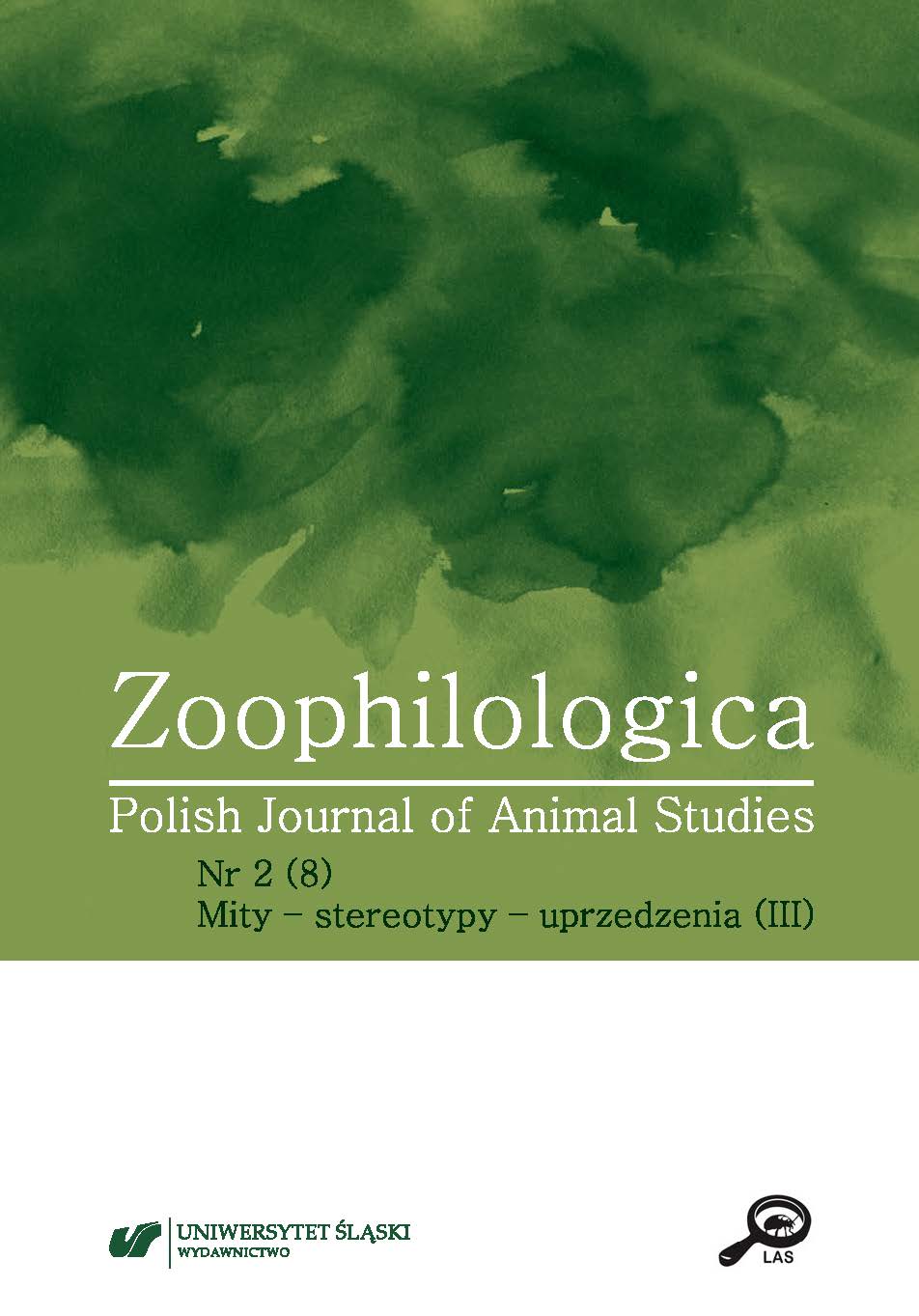
No. 2 (8) (2021)
Published: 2022-01-12
10.31261/ZOOPHILOLOGICA
This work is licensed under a Creative Commons Attribution-ShareAlike 4.0 International License.

 English
 Русский
 Język Polski