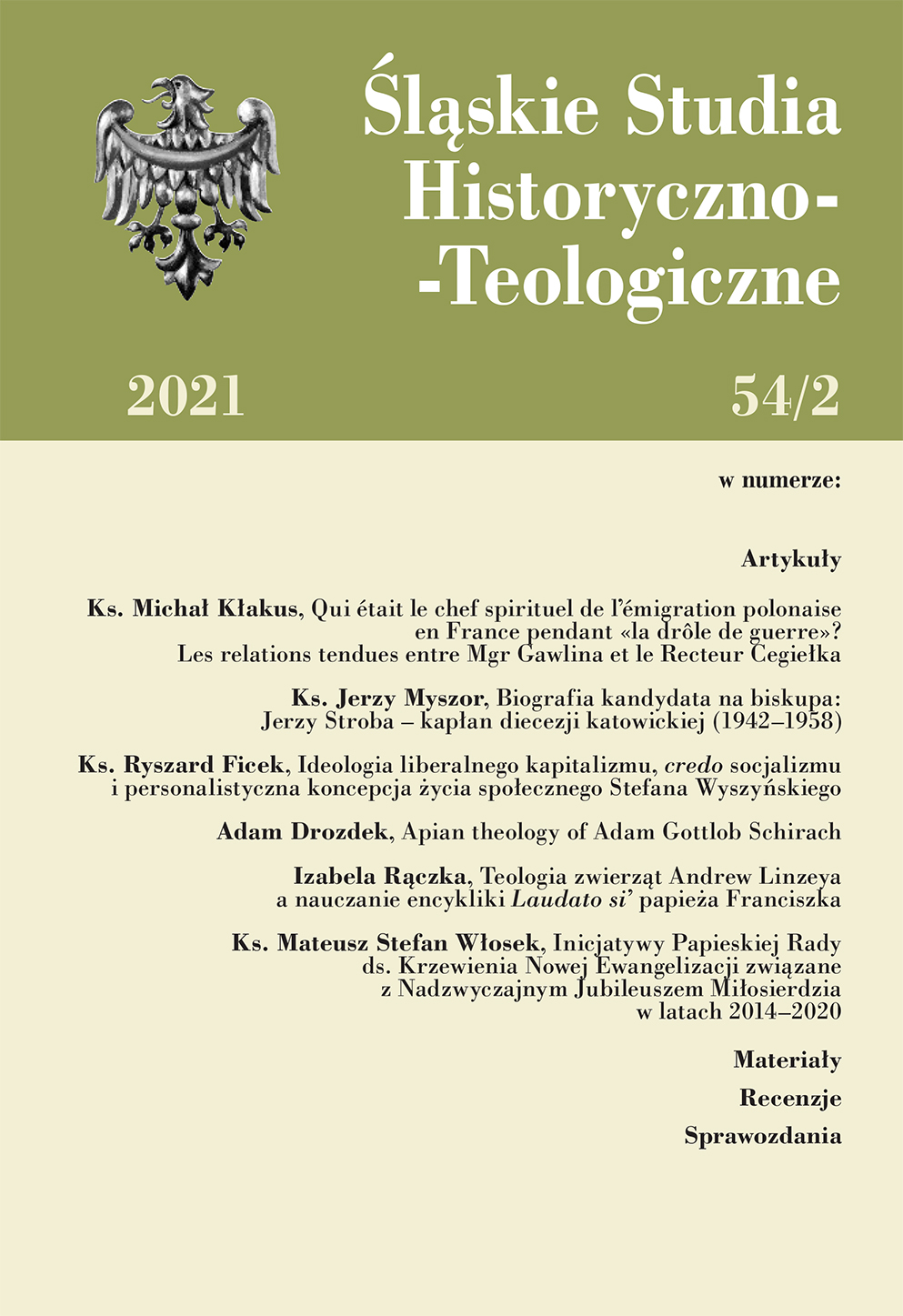
In October 1939, Army Bishop Józef Gawlina arrived in France. A few days earlier, he had received official confirmation from Pope Pius XII of his pre-war assignment to organize military pastoral care. At that time in Paris, the head of the Polish pastoral ministry was Fr. Franciszek Cegiełka. This article addresses the issue of their mutual cooperation. It discusses the reasons for conflicts and rivalries between these two ambitious, intelligent and zealous priests. It also reveals Cardinal Hlond’s role in the dispute between the two clergymen.
In the article, the author discusses one of the typical biographies of a candidate for bishop, whom Jerzy Stroba nominally was - the suffragan for the Archdiocese of Gniezno, or in fact, the suffragan in the Gorzów Ordinariate, alongside Bishop Wilhelm Pluta. The biography has a chronological order and presents the Silesian clergyman who was ordained as a priest by Cardinal Adolf Bertram, during the war, and who worked in various positions in the Katowice diocese, after the end of the war. In 1958, he was assigned to help another Silesian bishop, Wilhelm Pluta, the governor of the Gorzów Ordinariate, which became the apostolic administration in 1967 and next it was elevated to the rank of a diocese in 1972 . What is more, the author puts forward hypotheses on the circumstances of the election and nomination of Stroba as bishop
The presented article exhibits the personalist concept of Stefan Wyszyński’s social life in the context of the ideology of liberal capitalism and socialist conceptions. The leading thesis of these analyzes is to reveal the above systems not so much in antinomic or analogous terms. Liberal ideology and related to it capitalism arose in the mid-19th century and have constantly evolved since then, often changing their main features. Socialist ideology, on the other hand, was formed as a concept opposed to the capitalist reality of the 19th century. However, it never really existed in a particular form. The occurring system described as “socialism” was, in fact, a hybrid of liberal-capitalist ideas and a neo-feudal bureaucracy. A more detailed analysis of the above doctrines and their critical reinterpretation in the context of Wyszyński’s personalist thought affords to become aware of the dangers related to the ideologically motivated promotion of extreme, often distorted concepts of the human person and their application in the specific realities of the contemporary world.
Adam Gottlob Schirach was an eighteenth-century pastor and apiarist from Upper Lusatia. As a cleric and a practicing scientist, he combined his theological and scientific interests in proving the existence and the attributes of God through the observations of the anatomy, physiology, skills, and social life of bees. Being primarily an ecclesiastic, he wanted to derive for these investigations spiritual lessons for people to become more devoted in their religious life.
With the current development of interest in environmental issues, sensitivity regarding animals is increasing, also in the field of theological sciences. This article compares the views of Anglican theologian Andrew Linzey presented in Animal theology and the theological themes included in Pope Francis’ encyclical Laudato si’ relating to a similar area. Both texts significantly appreciate beings other than humans as having value in themselves and emphasize the interconnectedness of all creatures, including humans, with each other and God. They indicate that all creation exists for God and that the effects of the incarnation and redemption cover the whole world. There are also some differences between A. Linzey’s views and Pope’s thought result from different anthropology that impinges on themes concerning animal theology.
Nowadays, we can observe a disturbing phenomenon, where faith loses its vitality and erodes slowly. Therefore, in the present situation, the Church is undertaking the work of new evangelization, caring for the authentic transmission of faith with new dynamism and using new means. Consequently, the Pontifical Council for Promoting the New Evangelization was established. The aim of this article is to present the history of the creation and the course of evangelization initiatives of this dicastery, with particular emphasis on the Jubilee of Mercy. The analysis made it possible to establish that the actions of the Pontifical Council are consistent with the Pope's teaching on God's mercy. The initiatives taken are a specific manifestation of the new evangelization, one of the many tasks of which is also to announce the mercy of God to the world which becomes a real experience through works of mercy, proclaiming the word of God or administering the sacraments, especially the sacraments of penance and reconciliation.



 English
 Język Polski
 https://doi.org/10.31261/SSHT.2021.54.2.01