

Artykuł wykorzystuje metodę interpretacyjnej analizy tekstu oraz współczesną hermeneutykę literacką. Badanie koncentruje się na relacji między doświadczeniem jednostkowym a reprezentacją literacką.
Tekst Sauerlanda dotyczy różnic w aspiracjach i wyobrażeniach o wpływie „Solidarności” na podmiotowe przekształcenie kraju. Stanowi świadectwo i wyraźny obraz dramatycznego zderzenia strategii sieciowej oraz strategii samorządowej, które były w pewnym momencie brane pod uwagę, a także skali społecznej mobilizacji „Solidarności” w Polsce oraz potrzeby stworzenia nowego modelu państwa. Wszystko to zostaje ukazane w odniesieniu do dramatu modelu, który ostatecznie zdominował polską transformację, ze szczególnym uwzględnieniem roli i wpływu Lecha Wałęsy.
Autor postrzega fenomen „Solidarności” jako proces oraz rzeczywiste działanie nastawione na zmianę i zmierzające ku samorządności. Wykorzystuje własne obserwacje, doświadczenia i notatki wynikające z uczestnictwa w tych procesach, między innymi w kontekście planowania reform szkolnictwa wyższego.
Sauerland stawia zasadnicze pytanie dotyczące „Solidarności”: czy był to karnawał, czy rewolucja? A jeśli rewolucja, to czy bardziej przypominała rewolucję francuską, rosyjską czy amerykańską? Podkreśla, że jedynie Hannah Arendt rozumiała nie tylko historyczny, ale również „futurystyczny” sens rewolucji amerykańskiej.
Przywództwo wygląda inaczej w czasie karnawału, a inaczej podczas rewolucji — oba te zjawiska funkcjonują bowiem w całkowicie odmiennych kontekstach działania, przy czym wariant amerykański okazuje się szczególnie istotny. Autor analizuje tragiczną pozycję Lecha Wałęsy, sugerując istnienie utraconej alternatywy wobec scenariusza wpływu, który został ostatecznie zaakceptowany pod wpływem Wałęsy i jego zwolenników, mimo że ich dominacja osłabiła końcowe efekty zapoczątkowanych działań i procesów.
Download files
Citation rules
Licence

This work is licensed under a Creative Commons Attribution-ShareAlike 4.0 International License.
The Copyright Owners of the submitted texts grant the Reader the right to use the pdf documents under the provisions of the Creative Commons 4.0 International License: Attribution-Share-Alike (CC BY-SA). The user can copy and redistribute the material in any medium or format and remix, transform, and build upon the material for any purpose.
1. License
The University of Silesia Press provides immediate open access to journal’s content under the Creative Commons BY-SA 4.0 license (http://creativecommons.org/licenses/by-sa/4.0/). Authors who publish with this journal retain all copyrights and agree to the terms of the above-mentioned CC BY-SA 4.0 license.
2. Author’s Warranties
The author warrants that the article is original, written by stated author/s, has not been published before, contains no unlawful statements, does not infringe the rights of others, is subject to copyright that is vested exclusively in the author and free of any third party rights, and that any necessary written permissions to quote from other sources have been obtained by the author/s.
If the article contains illustrative material (drawings, photos, graphs, maps), the author declares that the said works are of his authorship, they do not infringe the rights of the third party (including personal rights, i.a. the authorization to reproduce physical likeness) and the author holds exclusive proprietary copyrights. The author publishes the above works as part of the article under the licence "Creative Commons Attribution-ShareAlike 4.0 International".
ATTENTION! When the legal situation of the illustrative material has not been determined and the necessary consent has not been granted by the proprietary copyrights holders, the submitted material will not be accepted for editorial process. At the same time the author takes full responsibility for providing false data (this also regards covering the costs incurred by the University of Silesia Press and financial claims of the third party).
3. User Rights
Under the CC BY-SA 4.0 license, the users are free to share (copy, distribute and transmit the contribution) and adapt (remix, transform, and build upon the material) the article for any purpose, provided they attribute the contribution in the manner specified by the author or licensor.
4. Co-Authorship
If the article was prepared jointly with other authors, the signatory of this form warrants that he/she has been authorized by all co-authors to sign this agreement on their behalf, and agrees to inform his/her co-authors of the terms of this agreement.
I hereby declare that in the event of withdrawal of the text from the publishing process or submitting it to another publisher without agreement from the editorial office, I agree to cover all costs incurred by the University of Silesia in connection with my application.
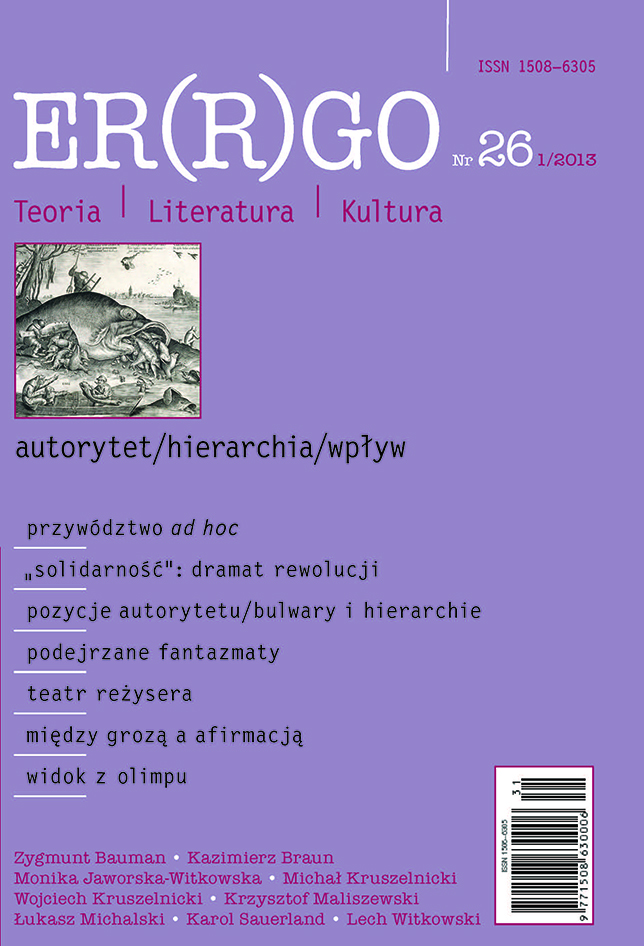
No. 26 (2013)
Published: 2013-01-01
 10.31261/errgo
This work is licensed under a Creative Commons Attribution-ShareAlike 4.0 International License.

 English
 Język Polski