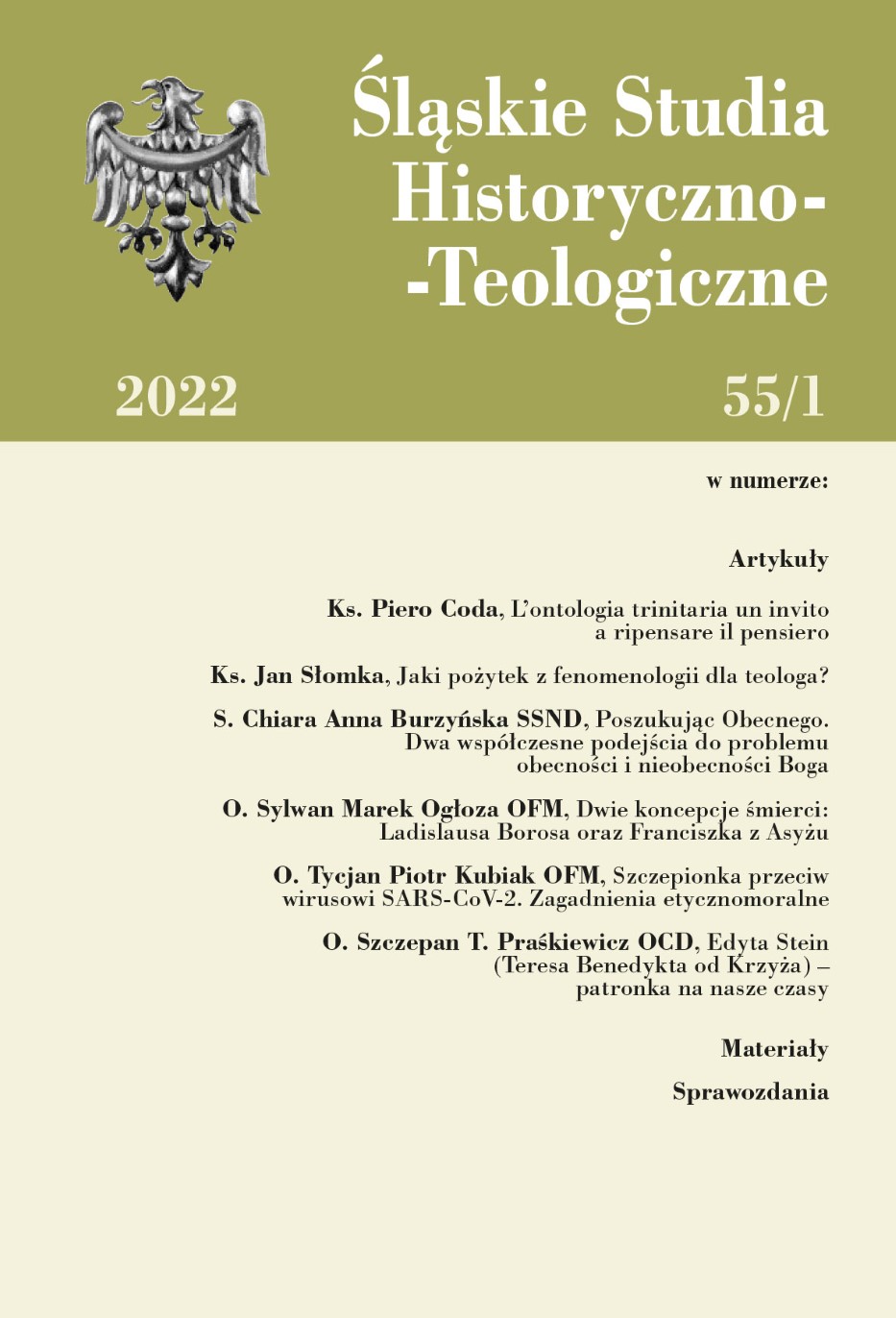
The contribution is divided into three moments: the first addresses the decisive meaning of the challenge that interpellates us today as a call to “rethink thought” in the perspective of an onto-logy disclosed as trinitarian and trinitizing by the event of Jesus Christ, received and interpreted in a horizon and with an intentionality that are not exclusively denominational; the second responds to four critical questions aimed at establishing the pertinent implementation of such a performative interpretation of existence and its intelligence in our demanding times; and lastly, the third focuses on two acquisitions for a theological itinerary that has already, at least in part and fruitfully, been undertaken and yet still needs to be continued at the service of the journey of the People of God in history.
The aim of the article is to examine the possibility of applying phenomenology (as presented by Levinas) in theology. Therefore, on the basis of Levinas’ texts, the main ideas of phenomenology were first presented: the principle of all principles and the resulting starting point of phenomenology: the search for meaning, not for objective support and certainty of truth. one pattern, the characteristics of the “I” as a cognizing subject (intentionality, sensuality, temporality). Then four points for the possible incorporation of phenomenology into theology are presented: theological concepts; procedures, systems and classifications; understanding; true.
The terms of presence and absence are of fundamental importance in describing the experience of human relationship with God. The article compares the understanding of these concepts and their role in the theological thought of Gerald O’Collins SJ and Anthony J. Godzieba. Both authors develop the idea of loving presence of self-revealing God in Christ, but they differ in their understanding of the concept of God’s absence. According to Godzieba, absence means God’s mystery and transcendence, which exceed human knowledge. Whereas, in O’Collins’ view Divine transcendence and incomprehensibility are included in the category of presence, which is strongly emphasized in his Christology.
The hypothesis of the final decision and the concept of sister death are part of the thanatology centered around hope. In his research, the role of the moment of death is emphasized by Ladislaus Boros. It is at the moment of death that a person reaches the fullness of his humanity through the possibility of making the first, fully free and conscious act. This ability arises from the closeness of Christ, with whom man comes face to face. This unique moment of intimacy with God enables him to decide to live with or without Christ. Francis of Assisi sees death as his sister. This positive image of death inscribes Francis’ sister into the current of medieval brotherhood. When man meets his death, he experiences transience in peace and hope. The sister who comes for him gradually leads him to the full transition to eternity, where Christ awaits man. Francis emphasizes the continuity of life whose sister death is the binder and link.
Society living in the modern world is witnessing constant changes that are taking place in the life space of individuals and societies in the global sense. These changes have both positive and negative effects on humanity. Within the last two years, the world has been hit by the SARS -CoV-2 coronavirus pandemic, which has taken the lives of 2. 4 million people. In the face of the pandemic, the work has begun to develop a vaccine as an antidote to the crisis.
This article outlines the issues surrounding the vaccine, which was introduced to the general public at the end of 2020. Despite the enthusiasm that has been generated by the rapid development of the vaccine, there are still some issues that point to the imperfection of the received product. The questions that arise are related to the side effects that an unstudied formulation may cause and the process of its creation itself. This article will also show the position of the Catholic Church on this issue.
With reference to the centenary of Edith Stein’s baptism, celebrated in 2022, and 80 years after her death in the gas chamber, the article recalls the essential elements of the message of this Daughter of Israel and Daughter of the Carmel, the order in which she took the religious name Teresa Benedicta of the Cross. It first presents this holy martyr as a patron saint of the Christian-Jewish dialogue, then patron saint of Europe, proclaimed by St John Paul II, and eventually also as patron of women. A significant part of the article is an examination of the possibility of St Edith Stein to be the fifth woman and the third Discalced Carmelite to receive the title of Doctor of the Church, with an indication that she could be recognised as Doctor Crucis in this group. The study ends with a reflection about Edith Stein as a defender of truth. After all, she said it herself that all those who seek truth, seek God, and that the defence of truth becomes the defence of God’s laws.




 English
 Język Polski
 https://doi.org/10.31261/SSHT.2022.55.1.01